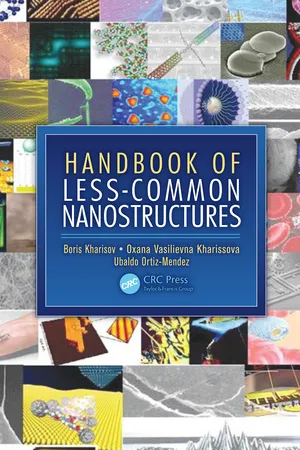
Handbook of Less-Common Nanostructures
eBook - ePub

Handbook of Less-Common Nanostructures

  1. English
  2. ePUB (mobile friendly)
  3. Available on iOS & Android
eBook - ePub

About this book

As nanotechnology has developed over the last two decades, some nanostructures, such as nanotubes, nanowires, and nanoparticles, have become very popular. However, recent research has led to the discovery of other, less-common nanoforms, which often serve as building blocks for more complex structures.

In an effort to organize the field, the Handbook of Less-Common Nanostructures presents an informal classification based mainly on the less-common nanostructures. A small nanotechnological encyclopedia, this book:


  • Describes a range of little-known nanostructures


  • Offers a unifying vision of the synthesis of nanostructures and the generalization of rare nanoforms


  • Includes downloadable resources with color versions of more than 100 nanostructures


  • Explores the fabrication of rare nanostructures, including modern physical, chemical, and biological synthesis techniques


The Handbook of Less-Common Nanostructures discusses a classification system not directly related to the dimensionality and chemical composition of nanostructure-forming compounds or composite. Instead, it is based mainly on the less-common nanostructures. Possessing unusual shapes and high surface areas, these structures are potentially very useful for catalytic, medical, electronic, and many other applications.

Frequently asked questions

Yes, you can cancel anytime from the Subscription tab in your account settings on the Perlego website. Your subscription will stay active until the end of your current billing period. Learn how to cancel your subscription.
No, books cannot be downloaded as external files, such as PDFs, for use outside of Perlego. However, you can download books within the Perlego app for offline reading on mobile or tablet. Learn more here.
Perlego offers two plans: Essential and Complete
  • Essential is ideal for learners and professionals who enjoy exploring a wide range of subjects. Access the Essential Library with 800,000+ trusted titles and best-sellers across business, personal growth, and the humanities. Includes unlimited reading time and Standard Read Aloud voice.
  • Complete: Perfect for advanced learners and researchers needing full, unrestricted access. Unlock 1.4M+ books across hundreds of subjects, including academic and specialized titles. The Complete Plan also includes advanced features like Premium Read Aloud and Research Assistant.
Both plans are available with monthly, semester, or annual billing cycles.
We are an online textbook subscription service, where you can get access to an entire online library for less than the price of a single book per month. With over 1 million books across 1000+ topics, we’ve got you covered! Learn more here.
Look out for the read-aloud symbol on your next book to see if you can listen to it. The read-aloud tool reads text aloud for you, highlighting the text as it is being read. You can pause it, speed it up and slow it down. Learn more here.
Yes! You can use the Perlego app on both iOS or Android devices to read anytime, anywhere — even offline. Perfect for commutes or when you’re on the go.
Please note we cannot support devices running on iOS 13 and Android 7 or earlier. Learn more about using the app.
Yes, you can access Handbook of Less-Common Nanostructures by Boris I. Kharisov,Oxana Vasilievna Kharissova,Ubaldo Ortiz-Mendez in PDF and/or ePUB format, as well as other popular books in Physical Sciences & Condensed Matter. We have over one million books available in our catalogue for you to explore.

Information

Table of contents

  1. Cover
  2. Half Title
  3. Title Page
  4. Copyright Page
  5. Dedication
  6. Frontmatter
  7. Contents
  8. Abbreviations
  9. Preface
  10. Acknowledgments
  11. Authors
  12. Part I: Introduction to Nanostructures
  13. Part II: Less-Common Nanostructures
  14. Part III: Selected Intriguing Topics in Nanotechnology
  15. Part IV: Nanometals and Nanoalloys
  16. Final Remarks (Conclusions and Future Outlook)