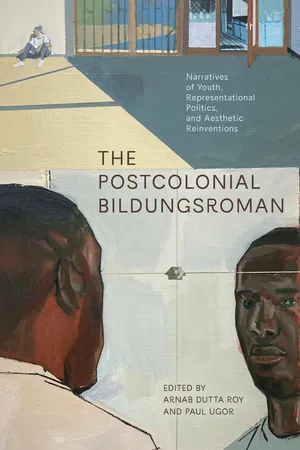
The Postcolonial Bildungsroman
eBook - ePub

The Postcolonial Bildungsroman

Narratives of Youth, Representational Politics, and Aesthetic Reinventions

  1. English
  2. ePUB (mobile friendly)
  3. Available on iOS & Android
eBook - ePub

The Postcolonial Bildungsroman

Narratives of Youth, Representational Politics, and Aesthetic Reinventions

About this book

Offering a fresh comparative lens, this volume demonstrates how postcolonial writers have transformed the Bildungsroman from an eighteenth-century European genre meant to explore local themes around childhood development into one of the most cosmopolitan literary mediums for communicating overlapping concerns about global modernity. Chapters examine identity, sexuality, human rights, the climate crisis, neoliberal globalization, and a host of other issues in work from a wide range of postcolonial locations across Asia, Europe, Africa, the Americas, Australia, and New Zealand. Forging productive engagements between narratology and genre theory, the volume documents the aesthetic and thematic shifts that have accompanied the Bildungsroman over time, particularly in the context of anticolonial, liberationist, and self-determination struggles from the mid-twentieth century onwards in the Global South. With essays from multiple continents, The Postcolonial Bildungsroman makes a crucial intervention to the existing scholarship on this influential genre and a unique contribution to the study of world literature.

Contributors: David Babcock, Sarah Brouillette, Gregory Byala, Deena Dinat, Prathim-Maya Dora-Laskey, José-Santiago Fernández-Vázquez, Ericka A. Hoagland, Elizabeth Jackson, Feroza Jussawala, Andrew David King, Aruna Krishnamurthy, Simone Maria Puleo, Peter Ribic, Arnab Dutta Roy, Craig Smith, Antonette Talaue-Arogo, Paul Ugor, Julieann Veronica Ulin, Rachel Ann Walsh, Maria Su Wang, Bethany Williamson, Helena Wu, Julia Wurr.

Frequently asked questions

Yes, you can cancel anytime from the Subscription tab in your account settings on the Perlego website. Your subscription will stay active until the end of your current billing period. Learn how to cancel your subscription.
No, books cannot be downloaded as external files, such as PDFs, for use outside of Perlego. However, you can download books within the Perlego app for offline reading on mobile or tablet. Learn more here.
Perlego offers two plans: Essential and Complete
  • Essential is ideal for learners and professionals who enjoy exploring a wide range of subjects. Access the Essential Library with 800,000+ trusted titles and best-sellers across business, personal growth, and the humanities. Includes unlimited reading time and Standard Read Aloud voice.
  • Complete: Perfect for advanced learners and researchers needing full, unrestricted access. Unlock 1.4M+ books across hundreds of subjects, including academic and specialized titles. The Complete Plan also includes advanced features like Premium Read Aloud and Research Assistant.
Both plans are available with monthly, semester, or annual billing cycles.
We are an online textbook subscription service, where you can get access to an entire online library for less than the price of a single book per month. With over 1 million books across 1000+ topics, we’ve got you covered! Learn more here.
Look out for the read-aloud symbol on your next book to see if you can listen to it. The read-aloud tool reads text aloud for you, highlighting the text as it is being read. You can pause it, speed it up and slow it down. Learn more here.
Yes! You can use the Perlego app on both iOS or Android devices to read anytime, anywhere — even offline. Perfect for commutes or when you’re on the go.
Please note we cannot support devices running on iOS 13 and Android 7 or earlier. Learn more about using the app.
Yes, you can access The Postcolonial Bildungsroman by Arnab Dutta Roy,Paul Ugor in PDF and/or ePUB format. We have over one million books available in our catalogue for you to explore.

Information

Table of contents

  1. Cover
  2. Half Title
  3. Title
  4. Copyright
  5. Dedication
  6. Contents
  7. Acknowledgements
  8. Introduction
  9. I. Historicizing the Postcolonial Bildungsroman
  10. II. Coloniality, Postcoloniality, Cosmopolitanism, and the Bildungsroman
  11. III. Childhood, Nation, and Narration
  12. IV. Modernity and the Postcolonial Bildungsroman
  13. V. Identity Politics and the Postcolonial Bildungsroman
  14. Afterword
  15. Contributors
  16. Index