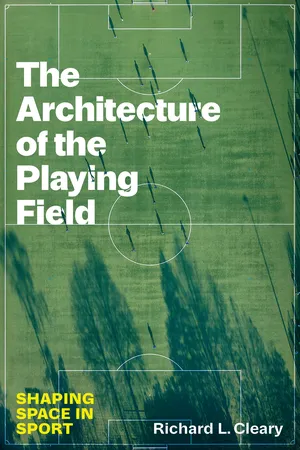
The Architecture of the Playing Field
eBook - ePub

The Architecture of the Playing Field

Shaping Space in Sport

  1. English
  2. ePUB (mobile friendly)
  3. Available on iOS & Android
eBook - ePub

The Architecture of the Playing Field

Shaping Space in Sport

About this book

A novel exploration of playing fields as aesthetic and architectural spaces that frame athletes' creativity and spectators' evolving experiences of sport.

The playing field is more than an arena for sporting rivalry. It is a laboratory of invention, where athletes and coaches create new uses for the human body in response to the constraints and affordances of space. Indeed, Richard Cleary argues that, from translucent squash courts to the NBA three-point line to the city streets used by skateboarders, all sports have embedded spatial relationships that are also charged with social significance.

The Architecture of the Playing Field explores the aesthetic and physical experiences of the grounds on which we compete. Cleary digs into the perspectives of spectators, athletes, coaches, and umpires—perspectives that have changed along with the shifting configuration and mediation of the field, from early live sports coverage to today's TV broadcasts overlaid with high-tech graphics and observed from every angle. Cleary shows how rules governing the size, shape, and divisions of the field reflect sports' entwinement with societies at large, in particular the politics of race and gender. Mindful as well that some sports resist containment, he analyzes the disruptive use of space by snowboarders and parkour athletes. The Architecture of the Playing Field sensitizes us to the interplay of settings and bodies in motion fundamental to the power of sport.

Frequently asked questions

Yes, you can cancel anytime from the Subscription tab in your account settings on the Perlego website. Your subscription will stay active until the end of your current billing period. Learn how to cancel your subscription.
No, books cannot be downloaded as external files, such as PDFs, for use outside of Perlego. However, you can download books within the Perlego app for offline reading on mobile or tablet. Learn more here.
Perlego offers two plans: Essential and Complete
  • Essential is ideal for learners and professionals who enjoy exploring a wide range of subjects. Access the Essential Library with 800,000+ trusted titles and best-sellers across business, personal growth, and the humanities. Includes unlimited reading time and Standard Read Aloud voice.
  • Complete: Perfect for advanced learners and researchers needing full, unrestricted access. Unlock 1.4M+ books across hundreds of subjects, including academic and specialized titles. The Complete Plan also includes advanced features like Premium Read Aloud and Research Assistant.
Both plans are available with monthly, semester, or annual billing cycles.
We are an online textbook subscription service, where you can get access to an entire online library for less than the price of a single book per month. With over 1 million books across 1000+ topics, we’ve got you covered! Learn more here.
Look out for the read-aloud symbol on your next book to see if you can listen to it. The read-aloud tool reads text aloud for you, highlighting the text as it is being read. You can pause it, speed it up and slow it down. Learn more here.
Yes! You can use the Perlego app on both iOS or Android devices to read anytime, anywhere — even offline. Perfect for commutes or when you’re on the go.
Please note we cannot support devices running on iOS 13 and Android 7 or earlier. Learn more about using the app.
Yes, you can access The Architecture of the Playing Field by Richard L. Cleary in PDF and/or ePUB format. We have over one million books available in our catalogue for you to explore.

Information

Table of contents

  1. Cover
  2. Halftitle Page
  3. Series
  4. Title Page
  5. Copyright Page
  6. Contents
  7. Illustration
  8. Introduction
  9. Chapter 01 : Frames
  10. Chapter 02 : Mediated Space
  11. Chapter 03 : Laboratories Of Spatial Invention
  12. Chapter 04 : Sports, Space, And Culture
  13. Epilogue
  14. Acknowledgments
  15. Notes
  16. Bibliography
  17. Index