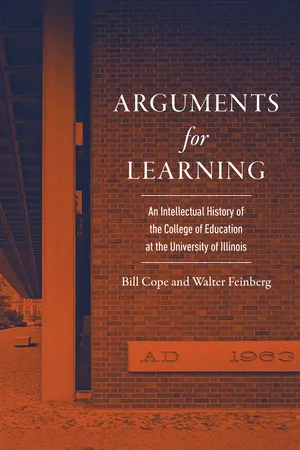
Arguments for Learning
eBook - ePub

Arguments for Learning

An Intellectual History of the College of Education at the University of Illinois

  1. English
  2. ePUB (mobile friendly)
  3. Available on iOS & Android
eBook - ePub

Arguments for Learning

An Intellectual History of the College of Education at the University of Illinois

About this book

Almost every educational idea worth a thought has been considered at the University of Illinois, and anything worth trying has been tested. In this history of ideas, Bill Cope and Walter Feinberg chronicle the intellectual lives of education thinkers at the university while tracking the development of educational ideas and practices in general.

Cope and Feinberg draw on conversations, narratives, and archival research that reveal how different generations explored their role in defining and carrying out the College's multifaceted mission. Their account raises critical questions about the character of learning, the aims of teaching, and the nature of teaching as a profession. At the same time, the authors address issues that range from the role of schools in fostering individual and collective identity to the introduction of computer-mediated and online learning. Cope and Feinberg examine changes in self-understanding about fundamental ideas and chart how the College evolved from its original narrow mission of training children's schoolteachers to embracing global perspectives.

A wide-ranging portrait of an institution, Arguments for Learning uses the School of Education to tell the stories of thinkers dedicated to the idea that education can change the world for the better.

Frequently asked questions

Yes, you can cancel anytime from the Subscription tab in your account settings on the Perlego website. Your subscription will stay active until the end of your current billing period. Learn how to cancel your subscription.
No, books cannot be downloaded as external files, such as PDFs, for use outside of Perlego. However, you can download books within the Perlego app for offline reading on mobile or tablet. Learn more here.
Perlego offers two plans: Essential and Complete
  • Essential is ideal for learners and professionals who enjoy exploring a wide range of subjects. Access the Essential Library with 800,000+ trusted titles and best-sellers across business, personal growth, and the humanities. Includes unlimited reading time and Standard Read Aloud voice.
  • Complete: Perfect for advanced learners and researchers needing full, unrestricted access. Unlock 1.4M+ books across hundreds of subjects, including academic and specialized titles. The Complete Plan also includes advanced features like Premium Read Aloud and Research Assistant.
Both plans are available with monthly, semester, or annual billing cycles.
We are an online textbook subscription service, where you can get access to an entire online library for less than the price of a single book per month. With over 1 million books across 1000+ topics, we’ve got you covered! Learn more here.
Look out for the read-aloud symbol on your next book to see if you can listen to it. The read-aloud tool reads text aloud for you, highlighting the text as it is being read. You can pause it, speed it up and slow it down. Learn more here.
Yes! You can use the Perlego app on both iOS or Android devices to read anytime, anywhere — even offline. Perfect for commutes or when you’re on the go.
Please note we cannot support devices running on iOS 13 and Android 7 or earlier. Learn more about using the app.
Yes, you can access Arguments for Learning by Bill Cope,Walter Feinberg in PDF and/or ePUB format, as well as other popular books in Education & Education General. We have over one million books available in our catalogue for you to explore.

Information

Table of contents

  1. Cover Page
  2. Halftitle Page
  3. Title Page
  4. Copyright Page
  5. Contents
  6. Foreword
  7. Acknowledgments
  8. Introduction
  9. Part I. Beginnings
  10. Part II. Defining the Discipline
  11. Part III. Equity and Diversity in Learning
  12. Part IV. Technology in Learning
  13. Afterword
  14. Notes
  15. References
  16. Index