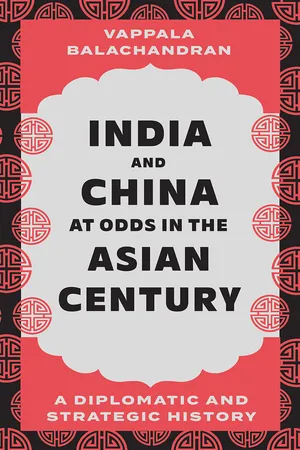
India and China at Odds in the Asian Century
eBook - ePub

India and China at Odds in the Asian Century

A Diplomatic and Strategic History

  1. English
  2. ePUB (mobile friendly)
  3. Available on iOS & Android
eBook - ePub

India and China at Odds in the Asian Century

A Diplomatic and Strategic History

About this book

The term ‘Asian century’ was first coined by the US Senate Foreign Relations Committee in 1985 when discussing the Asian economic leap forward. From 1988, diplomats and the media also started using the term, further to the successful Deng Xiaoping–Rajiv Gandhi summit held that December in Beijing, for which Vappala Balachandran, under Prime Minister Gandhi’s express directions, led a small team of officials for more than a year of discreet ‘off-line’ talks with key Chinese counterparts—separate from the official diplomatic engagement.

The Chinese–Indian thaw, which lasted until 1998, prompted highly optimistic visions of a ‘China–India Century of Cooperation’ enabling both powers to compete with the US and EU in terms of trade and military capacity. None of this happened, and instead the China–India relationship is highly rancorous, punctuated by trade spats and border skirmishing between the People’s Liberation Army and the Indian Army. New Delhi has gravitated towards the US in the hope of checkmating an assertive Beijing’s pursuit of global military and trade dominance. This book offers a comprehensive analysis of India and China’s comparative strategic capabilities, sharing many insights drawn from the author’s first-hand engagement with and research into the questions discussed.

The opinions expressed in this book are personal and do not represent those of the Government of India.

Frequently asked questions

Yes, you can cancel anytime from the Subscription tab in your account settings on the Perlego website. Your subscription will stay active until the end of your current billing period. Learn how to cancel your subscription.
No, books cannot be downloaded as external files, such as PDFs, for use outside of Perlego. However, you can download books within the Perlego app for offline reading on mobile or tablet. Learn more here.
Perlego offers two plans: Essential and Complete
  • Essential is ideal for learners and professionals who enjoy exploring a wide range of subjects. Access the Essential Library with 800,000+ trusted titles and best-sellers across business, personal growth, and the humanities. Includes unlimited reading time and Standard Read Aloud voice.
  • Complete: Perfect for advanced learners and researchers needing full, unrestricted access. Unlock 1.4M+ books across hundreds of subjects, including academic and specialized titles. The Complete Plan also includes advanced features like Premium Read Aloud and Research Assistant.
Both plans are available with monthly, semester, or annual billing cycles.
We are an online textbook subscription service, where you can get access to an entire online library for less than the price of a single book per month. With over 1 million books across 1000+ topics, we’ve got you covered! Learn more here.
Look out for the read-aloud symbol on your next book to see if you can listen to it. The read-aloud tool reads text aloud for you, highlighting the text as it is being read. You can pause it, speed it up and slow it down. Learn more here.
Yes! You can use the Perlego app on both iOS or Android devices to read anytime, anywhere — even offline. Perfect for commutes or when you’re on the go.
Please note we cannot support devices running on iOS 13 and Android 7 or earlier. Learn more about using the app.
Yes, you can access India and China at Odds in the Asian Century by Vappala Balachandran in PDF and/or ePUB format, as well as other popular books in Politics & International Relations & International Relations. We have over one million books available in our catalogue for you to explore.

Table of contents

  1. Cover
  2. Half Title
  3. Title
  4. Copyright
  5. Contents
  6. Mise-en-Scène
  7. Introduction
  8. Part I: India And China, Ancient And Modern
  9. Part II: Competing Visions Of “India”
  10. Part III: The Contemporary Relationship
  11. Conclusions
  12. Epilogue
  13. Notes
  14. Select Bibliography
  15. Index
  16. Back Cover