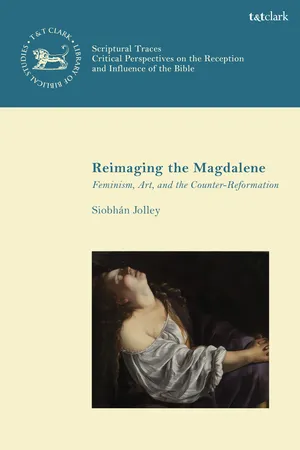
This book offers a new, intersectional feminist approach to utilising and interpreting the visual reception of Mary Magdalene. Through employment of Liberative Reception Criticism, which develops traditional reception theory in line with liberative hermeneutics, via the insights of intersectionality as critical theory, Siobhán Jolley provides a novel means of analysing how women, and particularly the Magdalene, are imaged in Christian tradition.
Knowledge of both the biblical figure of Mary Magdalene and her cultural reception continue to be dominated by long-discredited ideas about her life and sexuality, which bear the hallmarks of their development under patriarchy. Through close study of relevant biblical texts and extracanonical accounts, and a comprehensive survey of the Magdalene's presentation in the Italian art of the Counter-Reformation, Jolley demonstrates that the patriarchal portrayal of the Magdalene as a sexualised penitent and mournful witness to the resurrection is sustained by its mythic attachment to biblical text. Rather than adopting the same tropes uncritically, we are invited to look again at artworks and related texts in order to explore what happens when the influence of patriarchy is actively and intersectionally resisted. Ultimately, the Magdalene is transformed from a reductive and patriarchally mythologised figure to a multidimensional character, who is relatable and liberative as an exemplar.
- 217 pages
- English
- ePUB (mobile friendly)
- Available on iOS & Android
eBook - ePub
About this book
Information
Topic
Theology & ReligionSubtopic
Biblical StudiesTable of contents
- Cover
- Title Page
- Table of Contents
- List of Figures
- Acknowledgements
- Abbreviations
- Introduction
- Chapter 1: Liberating the Magdalene
- Part I: The Endurance of Myth and Narrative
- Part II: The Power of Art and Image
- Conclusion
- Bibliography
- Index
- Copyright Page
Trusted by 375,005 students
Access to over 1.5 million titles for a fair monthly price.
Study more efficiently using our study tools.
Frequently asked questions
Yes, you can cancel anytime from the Subscription tab in your account settings on the Perlego website. Your subscription will stay active until the end of your current billing period. Learn how to cancel your subscription
No, books cannot be downloaded as external files, such as PDFs, for use outside of Perlego. However, you can download books within the Perlego app for offline reading on mobile or tablet. Learn how to download books offline
Perlego offers two plans: Essential and Complete
- Essential is ideal for learners and professionals who enjoy exploring a wide range of subjects. Access the Essential Library with 800,000+ trusted titles and best-sellers across business, personal growth, and the humanities. Includes unlimited reading time and Standard Read Aloud voice.
- Complete: Perfect for advanced learners and researchers needing full, unrestricted access. Unlock 1.5M+ books across hundreds of subjects, including academic and specialized titles. The Complete Plan also includes advanced features like Premium Read Aloud and Research Assistant.
We are an online textbook subscription service, where you can get access to an entire online library for less than the price of a single book per month. With over 1.5 million books across 990+ topics, we’ve got you covered! Learn about our mission
Look out for the read-aloud symbol on your next book to see if you can listen to it. The read-aloud tool reads text aloud for you, highlighting the text as it is being read. You can pause it, speed it up and slow it down. Learn more about Read Aloud
Yes! You can use the Perlego app on both iOS and Android devices to read anytime, anywhere — even offline. Perfect for commutes or when you’re on the go.
Please note we cannot support devices running on iOS 13 and Android 7 or earlier. Learn more about using the app
Please note we cannot support devices running on iOS 13 and Android 7 or earlier. Learn more about using the app
Yes, you can access Reimaging the Magdalene by Siobhán Jolley in PDF and/or ePUB format, as well as other popular books in Theology & Religion & Biblical Studies. We have over 1.5 million books available in our catalogue for you to explore.