The definitive guide to making strong, reliable splices in braided rope, using step-by-step photographs and clear instructions to help readers master this important but tricky skill.
For any seafarer, splicing rope is an essential skill. But the traditional 3-strand rope is fast disappearing. So how do you splice braided rope?
This is the ultimate guide to this crucial knowledge. Most of the techniques are easy to master – and also fun to do. See why splices are better – and stronger – than knots or shackles for joining or shortening rope, and follow the photographs and steps to find out how to splice efficiently.
In this fully updated second edition, you will learn how to:
· Select ropes in the materials that best suit your on-board requirements
· Customise your ropes to make your setup easier and safer
· Optimise your deck layout and save weight on board
· Taper your sheets for ease of handling
· Splice an extra cover on your ropes to give better grip in clutches, avoid chafe and make them last longer
While a knot can reduce the strength of a rope by as much as 50%, a well-spliced rope loses only 5–10%. The techniques, insights and suggestions within these pages will be invaluable to all boaters, whether recreational or commercial. This refreshed new edition has been updated to take in to account developments in fibre technology and includes new splicing techniques and updated photography.
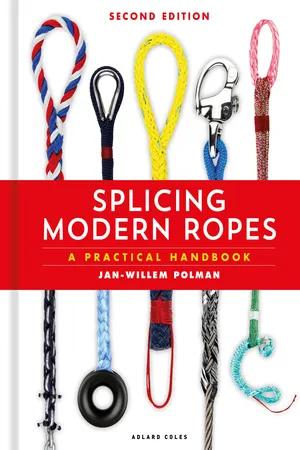
- 188 pages
- English
- ePUB (mobile friendly)
- Available on iOS & Android
eBook - ePub
About this book
Information
Edition
2Table of contents
- Cover
- Title Page
- Contents
- Brand names used
- Introduction
- 1. Synthetic fibres
- 2. Construction of ropes
- 3. Which type of rope?
- 4. Before you start
- 5. Splice in plaited or twisted ropes
- 6. Eye splice in polyester ropes
- 7. Eye splice in Dyneema ropes
- 8. Dyneema shackles
- 9. Weight savings and tapering
- 10. Thickening and strengthening
- 11. Continuous loops
- 12. Whippings
- 13. Reeving of new halyards
- 14. Splicing tools
- Appendices
- Acknowledgements
- About the author
- Bibliography
- Index
- Copyright
Trusted by 375,005 students
Access to over 1.5 million titles for a fair monthly price.
Study more efficiently using our study tools.