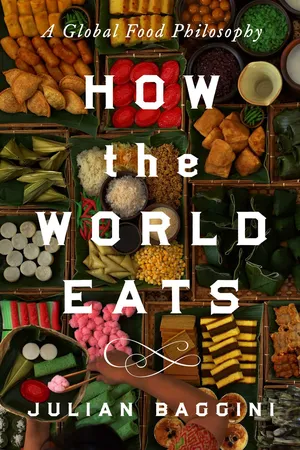
From the bestselling author of How the World Thinks, an exploration of how we grow, make, buy and eat our food around the world—and a proposal for a global philosophy of food. How we live is shaped by how we eat. You can see this in the vastly different approaches to growing, preparing and eating food around the world, such as the hunter-gatherer Hadza in Tanzania whose sustainable lifestyle is under threat in a crowded planet, or Western societies whose food is farmed or bred in vast intensive enterprises. And most of us now rely on a complex global food web of production, distribution, consumption and disposal, which is now contending with unprecedented challenges. The need for a better understanding of how we feed ourselves has never been more urgent. In this wide-ranging and definitive book, philosopher Julian Baggini expertly delves into the best and worst food practises in a huge array of different societies, past and present. His exploration takes him from cutting-edge technologies, such as new farming methods, cultured meat, GM and astronaut food, to the ethics and health of ultra processed food and aquaculture, as he takes a forensic look at the effectiveness of our food governance, the difficulties of food wastage and the effects of commodification. Extracting essential principles to guide how we eat in the future, How the World Eats is a thought-provoking and illuminating call for a pluralistic, humane, resourceful and equitable global food philosophy that will guide us towards a food system fit for the twenty-first century and beyond.
- English
- ePUB (mobile friendly)
- Available on iOS & Android
eBook - ePub
About this book
Information
Table of contents
- Cover
- Title Page
- Epigraph
- Introduction
- Part One: Land
- Part Two: People
- Part Three: Other Animals
- Part Four: Technology
- Conclusion: A Global Food Philosophy
- About the Author
- Notes
- References
- Index
- Credits
- Copyright
Trusted by 375,005 students
Access to over 1.5 million titles for a fair monthly price.
Study more efficiently using our study tools.
Frequently asked questions
Yes, you can cancel anytime from the Subscription tab in your account settings on the Perlego website. Your subscription will stay active until the end of your current billing period. Learn how to cancel your subscription
No, books cannot be downloaded as external files, such as PDFs, for use outside of Perlego. However, you can download books within the Perlego app for offline reading on mobile or tablet. Learn how to download books offline
Perlego offers two plans: Essential and Complete
- Essential is ideal for learners and professionals who enjoy exploring a wide range of subjects. Access the Essential Library with 800,000+ trusted titles and best-sellers across business, personal growth, and the humanities. Includes unlimited reading time and Standard Read Aloud voice.
- Complete: Perfect for advanced learners and researchers needing full, unrestricted access. Unlock 1.5M+ books across hundreds of subjects, including academic and specialized titles. The Complete Plan also includes advanced features like Premium Read Aloud and Research Assistant.
We are an online textbook subscription service, where you can get access to an entire online library for less than the price of a single book per month. With over 1.5 million books across 990+ topics, we’ve got you covered! Learn about our mission
Look out for the read-aloud symbol on your next book to see if you can listen to it. The read-aloud tool reads text aloud for you, highlighting the text as it is being read. You can pause it, speed it up and slow it down. Learn more about Read Aloud
Yes! You can use the Perlego app on both iOS and Android devices to read anytime, anywhere — even offline. Perfect for commutes or when you’re on the go.
Please note we cannot support devices running on iOS 13 and Android 7 or earlier. Learn more about using the app
Please note we cannot support devices running on iOS 13 and Android 7 or earlier. Learn more about using the app
Yes, you can access How the World Eats by Julian Baggini in PDF and/or ePUB format, as well as other popular books in Politik & Internationale Beziehungen & Geschichte & Theorie der Philosophie. We have over 1.5 million books available in our catalogue for you to explore.