- English
- ePUB (mobile friendly)
- Available on iOS & Android
About this book
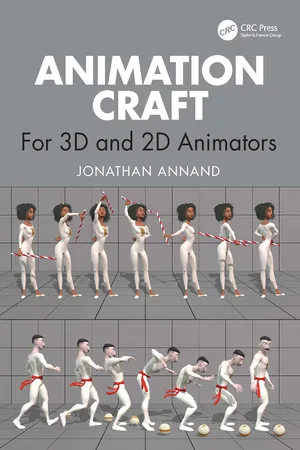
This book is for those who want to learn the craft or mechanics of animation, how to actually animate a scene from start to finish, or take their animation to the next level. Using over 600 examples, this book answers the questions about the craft of animation that are often not taught in schools or books.
Each chapter contains step-by-step examples explaining the principles of animation and how to avoid common problems that occur when animating. This book also teaches you how to critique an animated scene objectively, rather than subjectively — then fix what's wrong with it.
Animation Craft for 3D and 2D Animators will be a great resource for any beginner looking to learn the fundamentals of animation, or more experienced animators looking to hone their craft.
Frequently asked questions
- Essential is ideal for learners and professionals who enjoy exploring a wide range of subjects. Access the Essential Library with 800,000+ trusted titles and best-sellers across business, personal growth, and the humanities. Includes unlimited reading time and Standard Read Aloud voice.
- Complete: Perfect for advanced learners and researchers needing full, unrestricted access. Unlock 1.4M+ books across hundreds of subjects, including academic and specialized titles. The Complete Plan also includes advanced features like Premium Read Aloud and Research Assistant.
Please note we cannot support devices running on iOS 13 and Android 7 or earlier. Learn more about using the app.
Information
Table of contents
- Cover Page
- Half-Title Page
- Title Page
- Copyright Page
- Dedication Page
- Acknowledgments
- Contents
- Foreword by J. J. Sedelmaier
- Introduction
- Chapter 1: The Basics
- Chapter 2: A Brief History of Character Animation
- Chapter 3: Squash and Stretch
- Chapter 4: Posing
- Chapter 5: Rhythm
- Chapter 6: Exaggeration
- Chapter 7: Weight and Balance
- Chapter 8: Foot Plant
- Chapter 9: Arcs
- Chapter 10: Walk and Run Cycles
- Chapter 11: Timing and Spacing
- Chapter 12: Slow-In & Slow-Out
- Chapter 13: Overlap and Follow-Through
- Chapter 14: Successive Breaking of Joints
- Chapter 15: Anticipation
- Chapter 16: Breakdowns and Inbetweens
- Chapter 17: Accents
- Chapter 18: Secondary Action
- Chapter 19: Expressions
- Chapter 20: Dialogue
- Chapter 21: Staging
- Chapter 22: Putting It All Together
- Chapter 23: Critiquing a Scene
- Chapter 24: Scene Checklist
- Footnotes
- Selected Bibliography
- Index
- Credits