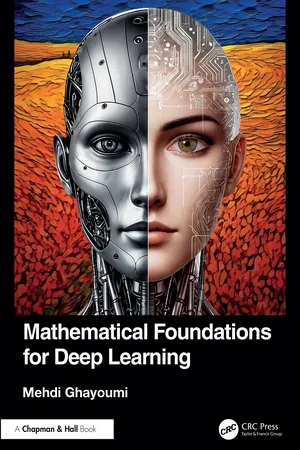
Mathematical Foundations for Deep Learning
eBook - ePub

Mathematical Foundations for Deep Learning

  1. English
  2. ePUB (mobile friendly)
  3. Available on iOS & Android
eBook - ePub

Mathematical Foundations for Deep Learning

About this book

Mathematical Foundations for Deep Learning bridges the gap between theoretical mathematics and practical applications in artificial intelligence (AI). This guide delves into the fundamental mathematical concepts that power modern deep learning, equipping readers with the tools and knowledge needed to excel in the rapidly evolving field of artificial intelligence.

Designed for learners at all levels, from beginners to experts, the book makes mathematical ideas accessible through clear explanations, real-world examples, and targeted exercises. Readers will master core concepts in linear algebra, calculus, and optimization techniques; understand the mechanics of deep learning models; and apply theory to practice using frameworks like TensorFlow and PyTorch.

By integrating theory with practical application, Mathematical Foundations for Deep Learning prepares you to navigate the complexities of AI confidently. Whether you're aiming to develop practical skills for AI projects, advance to emerging trends in deep learning, or lay a strong foundation for future studies, this book serves as an indispensable resource for achieving proficiency in the field.

Embark on an enlightening journey that fosters critical thinking and continuous learning. Invest in your future with a solid mathematical base, reinforced by case studies and applications that bring theory to life, and gain insights into the future of deep learning.

Frequently asked questions

Yes, you can cancel anytime from the Subscription tab in your account settings on the Perlego website. Your subscription will stay active until the end of your current billing period. Learn how to cancel your subscription.
No, books cannot be downloaded as external files, such as PDFs, for use outside of Perlego. However, you can download books within the Perlego app for offline reading on mobile or tablet. Learn more here.
Perlego offers two plans: Essential and Complete
  • Essential is ideal for learners and professionals who enjoy exploring a wide range of subjects. Access the Essential Library with 800,000+ trusted titles and best-sellers across business, personal growth, and the humanities. Includes unlimited reading time and Standard Read Aloud voice.
  • Complete: Perfect for advanced learners and researchers needing full, unrestricted access. Unlock 1.4M+ books across hundreds of subjects, including academic and specialized titles. The Complete Plan also includes advanced features like Premium Read Aloud and Research Assistant.
Both plans are available with monthly, semester, or annual billing cycles.
We are an online textbook subscription service, where you can get access to an entire online library for less than the price of a single book per month. With over 1 million books across 1000+ topics, we’ve got you covered! Learn more here.
Look out for the read-aloud symbol on your next book to see if you can listen to it. The read-aloud tool reads text aloud for you, highlighting the text as it is being read. You can pause it, speed it up and slow it down. Learn more here.
Yes! You can use the Perlego app on both iOS or Android devices to read anytime, anywhere — even offline. Perfect for commutes or when you’re on the go.
Please note we cannot support devices running on iOS 13 and Android 7 or earlier. Learn more about using the app.
Yes, you can access Mathematical Foundations for Deep Learning by Mehdi Ghayoumi in PDF and/or ePUB format, as well as other popular books in Computer Science & Business Intelligence. We have over one million books available in our catalogue for you to explore.

Table of contents

  1. Cover
  2. Half-Title Page
  3. Title Page
  4. Copyright Page
  5. Table of Contents
  6. Preface
  7. Acknowledgments
  8. About the Author
  9. 1 Introduction
  10. 2 Linear Algebra
  11. 3 Multivariate Calculus
  12. 4 Probability Theory and Statistics
  13. 5 Optimization Theory
  14. 6 Information Theory
  15. 7 Graph Theory
  16. 8 Differential Geometry
  17. 9 Topology in Deep Learning
  18. 10 Harmonic Analysis for CNNs
  19. 11 Dynamical Systems and Differential Equations for RNNs
  20. 12 Quantum Computing
  21. Bibliography
  22. Index