eBook - PDF
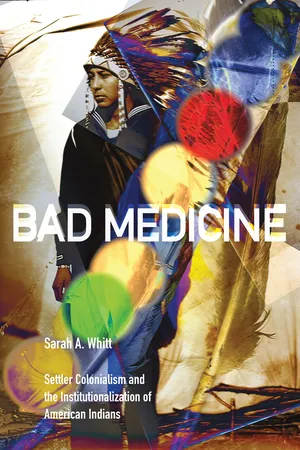
Bad Medicine
Settler Colonialism and the Institutionalization of American Indians
- 289 pages
- English
- PDF
- Available on iOS & Android
eBook - PDF
About this book
In Bad Medicine, Sarah A. Whitt exposes how Native American boarding schools and other settler institutions like asylums, factories, and hospitals during the late nineteenth and early twentieth centuries worked together as a part of an interconnected system of settler domination. In so doing, Whitt centers the experiences of Indigenous youth and adults alike at the Carlisle Indian School, Canton Asylum for Insane Indians, Ford Motor Company Factory, House of the Good Shepherd, and other Progressive Era facilities. She demonstrates that in the administration of these institutions, which involved moving Indigenous people from one location to another, everyday white Americans became deputized as agents of the settler order. Bringing together Native American history, settler colonial studies, and the history of medicine, Whitt breaks new ground by showing how the confinement of Indigenous people across interlocking institutional sites helped concretize networks of white racial power—a regime that Native nations and communities continue to negotiate and actively resist today.
Information
Publisher
Duke University Press BooksYear
2025Print ISBN
9781478031260
9781478028048
eBook ISBN
9781478060253
Table of contents
- Cover
- Table of Contents
- Acknowledgments
- Introduction: Bad Medicine
- 1. “An Ordinary Case of Discipline”: Surveillance and Punishment at the Carlisle Indian Industrial School, 1879–1918
- 2. “Hoe Handle Medicine”: Medicinal Labor at the Ford Motor Company and Lancaster General Hospital
- 3. Sisters Magdalene: Entwined Histories of “Reform” at Good Shepherd Homes
- 4. “Care and Maintenance”: Settler Ableism and Land Dispossession at the Canton Asylum for Insane Indians, 1902–1934
- Epilogue: Indigenous Futurities and the Afterlives of Institutionalization
- Appendix
- Notes
- Bibliography
- Index
Trusted by 375,005 students
Access to over 1.5 million titles for a fair monthly price.
Study more efficiently using our study tools.
Frequently asked questions
Yes, you can cancel anytime from the Subscription tab in your account settings on the Perlego website. Your subscription will stay active until the end of your current billing period. Learn how to cancel your subscription
No, books cannot be downloaded as external files, such as PDFs, for use outside of Perlego. However, you can download books within the Perlego app for offline reading on mobile or tablet. Learn how to download books offline
Perlego offers two plans: Essential and Complete
- Essential is ideal for learners and professionals who enjoy exploring a wide range of subjects. Access the Essential Library with 800,000+ trusted titles and best-sellers across business, personal growth, and the humanities. Includes unlimited reading time and Standard Read Aloud voice.
- Complete: Perfect for advanced learners and researchers needing full, unrestricted access. Unlock 1.5M+ books across hundreds of subjects, including academic and specialized titles. The Complete Plan also includes advanced features like Premium Read Aloud and Research Assistant.
We are an online textbook subscription service, where you can get access to an entire online library for less than the price of a single book per month. With over 1.5 million books across 990+ topics, we’ve got you covered! Learn about our mission
Look out for the read-aloud symbol on your next book to see if you can listen to it. The read-aloud tool reads text aloud for you, highlighting the text as it is being read. You can pause it, speed it up and slow it down. Learn more about Read Aloud
Yes! You can use the Perlego app on both iOS and Android devices to read anytime, anywhere — even offline. Perfect for commutes or when you’re on the go.
Please note we cannot support devices running on iOS 13 and Android 7 or earlier. Learn more about using the app
Please note we cannot support devices running on iOS 13 and Android 7 or earlier. Learn more about using the app
Yes, you can access Bad Medicine by Sarah A. Whitt in PDF and/or ePUB format, as well as other popular books in History & North American History. We have over 1.5 million books available in our catalogue for you to explore.