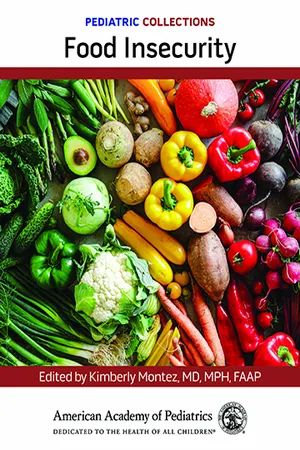
Pediatric Collections offers what you need to know - original, focused research in a snapshot approach. Pediatric Collections: Food Insecurity is designed specifically for pediatric clinicians and healthcare professionals to address food insecurity within clinical environments. Food insecurity significantly impacts single parents, individuals from racial and ethnic minorities, those with low incomes, and families with young children. It has a negative effect on health across all stages of life, leading to adverse psychosocial and physical health outcomes. Food insecurity can also hinder academic success and impose significant economic burdens on healthcare expenses. With the integration of screening for food insecurity in pediatric clinical settings now recognized as a standard of care, there are numerous intervention practices available that can be easily scaled and adopted within your practice and community.
eBook - PDF
About this book
Information
Topic
MedicineSubtopic
Clinical MedicineTable of contents
- Front Matter
- Community-Led Interventions to Address Food Inequity
- Farm to Families: Clinic-based Produce Provision to Address Food Insecurity During the Pandemic
- Accuracy of a Single Financial Security Question to Screen for Social Needs
- Food Insecurity Screening and Intervention in United States Children’s Hospitals
- Food Insecurity Screening of Hospitalized Patients: A Descriptive Analysis
- Evaluating Screening to Assess Endorsement of Food Insecurity in the Inpatient Setting
- Quality Improvement to Identify and Address Food Insecurity During Pediatric Hospitalizations
- Progress and Potential: Addressing Food Insecurity in Caregivers of Hospitalized Children
- Disparities and Biases in Food Insecurity Screening Among Admitted Children
- Food Insecurity and Experiences of Discrimination Among Caregivers of Hospitalized Children
- Reducing Caregiver Hunger During Pediatric Hospitalization
- Food Insecurity and Community-Based Food Resources Among Caregivers of Hospitalized Children
- Addressing Food Insecurity Among Hospitalized Children: Upstream and Downstream Approaches
- Identifying Food Insecurity in Cardiology Clinic and Connecting Families to Resources
- Establishing a Permanent Food Pantry in a Pediatric Emergency Department
- SNAP Participation and Emergency Department Use
- Perspectives From Urban WIC-Eligible Caregivers to Improve Produce Access
- Caregiver Perspectives on Improving Government Nutrition Benefit Programs
- Caregiver Perspectives on Underutilization of WIC: A Qualitative Study
- Assessing and Improving WIC Enrollment in the Primary Care Setting: A Quality Initiative
- Health Care as a Partner in Federal Nutrition Programs: Call for Advocacy
- Cost-effectiveness of Improved WIC Food Package for Preventing Childhood Obesity
- Trends in Severe Obesity Among Children Aged 2 to 4 Years in WIC: 2010 to 2020
- Universal Free School Meals Policy and Childhood Obesity
- Food Insecurity and Childhood Obesity: A Systematic Review
- Food Insecurity and Cardiometabolic Markers: Results From the Study of Latino Youth
- Pediatric Formulas: An Update
Trusted by 375,005 students
Access to over 1.5 million titles for a fair monthly price.
Study more efficiently using our study tools.
Frequently asked questions
Yes, you can cancel anytime from the Subscription tab in your account settings on the Perlego website. Your subscription will stay active until the end of your current billing period. Learn how to cancel your subscription
No, books cannot be downloaded as external files, such as PDFs, for use outside of Perlego. However, you can download books within the Perlego app for offline reading on mobile or tablet. Learn how to download books offline
Perlego offers two plans: Essential and Complete
- Essential is ideal for learners and professionals who enjoy exploring a wide range of subjects. Access the Essential Library with 800,000+ trusted titles and best-sellers across business, personal growth, and the humanities. Includes unlimited reading time and Standard Read Aloud voice.
- Complete: Perfect for advanced learners and researchers needing full, unrestricted access. Unlock 1.5M+ books across hundreds of subjects, including academic and specialized titles. The Complete Plan also includes advanced features like Premium Read Aloud and Research Assistant.
We are an online textbook subscription service, where you can get access to an entire online library for less than the price of a single book per month. With over 1.5 million books across 990+ topics, we’ve got you covered! Learn about our mission
Look out for the read-aloud symbol on your next book to see if you can listen to it. The read-aloud tool reads text aloud for you, highlighting the text as it is being read. You can pause it, speed it up and slow it down. Learn more about Read Aloud
Yes! You can use the Perlego app on both iOS and Android devices to read anytime, anywhere — even offline. Perfect for commutes or when you’re on the go.
Please note we cannot support devices running on iOS 13 and Android 7 or earlier. Learn more about using the app
Please note we cannot support devices running on iOS 13 and Android 7 or earlier. Learn more about using the app
Yes, you can access Pediatric Collections: Food Insecurity by in PDF and/or ePUB format, as well as other popular books in Medicine & Clinical Medicine. We have over 1.5 million books available in our catalogue for you to explore.