The rich and ongoing development of Russian lyric poetry, explored through close readings of thirty-four poems by poets ranging from Alexander Blok to Maria Stepanova
The Russian cultural tradition treats poetry as the supreme artistic form, with Alexander Pushkin as its national hero. Modern Russian lyric poets, often on the right side of history but the wrong side of their country’s politics, have engaged intensely with subjectivity, aesthetic movements, ideology (usually subversive), and literature itself. All the World on a Page gathers thirty-four poems, written between 1907 and 2022, presenting each poem in the original Russian and an English translation, accompanied by an essay that places the poem in its cultural, historical, and biographical contexts. The poems, both canonical and lesser-known works, extend across a range of moods and scenes: Velimir Khlebnikov’s Futurist revolutionary prophecy, Anna Akhmatova’s lyric cycle about poetic inspiration, Vladimir Nabokov’s Symbolist erotic dreamworld, Joseph Brodsky’s pastiche of a Chekhovian play set on a country estate, Maria Stepanova’s pandemic allegory of political repression, Galina Rymbu’s energetic manifesto “My Vagina.”
An introduction explores the abiding inspiration of modernism on the Russian lyric tradition. Kahn and Lipovetsky's separate chapter essays, informed by extensive knowledge of the existing scholarship and critical styles of interpretation, consider how the interplay of originality and tradition and form and voice work to engage the reader. The poems themselves, many of them in newly commissioned translations, operate outside state-mandated poetic styles to address the reader directly, “tête-à-tête,” as Brodsky said in his 1987 Nobel lecture. With each chapter devoted to a different poem, All the World on a Page allows readers to experience the richness of Russian poetry through poems and poets rather than through movements.
eBook - ePub
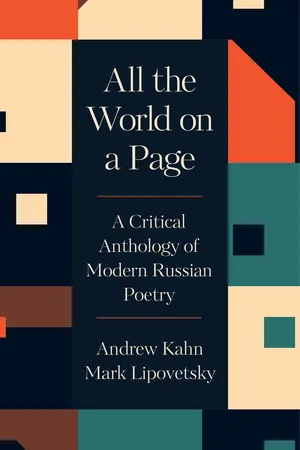
All the World on a Page
A Critical Anthology of Modern Russian Poetry
- English
- ePUB (mobile friendly)
- Available on iOS & Android
eBook - ePub
About this book
Information
Publisher
Princeton University PressYear
2025Print ISBN
9780691259642
9780691207162
eBook ISBN
9780691269399
Table of contents
- Cover Page
- Title Page
- Copyright
- Contents
- Note on the Text
- Introduction: Enduring Modernism
- 1. Alexander Blok, “Free Thoughts. On Death” (1908): In Baudelaire’s Shadow
- 2. Elena Guro, “Gone to sleep, gone quiet now, so kind” (1912): Performing Sincerity
- 3. Vladimir Mayakovsky, “Listen!” (1914): Love and the Egotistical Sublime
- 4. Nikolai Gumilev, “The Sixth Sense” (1920): Poetic Darwinism
- 5. Vladislav Khodasevich, “Ballad” (1922): The Return of Orpheus
- 6. Velimir Khlebnikov, “Suppose I make a timepiece of humanity” (1922): The King of Time
- 7. Boris Pasternak, “Poetry” (1922): Experiencing Lyric
- 8. Osip Mandelstam, “The Horseshoe Finder (A Pindaric Fragment)” (1923): Time Future, Time Past
- 9. Mikhail Kuzmin, “Not a governor’s lady with an officer” (1924): Exit God
- 10. Vladimir Nabokov, “Lilith” (1928): Decadent Reverie
- 11. Daniil Kharms, “Myr” / “The Werld” (1930): I Think Therefore …
- 12. Alexander Vvedensky, “Guest on a Horse” (1931–34): Time–Space Conundrum
- 13. Nikolai Oleinikov, “Cockroach” (1934): A Farcical Tragedy
- 14. Marina Tsvetaeva, “I Embrace You Like the Horizon” (1936): Transcendent Love
- 15. Anna Akhmatova, “Secrets of Craft” (1936–60): The Forms of Inspiration
- 16. Ian Satunovsky, “Yesterday, late on my way to work” (1939): Poetics of the Ethical
- 17. Gennady Gor, “I lie together with my wife, the two of us in the apartment” (1942–44): Is There Life after Death?
- 18. Igor Kholin, “Fences. Trash-heaps. Flyers. Ads” (mid-1950s): The Slums of Communism
- 19. Nikolai Zabolotsky, “Somewhere not far from Magadan” (1956): A Gulag Elegy
- 20. Bella Akhmadulina, “Along My Street” (1959): An Elegy on Betrayal
- 21. Alexander Galich, “The Night Watch” (1963): History as the Uncanny
- 22. Vladimir Vysotsky, “My Gypsy Song” (1967–68): Choreography of Despair
- 23. Dmitri Prigov, Three Poems about Dishwashing (1980s): The Banality of the Romantic
- 24. Elena Shvarts, “A Rubbish Heap” (1983): An Ode to Rot
- 25. Ry Nikonova, “furious furious rabious” (1985): Threading the Avant-Garde
- 26. Olga Sedakova, “The Grasshopper and the Cricket” (1979–85): The Music of the Earth
- 27. Lev Losev, “One Day in the Life of Lev Vladimirovich” (1985): Self-Portrait in a Cloudy Mirror
- 28. Joseph Brodsky, “Homage to Chekhov” (1993): Pastiching the Prosaic
- 29. Lev Rubinshtein, “That’s me” (1995): The Self as Card Index
- 30. Elena Fanailova, “… Again they’re off for their Afghanistan” (2003): Scars of Imperial Eros
- 31. Linor Goralik, “Little Star” (2010): The Tale of the Hare and the Wolf
- 32. Galina Rymbu, “My Vagina” (2018): The Personal Is the Political
- 33. Polina Barskova, “Children’s Literature” (2019): The Garden of Earthly Delights
- 34. Maria Stepanova, “A little like this: instead of coming out of the closet” (2021): A Quiet Apocalypse
- Acknowledgments
- Notes and References
- Suggestions for Further Reading
- Index
Trusted by 375,005 students
Access to over 1.5 million titles for a fair monthly price.
Study more efficiently using our study tools.
Frequently asked questions
Yes, you can cancel anytime from the Subscription tab in your account settings on the Perlego website. Your subscription will stay active until the end of your current billing period. Learn how to cancel your subscription
No, books cannot be downloaded as external files, such as PDFs, for use outside of Perlego. However, you can download books within the Perlego app for offline reading on mobile or tablet. Learn how to download books offline
Perlego offers two plans: Essential and Complete
- Essential is ideal for learners and professionals who enjoy exploring a wide range of subjects. Access the Essential Library with 800,000+ trusted titles and best-sellers across business, personal growth, and the humanities. Includes unlimited reading time and Standard Read Aloud voice.
- Complete: Perfect for advanced learners and researchers needing full, unrestricted access. Unlock 1.5M+ books across hundreds of subjects, including academic and specialized titles. The Complete Plan also includes advanced features like Premium Read Aloud and Research Assistant.
We are an online textbook subscription service, where you can get access to an entire online library for less than the price of a single book per month. With over 1.5 million books across 990+ topics, we’ve got you covered! Learn about our mission
Look out for the read-aloud symbol on your next book to see if you can listen to it. The read-aloud tool reads text aloud for you, highlighting the text as it is being read. You can pause it, speed it up and slow it down. Learn more about Read Aloud
Yes! You can use the Perlego app on both iOS and Android devices to read anytime, anywhere — even offline. Perfect for commutes or when you’re on the go.
Please note we cannot support devices running on iOS 13 and Android 7 or earlier. Learn more about using the app
Please note we cannot support devices running on iOS 13 and Android 7 or earlier. Learn more about using the app
Yes, you can access All the World on a Page by Andrew Kahn,Mark Lipovetsky in PDF and/or ePUB format, as well as other popular books in Literature & Modern Literary Criticism. We have over 1.5 million books available in our catalogue for you to explore.