This is the first such collection of essays presenting a critical multi-author examination of language and power relations in Ukraine and Kazakhstan. The post-Soviet period in Ukraine and Kazakhstan has been characterized not only by changes in the economic marketplace in the transition from communism to capitalism, but also in the linguistic marketplace. During the Soviet period, Russian was the primary language of schooling, media, and government administration in both countries, leading to widespread language shift away from their titular languages, especially among the educated urban elites. Since independence, Ukrainian and Kazakh, which occupied relatively peripheral positions in the Soviet-era marketplace, have been elevated to the status of national languages and institutionalized in government and schools, thus increasing their symbolic power. Nevertheless, the years since independence have also seen contentious debates around language. Employing various methodological tools ranging from surveys to critical discourse analysis of legislation, literary texts and social media products, the authors in this volume seek to demonstrate and explain how political relations and hegemonic ideologies have been reproduced and negotiated at both the macro-level in legislation on language and state-sponsored media channels and embodiments of political and linguistic ideologies in translations, as well as at the micro-level of everyday language practices, school choice, and discourses on social media platforms. Among the authors are Elise S. Ahn, Igor Danylenko, Bridget Goodman, Lada Kolomiyets, Svitlana Melnyk, Juldyz Smagulova, Yuliia Soroka, and Maryna Vardanian.
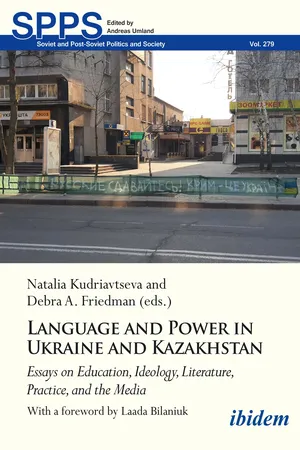
eBook - PDF
Language and Power in Ukraine and Kazakhstan
Essays on Education, Ideology, Literature, Practice, and the Media
- 287 pages
- English
- PDF
- Available on iOS & Android
eBook - PDF
Language and Power in Ukraine and Kazakhstan
Essays on Education, Ideology, Literature, Practice, and the Media
About this book
Information
Table of contents
- Acknowledgement
- Foreword
- Introduction
- Introduction: Critical Perspectives on Language and Power in Ukraine and Kazakhstan
- Pen and Sword: Tracing the Ideological Dimension of Ukraine’s Language-in-Education Policy in Wartime
- Translation as Ideology: Nation-Building vs Colonization in Diasporic-Ukrainian and Soviet Literature for Young Adults
- Language and Social Inequalities in Ukraine: Monolingual and Bilingual Practices
- School Language Choice in Almaty, Kazakhstan, and Emerging Educational Inequality
- Pro-change or Safeguarding the Status-Quo: Language Ideological Debates Surrounding the 2019 Ukrainian Orthography
- Deconstruction of Russia’s Newspeak in Ukrainian Humorous Translation and Digital Folklore
- Conclusion
- Our Authors
- Index
Trusted by 375,005 students
Access to over 1.5 million titles for a fair monthly price.
Study more efficiently using our study tools.
Frequently asked questions
Yes, you can cancel anytime from the Subscription tab in your account settings on the Perlego website. Your subscription will stay active until the end of your current billing period. Learn how to cancel your subscription
No, books cannot be downloaded as external files, such as PDFs, for use outside of Perlego. However, you can download books within the Perlego app for offline reading on mobile or tablet. Learn how to download books offline
Perlego offers two plans: Essential and Complete
- Essential is ideal for learners and professionals who enjoy exploring a wide range of subjects. Access the Essential Library with 800,000+ trusted titles and best-sellers across business, personal growth, and the humanities. Includes unlimited reading time and Standard Read Aloud voice.
- Complete: Perfect for advanced learners and researchers needing full, unrestricted access. Unlock 1.5M+ books across hundreds of subjects, including academic and specialized titles. The Complete Plan also includes advanced features like Premium Read Aloud and Research Assistant.
We are an online textbook subscription service, where you can get access to an entire online library for less than the price of a single book per month. With over 1.5 million books across 990+ topics, we’ve got you covered! Learn about our mission
Look out for the read-aloud symbol on your next book to see if you can listen to it. The read-aloud tool reads text aloud for you, highlighting the text as it is being read. You can pause it, speed it up and slow it down. Learn more about Read Aloud
Yes! You can use the Perlego app on both iOS and Android devices to read anytime, anywhere — even offline. Perfect for commutes or when you’re on the go.
Please note we cannot support devices running on iOS 13 and Android 7 or earlier. Learn more about using the app
Please note we cannot support devices running on iOS 13 and Android 7 or earlier. Learn more about using the app
Yes, you can access Language and Power in Ukraine and Kazakhstan by Debra A. Friedman,Natalia Kudriavtseva in PDF and/or ePUB format. We have over 1.5 million books available in our catalogue for you to explore.