eBook - ePub
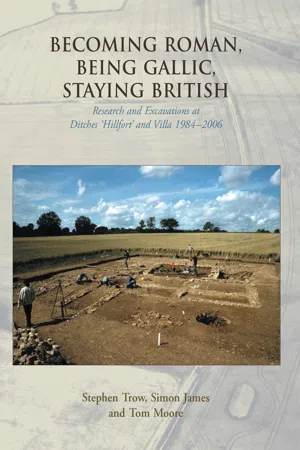
Becoming Roman, Being Gallic, Staying British
Research and Excavations at Ditches 'hillfort' and villa 1984-2006
- 240 pages
- English
- ePUB (mobile friendly)
- Available on iOS & Android
eBook - ePub
Becoming Roman, Being Gallic, Staying British
Research and Excavations at Ditches 'hillfort' and villa 1984-2006
About this book
Excavations carried out from 1984-1985 at Ditches in Gloucestershire identified a large, late Iron Age enclosure which contained a remarkably early Roman villa. This long awaited excavation report reinterprets this evidence in the light of more recent studies of the late Iron Age-Roman transition. It extends our understanding of the Ditches-Bagendon-Cirencester oppida complex, and corroborates the latest thinking on the nature of Romanisation. New conceptions are challenging the significance of the Claudian invasion of AD 43, suggesting that Roman political influence in southern Britain was much more important than commonly thought decades before this. The Roman take-over was a long drawn-out process, which began especially with intimate links between Caesar and his successors and the dynasts they supported or implanted in Britain on the other. High status archaeological sites are central to these relations, including the so-called oppida , developed in southern Britain in the decades between Caesar's raids and the Claudian occupation. Ditches provides further corroborative evidence. Several phases of Romano-British building were uncovered, revealing an unusual sequence of development for a villa in the region and representing an exceptionally early villa beyond south-east England. Discoveries included a well-preserved cellar and a range of finds, including Gallo-Belgic wares, Iron Age coins, coin moulds, Venus figurines and brooches indicating high-status occupation. The form and date of the villa also provides evidence of connections between the late Iron Age elites and communities of southern England and Gaul. Further evidence suggests the villa was abandoned in the later second century AD, emphasising the unusual sequence of the site.
Information
Subtopic
British HistoryIndex
Social SciencesTHE COARSEWARE POTTERY
Methodology
Around 4,000 sherds (55kg) of coarse pottery were recovered from the 1984 and 1985 excavations. These have been quantified using rim equivalents (RE), weight and sherd numbers (see graphs). Only the stratified assemblages have been fully quantified by fabric and form.
A new fabric series was established which has been closely correlated to the fabric series established by Stephen Trow (1988b). This was done to enable close comparison between the 1982–3 assemblage and the 1984–5 material and has also been used to quantify the material from Bagendon (1979–1981), which displays a number of similarities in fabrics and forms with the first century AD deposits from Ditches. This allows for quantitative comparison between the two sites in form and fabric, discussion of which can be found in the analysis of material from Bagendon.
The assemblage was divided on the basis of fabric assessed from a fresh break using a binocular microscope. In some areas fabrics represent variants of the same pottery groups and have been combined under the general groups/ names below. Where possible, parallels with Trow’s earlier fabric types are provided and with major assemblages elsewhere, including Frocester (Timby 2000), Duntisbourne Grove, Middle Duntisbourne, Birdlip Quarry (Timby 1999a), Conderton Camp (Morris 2005), Uley West Hill (Leach 1993) and Cirencester (Rigby 1982). In order to facilitate easy comparison with Trow’s report on the 1982–3 excavations the same form types were used with additions added for the 1984–85 assemblage where form parallels could not be discerned in the existing form groups. Form and fabrics were paralleled with large published assemblages from the region in order to provide specific parallels and dates, these included Weston-under-Penyard-Ariconium (Willis 2000a), Bagendon (Clifford 1961), Uley West Hill (Leach 1993), Frocester (Timby 2000), Kingsholm (Darling 1985), early and late Roman Cirencester (Cooper 1998; Rigby 1982), Thornill (Timby 2004) and the Ermin Street sites at Duntisbourne and Birdlip Quarry (Timby 1999a). Comparisons in form and fabric were also made with the National Fabric series (Tomber and Dore 1998) and with Tyers (1996).
Fabrics
Fabrics for the earlier contexts were divided in to the same groups as in Trow (1988b) for comparison between the 1982–3 and 1984–5 excavations. Trow divided the fabrics in to broader groups as follows. The corresponding 1984–5 fabrics have been grouped as close as possible in to these groups:
Group A: handmade, limestone tempered Iron Age tradition pottery (84–5 fabrics: MALV, L1, L2, L3).
Group B: handmade/wheel turned grog tempered wares (84–5 fabrics: GROG1, GROG2, GROG3).
Group C: (84–5 fabric GROGBAG).
Group D: early Severn Valley Wares (84–5 fabrics: SVWO/R).
Group E: Savernake wares (84–5 fabrics: SAV1–6).
Group F: finewares (GROGFW, WW, FWB, including samian, Gaulish imports and amphorae.
Groups A–F match Trow’s fabric groups (1988b, 64). Further groups G–M have been added to include fabrics not grouped by Trow and those only present in the later contexts (see below). Because of the predominantly later date of most of these wares, these have not been used to compare with the 1982–3 assemblage. The fabric descriptions below have been grouped together under the major wares.
Forms
In order to compare with the coarse pottery from the 1982–3 report the form types have been grouped in to the same groups outlined by Trow (1988b) with additions to include forms not present in 1982–3 assemblage. These groups are divided as such (see Trow 1988b, 64):
Group 1: Jars in Iron Age tradition forms (JA and JB).
Group 2: bead rimmed vessels (JC).
Group 3: storage jars (JG).
Group 4: wide mouthed and necked bowls (BC and BD) (includes JK; straight necked jars).
Group 5: carinated bowls (BE).
Group 6: platters (DA).
Group 7: beakers (K).
The following additional groups have been added to Trow’s groups:
Group 8: Flanged bowls (FB) (found in SVWs, OXCC and BB wares).
Group 9: Tankards (TK).
Group 10: Flagons (FL).
Group 11: Tripod vessel (DC).
Group 12: Samian derived forms (found solely in SVWs) (SD).
Other: includes other forms including bases which do not fit the existing categories above.
Fabric descriptions
Group A: Limestone tempered wares
MALV1: Black-grey with inclusions rarely exceeding 2mm, with burnished surfaces, occasionally decorated with vertical burnished hatching.
Forms: everted rims jars and storage vessels.
Parallels: Trow fabric 1; Timby 1999,
MALVL1; Peacock B1; GL TF 33.
Date: Iron Age–first century AD.
MALV2: Dark-grey black (occasionally varying with firing to oxidised reddy light brown areas on interior surfaces, e.g. Fig. 43, no. 156). Inclusions include abundant limestone and occasional organic voids. Forms: jars with everted rims and storage vessels.
Parallels: Trow fabric 1.
Date: Iron Age–first century AD.
L1: Coarse fabric with frequent inclusions. Inclusions of abundant limestone. A dark-black grey core with orange-brown to black-brown exterior surfaces. Possibly local origin.
Forms: Iron Age form jars and storage vessels.
Parallels: Trow fabric 2?
Date: first century BC–first century AD.
L2: Limestone tempered ware rarely found in both the 1982–3 and 1984–5 excavations, may be of local manufacture.
Forms: uncertain.
Parallel: Trow fabric 3.
Date: Iron Age.
L3: Black fabric with few inclusions, friable and void ridden. The limestone inclusions are generally small and whiter than those in fabrics L1 and 2. Dark grey black but some vessel have yellow/orange brown area and black areas of varying firing. Inclusions of frequent voids (up to 2mm) from organic temper and limestone inclusions (0.1–2mm diameter).
Forms: Iron Age handmade forms, small usually upright jars (see Ashville form B; DeRoche 1978).
Parallels: Trow 3?
Date: Occurrence in association with Savernake wares suggests possibly early first century AD (see be...
Table of contents
- Title Page
- Copyright Page
- Table of Contents
- LIST OF FIGURES
- LIST OF TABLES
- PREFACE
- SUMMARY
- RESUMÉ
- ZUSAMMENFASSUNG
- ACKNOWLEDGEMENTS
- INTRODUCTION
- THE 1984–5 EXCAVATIONS
- PRESERVATION OF THE VILLA
- GEOPHYSICAL SURVEY
- DISCUSSION OF THE IRON AGE AND ROMAN REMAINS
- GALLO-BELGIC AND LOCAL FINEWARES
- THE SAMIAN
- THE COARSEWARE POTTERY
- BROOCHES
- IRON AGE COINS
- ROMAN COINS
- CLAUDIAN PROVINCIAL COIN
- AN IRON FINGER-RING
- PIPECLAY FIGURINES
- THE GLASS
- THE TOUCHSTONE
- WORKED STONE
- WORKED BONE
- LEAD/LEAD ALLOY SNAKE BRACELET
- FINDS OF LEAD ALLOY
- FINDS OF COPPER ALLOY
- FINDS OF IRON
- CARPENTRY NAILS
- FINDS OF BAKED CLAY
- WALL PLASTER
- MARINE MOLLUSC SHELLS
- HUMAN REMAINS
- THE CHARRED PLANT REMAINS
- ANIMAL BONE
- BIBLIOGRAPHY
- INDEX
Trusted by 375,005 students
Access to over 1.5 million titles for a fair monthly price.
Study more efficiently using our study tools.
Frequently asked questions
Yes, you can cancel anytime from the Subscription tab in your account settings on the Perlego website. Your subscription will stay active until the end of your current billing period. Learn how to cancel your subscription
No, books cannot be downloaded as external files, such as PDFs, for use outside of Perlego. However, you can download books within the Perlego app for offline reading on mobile or tablet. Learn how to download books offline
Perlego offers two plans: Essential and Complete
- Essential is ideal for learners and professionals who enjoy exploring a wide range of subjects. Access the Essential Library with 800,000+ trusted titles and best-sellers across business, personal growth, and the humanities. Includes unlimited reading time and Standard Read Aloud voice.
- Complete: Perfect for advanced learners and researchers needing full, unrestricted access. Unlock 1.5M+ books across hundreds of subjects, including academic and specialized titles. The Complete Plan also includes advanced features like Premium Read Aloud and Research Assistant.
We are an online textbook subscription service, where you can get access to an entire online library for less than the price of a single book per month. With over 1.5 million books across 990+ topics, we’ve got you covered! Learn about our mission
Look out for the read-aloud symbol on your next book to see if you can listen to it. The read-aloud tool reads text aloud for you, highlighting the text as it is being read. You can pause it, speed it up and slow it down. Learn more about Read Aloud
Yes! You can use the Perlego app on both iOS and Android devices to read anytime, anywhere — even offline. Perfect for commutes or when you’re on the go.
Please note we cannot support devices running on iOS 13 and Android 7 or earlier. Learn more about using the app
Please note we cannot support devices running on iOS 13 and Android 7 or earlier. Learn more about using the app
Yes, you can access Becoming Roman, Being Gallic, Staying British by Stephen Trow,Simon James,Tom Moore, Simon James, Tom Moore in PDF and/or ePUB format, as well as other popular books in Social Sciences & British History. We have over 1.5 million books available in our catalogue for you to explore.