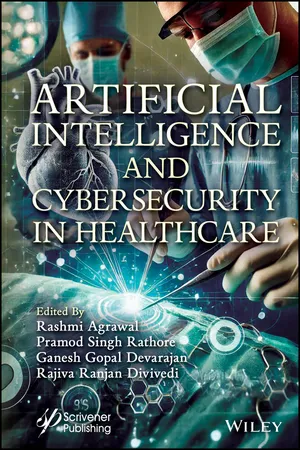
Artificial Intelligence and Cybersecurity in Healthcare
eBook - PDF

Artificial Intelligence and Cybersecurity in Healthcare

  1. 513 pages
  2. English
  3. PDF
  4. Available on iOS & Android
eBook - PDF

Artificial Intelligence and Cybersecurity in Healthcare

About this book

Artificial Intelligence and Cybersecurity in Healthcare provides a crucial exploration of AI and cybersecurity within healthcare Cyber Physical Systems (CPS), offering insights into the complex technological landscape shaping modern patient care and data protection.

As technology advances, healthcare has transformed, particularly through the implementation of CPS that integrate the digital and physical worlds, enhancing system efficiency and effectiveness. This increased reliance on technology raises significant security concerns. The book addresses the integration of AI and cybersecurity in healthcare CPS, detailing technological advancements, applications, and the challenges they present.

AI applications in healthcare CPS include remote patient monitoring, AI chatbots for patient assistance, and biometric authentication for data security. AI not only improves patient care and clinical decision-making by analyzing extensive data and optimizing treatment plans, but also enhances CPS security by detecting and responding to cyber threats. Nonetheless, AI systems are susceptible to attacks, emphasizing the need for robust cybersecurity.

Significant issues include the privacy and security of sensitive healthcare data, potential identity theft, and medical fraud from data breaches, alongside ethical concerns such as algorithmic bias. As the healthcare industry becomes increasingly digital and data-driven, integrating AI and cybersecurity measures into CPS is essential. This requires collaboration among healthcare providers, tech vendors, regulatory bodies, and cybersecurity experts to develop best practices and standards.

This book aims to provide a comprehensive understanding of AI, cybersecurity, and healthcare CPS. It explores technologies like augmented reality, blockchain, and the Internet of Things, addressing associated challenges like cybersecurity threats and ethical dilemmas.

Frequently asked questions

Yes, you can cancel anytime from the Subscription tab in your account settings on the Perlego website. Your subscription will stay active until the end of your current billing period. Learn how to cancel your subscription.
At the moment all of our mobile-responsive ePub books are available to download via the app. Most of our PDFs are also available to download and we're working on making the final remaining ones downloadable now. Learn more here.
Perlego offers two plans: Essential and Complete
  • Essential is ideal for learners and professionals who enjoy exploring a wide range of subjects. Access the Essential Library with 800,000+ trusted titles and best-sellers across business, personal growth, and the humanities. Includes unlimited reading time and Standard Read Aloud voice.
  • Complete: Perfect for advanced learners and researchers needing full, unrestricted access. Unlock 1.4M+ books across hundreds of subjects, including academic and specialized titles. The Complete Plan also includes advanced features like Premium Read Aloud and Research Assistant.
Both plans are available with monthly, semester, or annual billing cycles.
We are an online textbook subscription service, where you can get access to an entire online library for less than the price of a single book per month. With over 1 million books across 1000+ topics, we’ve got you covered! Learn more here.
Look out for the read-aloud symbol on your next book to see if you can listen to it. The read-aloud tool reads text aloud for you, highlighting the text as it is being read. You can pause it, speed it up and slow it down. Learn more here.
Yes! You can use the Perlego app on both iOS or Android devices to read anytime, anywhere — even offline. Perfect for commutes or when you’re on the go.
Please note we cannot support devices running on iOS 13 and Android 7 or earlier. Learn more about using the app.
Yes, you can access Artificial Intelligence and Cybersecurity in Healthcare by Rashmi Agrawal,Pramod Singh Rathore,Ganesh Gopal Deverajan,Rajiva Ranjan Divivedi in PDF and/or ePUB format, as well as other popular books in Computer Science & Artificial Intelligence (AI) & Semantics. We have over one million books available in our catalogue for you to explore.

Table of contents

  1. Cover
  2. Series Page
  3. Title Page
  4. Copyright Page
  5. Contents
  6. Preface
  7. Chapter 1 Digital Prescriptions for Improved Patient Care are Transforming Healthcare Through Voice-Based Technology
  8. Chapter 2 Securing IoMT-Based Healthcare System: Issues, Challenges, and Solutions
  9. Chapter 3 Fog Computing in Healthcare: Enhancing Security and Privacy in Distributed Systems
  10. Chapter 4 Blockchain Technology for Securing Healthcare Data in Cyber-Physical Systems
  11. Chapter 5 Augmented Reality and Virtual Reality in Healthcare: Advancements and Security Challenges
  12. Chapter 6 Next Generation Healthcare: Leveraging AI for Personalized Diagnosis, Treatment, and Monitoring
  13. Chapter 7 Exploring the Advantages and Security Aspects of Digital Twin Technology in Healthcare
  14. Chapter 8 An Extensive Study of AI and Cybersecurity in Healthcare
  15. Chapter 9 Cloud Computing in Healthcare: Risks and Security Measures
  16. Chapter 10 Explainable Artificial Intelligence in Healthcare: Transparency and Trustworthiness
  17. Chapter 11 Fuzzy Expert System to Diagnose the Heart Disease Risk Level
  18. Chapter 12 Search and Rescue–Based Sparse Auto-Encoder for Detecting Heart Disease in IoT Healthcare Environment
  19. Chapter 13 Growth Optimization–Based SBLRNN Model for Estimate Breast Cancer in IoT Healthcare Environment
  20. Chapter 14 Lightweight Fuzzy Logical MQTT Security System to Secure the Low Configurated Medical Device System by Communicating the IoT
  21. Chapter 15 IoT-Based Secured Biomedical Device to Remote Monitoring to the Patient
  22. Chapter 16 Fuzzy Interface Drug Delivery Decision-Making Algorithm
  23. Chapter 17 Implementation of Clinical Fuzzy-Based Decision Supportive System to Monitor Renal Function
  24. Chapter 18 Deep Learning–Based Medical Image Classification and Web Application Framework to Identify Alzheimer’s Disease
  25. Chapter 19 Using Deep Learning to Classify and Diagnose Alzheimer’s Disease
  26. Chapter 20 Developing a Soft Computing Fuzzy Interface System for Peptic Ulcer Diagnosis
  27. Chapter 21 Digital Twin Technology in Healthcare: Benefits and Security Considerations
  28. Chapter 22 Combating Cyber Threats Including Wormhole Attacks in Healthcare Cyber-Physical Systems: Advanced Prevention and Mitigation Techniques
  29. Index
  30. Also of Interest
  31. EULA