Explores the cultural role of screen storytelling in society
With significant evolutions in digital technologies and media distribution in the past two decades, the business of storytelling through screens has shifted dramatically. In the past, blockbuster movies and TV shows like Friends aimed first for domestic mass audiences, although the biggest hits circulated globally. Now, transnational distribution plays a primary role and imagined audiences are global. At the same time, the once-mass audience has significantly fragmented to enable an expansion in the range of commercially viable stories, as evident in series as varied as Atlanta, Better Things, and dozens of others that are not widely known, but deeply loved by their microaudiences.
Delving into the changing landscape of commercial screen storytelling, After Mass Media explores how industrial shifts and technological advancements have remade the narrative landscape over the past two decades. Television and movies have long shaped society, whether by telling us about the worlds around us or far away. By examining the internationalization of screen businesses, the rise of streaming services with multi-territory reach, and the stories made for this environment, this book sheds light on the profound transformations in television and film production and circulation. With a keen focus on major changes in the types of screen stories being told, Amanda D. Lotz unravels the industrial roots that made these transformations possible, challenges some conventional distinctions of screen storytelling, and provides new conceptual tools to make sense of the abundance and range of screen stories on offer.
Through its comprehensive analysis, After Mass Media exposes how contemporary industrial dynamics, particularly the erosion of traditional distribution models based on geography and mass audience reach, have far-reaching implications for our understanding of national video cultures.
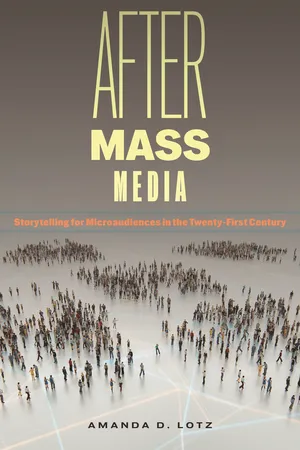
eBook - ePub
After Mass Media
Storytelling for Microaudiences in the Twenty-First Century
- English
- ePUB (mobile friendly)
- Available on iOS & Android
eBook - ePub
About this book
Information
Table of contents
- Cover
- Series Page
- Title Page
- Copyright
- Dedication
- Contents
- Introduction: Screen Stories and Twenty-First-Century Video Cultures
- 1. US Video Culture Now: Internet Distribution and an Internationalized Business
- 2. New Modes of Industrial Practice and Storytelling
- 3. Shifting Series: US Cable Innovation, Escalating Budgets, and Streamers Adjust the Playing Field
- 4. Series Strategies: Formats, Co-productions, Streamer Commissions
- 5. Limited Series or Ten-Hour Movies? Blurring Modes of Industrial Practice
- 6. The Cultural Roles of Screen Storytelling
- 7. Belonging and Resonance: Why Screen Stories Matter in the Age of Microaudiences
- Conclusion: Rethinking
- Acknowledgments
- Appendix A: Spectacular Series Budget Data
- Appendix B: Co-financing Data
- Notes
- References
- Index
- About the Author
Trusted by 375,005 students
Access to over 1.5 million titles for a fair monthly price.
Study more efficiently using our study tools.
Frequently asked questions
Yes, you can cancel anytime from the Subscription tab in your account settings on the Perlego website. Your subscription will stay active until the end of your current billing period. Learn how to cancel your subscription
No, books cannot be downloaded as external files, such as PDFs, for use outside of Perlego. However, you can download books within the Perlego app for offline reading on mobile or tablet. Learn how to download books offline
We are an online textbook subscription service, where you can get access to an entire online library for less than the price of a single book per month. With over 1.5 million books across 990+ topics, we’ve got you covered! Learn about our mission
Look out for the read-aloud symbol on your next book to see if you can listen to it. The read-aloud tool reads text aloud for you, highlighting the text as it is being read. You can pause it, speed it up and slow it down. Learn more about Read Aloud
Yes! You can use the Perlego app on both iOS and Android devices to read anytime, anywhere — even offline. Perfect for commutes or when you’re on the go.
Please note we cannot support devices running on iOS 13 and Android 7 or earlier. Learn more about using the app
Please note we cannot support devices running on iOS 13 and Android 7 or earlier. Learn more about using the app
Yes, you can access After Mass Media by Amanda D. Lotz in PDF and/or ePUB format, as well as other popular books in Social Sciences & Storytelling. We have over 1.5 million books available in our catalogue for you to explore.