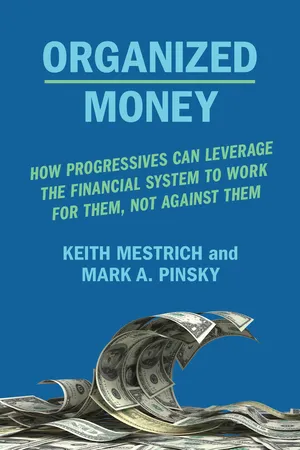
Organized Money
eBook - ePub

Organized Money

How Progressives Can Leverage the Financial System to Work for Them, Not Against Them

  1. English
  2. ePUB (mobile friendly)
  3. Available on iOS & Android
eBook - ePub

Organized Money

How Progressives Can Leverage the Financial System to Work for Them, Not Against Them

About this book

Two leading figures from the world of finance show how progressives can take their money away from conservative financial institutions and put it to good, lasting social use

The U.S. financial system may be working for some people, but it isn't working for most of us who care about progressive causes. In fact, our financial system taps your money to pay for a conservative agenda. It's a heads-they-win, tails-you-lose game when the fees you pay to use your credit card finance fossil fuels even when you buy green products. Conservative "money muscle" shapes our culture, society, politics, and public policy.

In this bold call to action, two leaders from the world of progressive finance propose a strategy to challenge this conservative dominance of the financial sector: organized progressive money. It's a $10 trillion plan for a full- service, market-scale progressive financial system. Mestrich and Pinsky explain how progressives can take control with financial institutions of their own and products that align with progressive values.

Organized Money warns that until progressives organize their money, they will lose again and again while conservatives will keep winning. It's a crucial message for the next progressive era, starting with the make-or-break 2020 election cycle, where American voters will be presented with a choice between conservative market fundamentalism that leaves them out or inclusive restorative capitalism that is good for people as well as profits.

Written in clear, engaging prose for non- financial readers and finance leaders alike, Organized Money is required reading for everyone ready to confront the excesses of conservative power and influence.

Frequently asked questions

Yes, you can cancel anytime from the Subscription tab in your account settings on the Perlego website. Your subscription will stay active until the end of your current billing period. Learn how to cancel your subscription.
At the moment all of our mobile-responsive ePub books are available to download via the app. Most of our PDFs are also available to download and we're working on making the final remaining ones downloadable now. Learn more here.
Perlego offers two plans: Essential and Complete
  • Essential is ideal for learners and professionals who enjoy exploring a wide range of subjects. Access the Essential Library with 800,000+ trusted titles and best-sellers across business, personal growth, and the humanities. Includes unlimited reading time and Standard Read Aloud voice.
  • Complete: Perfect for advanced learners and researchers needing full, unrestricted access. Unlock 1.4M+ books across hundreds of subjects, including academic and specialized titles. The Complete Plan also includes advanced features like Premium Read Aloud and Research Assistant.
Both plans are available with monthly, semester, or annual billing cycles.
We are an online textbook subscription service, where you can get access to an entire online library for less than the price of a single book per month. With over 1 million books across 1000+ topics, we’ve got you covered! Learn more here.
Look out for the read-aloud symbol on your next book to see if you can listen to it. The read-aloud tool reads text aloud for you, highlighting the text as it is being read. You can pause it, speed it up and slow it down. Learn more here.
Yes! You can use the Perlego app on both iOS or Android devices to read anytime, anywhere — even offline. Perfect for commutes or when you’re on the go.
Please note we cannot support devices running on iOS 13 and Android 7 or earlier. Learn more about using the app.
Yes, you can access Organized Money by Keith Mestrich,Mark A. Pinsky in PDF and/or ePUB format, as well as other popular books in Economics & Nonprofit Organizations & Charities. We have over one million books available in our catalogue for you to explore.

Information

Table of contents

  1. Cover
  2. Title Page
  3. Dedication
  4. Contents
  5. Preface: The Problem: It’s a “heads they win, tails you lose” game. What are your odds?
  6. 1. You and Your Money: If you don’t know how the financial system works, it probably doesn’t work for you
  7. 2. Market Fundamentalism: The financial system must be working for someone. Who?
  8. 3. Missing the Opportunity: If you want to see how far off track we are, follow the money going to Opportunity Zones
  9. 4. What Is Money Muscle?: When you make yourself indispensable, you’re powerful
  10. 5. Progress in Mainstream Money: This is not the first time progressives have seen signs of change in conventional finance, so what’s different now?
  11. 6. The Public-Purpose Economy: If you want to build a progressive financial system, you need a vision of the purpose it will serve
  12. 7. Pumping Progressive Money Muscle: Is progressive money muscle even a thing?
  13. 8. Progressive Finance in the United States: We have a 250-year history of inclusive and progressive finance that is central to our economic and social gains. It is hidden in plain sight. It is surging now
  14. 9. The Foundation of a Progressive Finance Network: In practice, progressive financial institutions have many of the building blocks they need to begin assembling an infrastructure that works for them
  15. 10. Whose Wealth Is It Anyway?: Progressives have more wealth than most people know. Where is it? What is it doing?
  16. 11. Organizing Progressive Money for Power and Influence: Progressives have never lacked ideas and vision. Organizing our money is an unprecedented strategy to power progressive gains
  17. Conclusion: Take a Shot!: We need to create the financial system Alexander Hamilton intended
  18. Authors’ Note
  19. Abbreviations
  20. Selected Resources
  21. Notes
  22. Index
  23. About the Authors
  24. Publishing in the Public Interest
  25. Copyright