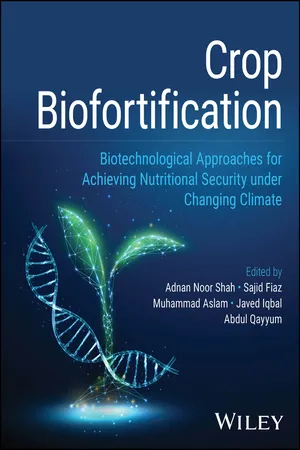
Crop Biofortification
Biotechnological Approaches for Achieving Nutritional Security under Changing Climate
- 499 pages
- English
- PDF
- Available on iOS & Android
Crop Biofortification
Biotechnological Approaches for Achieving Nutritional Security under Changing Climate
About this book
Develop more nutritious crops to aid in the fight against world hunger with this timely volume
One in nine people worldwide suffer from hunger or food scarcity. Massively increasing food production is one of the most urgent scientific projects in the modern world, particularly as a changing climate places increasing pressure on the global food supply and on sustainable food production processes. Biofortification is a process in which plant breeding, improved agronomic practices, and/or modern biotechnology are employed to increase nutrient density of crops without sacrificing any of their desirable characteristics. It's an essential tool in the global fight against hunger.
Crop Biofortification offers an up-to-the-minute overview of this essential subject and its recent advances. It covers all the latest methodologies and techniques deployed in biofortification, as well as surveying plant responses to genetically induced biofortification and the effect of climate change on biofortified crops. Designed to allow for the application of these techniques at the field level, it's a significant contribution towards the search for a sustainable global food supply.
Crop Biofortification readers will also find:
- Presentation of recent advances in omics, particularly metabolomics, which can decipher potential changes in plants caused by biofortification
- Detailed discussion of methods for increasing the nutritional content of edible plants to address specific nutritional deficiencies
- Contributions towards a road map for increasing global food production by 70% before the year 2050
Crop Biofortification is ideal for researchers, policymakers, and professionals interested in the potential biofortification of crop plants, as well as graduate and advanced undergraduate students in agronomy, plant physiology, plant breeding and genetics, agricultural biotechnology, and related fields.
Frequently asked questions
- Essential is ideal for learners and professionals who enjoy exploring a wide range of subjects. Access the Essential Library with 800,000+ trusted titles and best-sellers across business, personal growth, and the humanities. Includes unlimited reading time and Standard Read Aloud voice.
- Complete: Perfect for advanced learners and researchers needing full, unrestricted access. Unlock 1.4M+ books across hundreds of subjects, including academic and specialized titles. The Complete Plan also includes advanced features like Premium Read Aloud and Research Assistant.
Please note we cannot support devices running on iOS 13 and Android 7 or earlier. Learn more about using the app.
Information
Table of contents
- Cover
- Half Title Page
- Title Page
- Copyright
- Contents
- List of Contributors
- Preface
- Chapter 1: Biofortification of Food Grains in Relation to Food Security
- Chapter 2: Golden Rice Project and Its Impact on Global Nutritional Security
- Chapter 3: Biofortification of Cereals and Pulses Using New Breeding Techniques
- Chapter 4: Crops Biofortification through OMICs based Knowledge
- Chapter 5: Current Challenges and Recent Advancements in the Adoption of Omics to Enhance Biofortification
- Chapter 6: Role of Nanoparticles in Improving Biofortification: An Overview
- Chapter 7: Role of Seed-priming in Biofortification
- Chapter 8: Selenium Biofortification in Wheat: A Way Forward Toward Nutritional Security
- Chapter 9: Scope and Research Perspective of Lithium Biofortification in Crop Plants
- Chapter 10: Global Action Plan for Agricultural Diversification for Achieving Zero Hunger
- Chapter 11: Targeting Tissue-Specific Zinc Acquisition in Cereal
- Chapter 12: Combating Mineral Malnutrition Through Iron Biofortification in Cereal Crops
- Chapter 13: Selenium Biofortification in Horticultural Crops
- Chapter 14: Magnesium Mysteries Unveiled: Insights into Its Impact on Plants and Human Health and Biofortification Strategies to Enhance Magnesium Content in Cereal Crops
- Chapter 15: Combating Fe Biofortification Under Heavy Metal Pollution
- Chapter 16: Biofortification in Vegetables: Enhancing Nutritional Value for Improved Human Health
- Chapter 17: Genetic Engineering for Crop Biofortification
- Chapter 18: Development of Biofortified Crops through Marker-Assisted Selection
- Chapter 19: Agronomic Perspective of Improving Iodine Biofortification
- Chapter 20: Applications of Nanoparticles in Biofortification of Crops: Amplifying Nutritional Quality
- Chapter 21: Zinc Biofortification in Rice – From Conventional Breeding to Biotechnological Approaches
- Chapter 22: Modification in Conventional Methods and Modern Plant Breeding Techniques to Enhance Genetic Gain for Future Food Security
- Chapter 23: Biofortification of Crops and Vegetables to Achieve Food Nutritional Security
- Chapter 24: Genetic Diversity and Crop Genome-wide Association Studies to Identify Biofortified Traits for Micronutrients
- Chapter 25: Modification of Conventional Methods and Modern Plant Breeding Techniques to Enhance Genetic Gain for Future Food Security
- Chapter 26: Nanofertilizers for Growing Fortified Crops: A Need of the Day
- Index
- EULA