How we build our invisible libraries
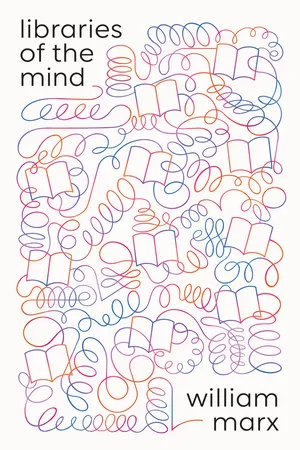
Erich Auerbach wrote his classic work Mimesis, a history of narrative from Homer to Proust, based largely on his memory of past reading. Having left his physical library behind when he fled to Istanbul to escape the Nazis, he was forced to rely on the invisible library of his mind. Each of us has such a library—if not as extensive as Auerbach’s—even if we are unaware of it. In this erudite and provocative book, William Marx explores our invisible libraries—how we build them and how we should expand them.
Libraries, Marx tells us, are mental realities, and, conversely, our minds are libraries. We never read books apart from other texts. We take them from mental shelves filled with a variety of works that help us understand what we are reading. And yet the libraries in our mind are not always what they should be. The selection on our mental shelves—often referred to as canon, heritage, patrimony, or tradition—needs to be modified and expanded. Our intangible libraries should incorporate what Marx calls the dark matter of literature: the works that have been lost, that exist only in fragments, that have been repurposed by their authors, or were never written in the first place. Marx suggests methods for recovering this missing literature, but he also warns us that adding new titles to our libraries is not enough. We must also adopt a new attitude, one that honors the diversity and otherness of literary works. We must shed our preconceptions and build within ourselves a mental world library.
- English
- ePUB (mobile friendly)
- Available on iOS & Android
eBook - ePub
Libraries of the Mind
About this book
Information
Publisher
Princeton University PressYear
2025Print ISBN
9780691267432
9780691267425
eBook ISBN
9780691273884
Table of contents
- Cover Page
- Series Page
- Title Page
- Copyright Page
- Epigraphs
- Contents
- Chapter One: Libraries of the Mind
- Chapter Two: The Dark Matter of Literature
- Chapter Three: The World Library
- Acknowledgments
- Illustration Credits
- Notes
- Index
Trusted by 375,005 students
Access to over 1.5 million titles for a fair monthly price.
Study more efficiently using our study tools.
Frequently asked questions
Yes, you can cancel anytime from the Subscription tab in your account settings on the Perlego website. Your subscription will stay active until the end of your current billing period. Learn how to cancel your subscription
No, books cannot be downloaded as external files, such as PDFs, for use outside of Perlego. However, you can download books within the Perlego app for offline reading on mobile or tablet. Learn how to download books offline
Perlego offers two plans: Essential and Complete
- Essential is ideal for learners and professionals who enjoy exploring a wide range of subjects. Access the Essential Library with 800,000+ trusted titles and best-sellers across business, personal growth, and the humanities. Includes unlimited reading time and Standard Read Aloud voice.
- Complete: Perfect for advanced learners and researchers needing full, unrestricted access. Unlock 1.5M+ books across hundreds of subjects, including academic and specialized titles. The Complete Plan also includes advanced features like Premium Read Aloud and Research Assistant.
We are an online textbook subscription service, where you can get access to an entire online library for less than the price of a single book per month. With over 1.5 million books across 990+ topics, we’ve got you covered! Learn about our mission
Look out for the read-aloud symbol on your next book to see if you can listen to it. The read-aloud tool reads text aloud for you, highlighting the text as it is being read. You can pause it, speed it up and slow it down. Learn more about Read Aloud
Yes! You can use the Perlego app on both iOS and Android devices to read anytime, anywhere — even offline. Perfect for commutes or when you’re on the go.
Please note we cannot support devices running on iOS 13 and Android 7 or earlier. Learn more about using the app
Please note we cannot support devices running on iOS 13 and Android 7 or earlier. Learn more about using the app
Yes, you can access Libraries of the Mind by William Marx in PDF and/or ePUB format, as well as other popular books in Literature & Literary Criticism. We have over 1.5 million books available in our catalogue for you to explore.