How Mayor Ray Flynn's leadership and a coalition of activists transformed Boston, challenging established powers and setting new precedents for urban governance
The Battle for Boston captures the remarkable era under Mayor Ray Flynn, whose election in 1983 marked the beginning of a profound shift in the city's political and social landscape. Don Gillis, a Flynn senior advisor, chronicles the inspiring journey of a city that dared to challenge the entrenched power brokers—including developers, landlords, and banking industry leaders—through powerful grassroots campaigns.
Gillis provides a vivid portrayal of the political dynamics and the coalition of community organizers, neighborhood leaders, and residents that played a pivotal role in rejecting the business-backed growth machine and the city's historically divisive racial politics. This book charts the strategic battles fought within the corridors of power and on the streets and highlights the substantial impact these movements had on the city's governance and power dynamics.
In a historic turn, in 2021, Michelle Wu became the first woman, person of color, and Asian- American elected Mayor of Boston. Wu's victory on a similarly progressive platform as Flynn underscores the enduring relevance of his legacy, signaling a hopeful future for more inclusive and effectively governed cities.
The Battle for Boston poses a critical inquiry: Can cities truly embrace progressivism and govern effectively in the twenty-first century? This qualitative narrative study is a testament to the possibility of such governance, driven by the indomitable spirit of those who strive for a fair and equitable society.
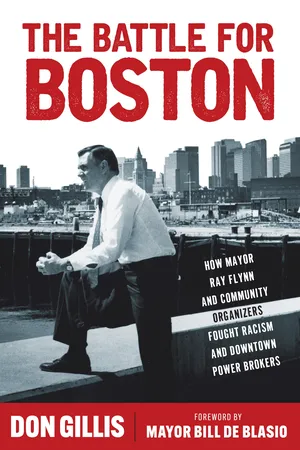
eBook - ePub
The Battle for Boston
How Mayor Ray Flynn and Community Organizers Fought Racism and Downtown Power Brokers
- English
- ePUB (mobile friendly)
- Available on iOS & Android
eBook - ePub
The Battle for Boston
How Mayor Ray Flynn and Community Organizers Fought Racism and Downtown Power Brokers
About this book
Information
Table of contents
- Cover
- Title Page
- Copyright
- Dedication
- Contents
- Boston Neighborhoods Map
- List of Charts and Tables
- Foreword by Mayor Bill de Blasio
- Preface: A City in the Twenty-First Century
- Introduction: Can Cities Be Economically and Socially Progressive?
- 1. City Limits and Opportunities
- 2. Political, Social, and Economic History of Boston
- 3. The New Boston and the 1983 Race for Mayor
- 4. Community Organizing as Political Governance
- 5. Confronting the Housing Crisis and Landlords
- 6. Redlining, Blockbusting, and Fighting Bank Discrimination
- 7. Challenging the Growth Machine: A New “Social Contract”
- 8. Boston’s Racial Politics: Ending Racial Violence
- 9. Civil Rights and Wrongs: The Search for Racial Justice
- 10. “Death at an Early Age”: Public Education Debates
- 11. Rebuilding the City: Urban Finances and Infrastructure
- 12. Confronting Poverty and Homelessness
- 13. The 2013 and 2021 Mayoral Elections: New Directions for Boston
- 14. How Does Urban Progressivism Succeed?
- Acknowledgments
- Appendix 1: Cities Defined as Progressive
- Appendix 2: Urban Theories Used in Boston Analysis
- Interviews by Author
- Notes
- Bibliography
- Index
- About the Author
Trusted by 375,005 students
Access to over 1.5 million titles for a fair monthly price.
Study more efficiently using our study tools.
Frequently asked questions
Yes, you can cancel anytime from the Subscription tab in your account settings on the Perlego website. Your subscription will stay active until the end of your current billing period. Learn how to cancel your subscription
No, books cannot be downloaded as external files, such as PDFs, for use outside of Perlego. However, you can download books within the Perlego app for offline reading on mobile or tablet. Learn how to download books offline
Perlego offers two plans: Essential and Complete
- Essential is ideal for learners and professionals who enjoy exploring a wide range of subjects. Access the Essential Library with 800,000+ trusted titles and best-sellers across business, personal growth, and the humanities. Includes unlimited reading time and Standard Read Aloud voice.
- Complete: Perfect for advanced learners and researchers needing full, unrestricted access. Unlock 1.5M+ books across hundreds of subjects, including academic and specialized titles. The Complete Plan also includes advanced features like Premium Read Aloud and Research Assistant.
We are an online textbook subscription service, where you can get access to an entire online library for less than the price of a single book per month. With over 1.5 million books across 990+ topics, we’ve got you covered! Learn about our mission
Look out for the read-aloud symbol on your next book to see if you can listen to it. The read-aloud tool reads text aloud for you, highlighting the text as it is being read. You can pause it, speed it up and slow it down. Learn more about Read Aloud
Yes! You can use the Perlego app on both iOS and Android devices to read anytime, anywhere — even offline. Perfect for commutes or when you’re on the go.
Please note we cannot support devices running on iOS 13 and Android 7 or earlier. Learn more about using the app
Please note we cannot support devices running on iOS 13 and Android 7 or earlier. Learn more about using the app
Yes, you can access The Battle for Boston by Don Gillis in PDF and/or ePUB format, as well as other popular books in Social Sciences & Political Biographies. We have over 1.5 million books available in our catalogue for you to explore.