- English
- ePUB (mobile friendly)
- Available on iOS & Android
eBook - ePub
About this book
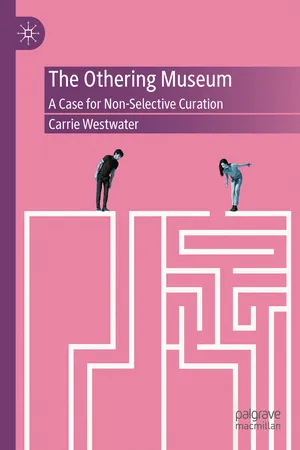
The term "othering" refers to a persistent Us and Them dynamic between museums and their participating public. To reframe this historically paternalistic subject-positioning, over the last decade or so many museums have made firm attempts to address this by attempting to move from being "providers" of engagements to facilitating access to cultural right by embedding co-curatorial techniques and participation. Through the analysis of three co-curated participatory case studies, this book examines how power performs in co-curatorial museum practice. It discusses how it is not just how the participatory process is enacted that is necessary to create this shift to a more socially just profile, but systemic pressures of vulnerability and responsibility found in the political economy of the museum and its participants. This book will chart how this dynamic performs in museums when working with different groups of people, such as volunteers, community participants, and professional artists, presented with differing levels of co-curatorial decision making. The book further investigates whether performances of power are relational to who the participants are, how the processes of participation are constructed, and where the participation takes place, what language is used when conducting these relationships and what the funded institutional responsibilities do to the co-curators (the community and museum staff) when traditional co-curation and co-curation in transition to non-selective curation is applied. Grounding this discussion is the development of this test method of non-selective curation which further illuminates some of these challenges and aims to successfully mitigate them through a radically open and inclusive approach to co-curation.
Information
Table of contents
- Cover
- Front Matter
- Part I. An Introduction and Theoretical Underpinnings
- Part II. Moving from Selective Curation to Non – Selective Curation
- Back Matter
Trusted by 375,005 students
Access to over 1.5 million titles for a fair monthly price.
Study more efficiently using our study tools.
Frequently asked questions
Yes, you can cancel anytime from the Subscription tab in your account settings on the Perlego website. Your subscription will stay active until the end of your current billing period. Learn how to cancel your subscription
No, books cannot be downloaded as external files, such as PDFs, for use outside of Perlego. However, you can download books within the Perlego app for offline reading on mobile or tablet. Learn how to download books offline
Perlego offers two plans: Essential and Complete
- Essential is ideal for learners and professionals who enjoy exploring a wide range of subjects. Access the Essential Library with 800,000+ trusted titles and best-sellers across business, personal growth, and the humanities. Includes unlimited reading time and Standard Read Aloud voice.
- Complete: Perfect for advanced learners and researchers needing full, unrestricted access. Unlock 1.5M+ books across hundreds of subjects, including academic and specialized titles. The Complete Plan also includes advanced features like Premium Read Aloud and Research Assistant.
We are an online textbook subscription service, where you can get access to an entire online library for less than the price of a single book per month. With over 1.5 million books across 990+ topics, we’ve got you covered! Learn about our mission
Look out for the read-aloud symbol on your next book to see if you can listen to it. The read-aloud tool reads text aloud for you, highlighting the text as it is being read. You can pause it, speed it up and slow it down. Learn more about Read Aloud
Yes! You can use the Perlego app on both iOS and Android devices to read anytime, anywhere — even offline. Perfect for commutes or when you’re on the go.
Please note we cannot support devices running on iOS 13 and Android 7 or earlier. Learn more about using the app
Please note we cannot support devices running on iOS 13 and Android 7 or earlier. Learn more about using the app
Yes, you can access The Othering Museum by Carrie Westwater in PDF and/or ePUB format, as well as other popular books in Social Sciences & Social Science Biographies. We have over 1.5 million books available in our catalogue for you to explore.