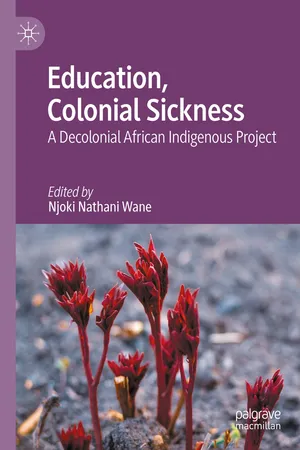
In the last two decades, we have witnessed the quest for decolonization; through research, writing, teaching, and curriculum across the globe. Calls to decolonize higher education have been overwhelming in recent year. However, the goal of decolonizing has evolved past not only the need to dismantle colonial empires but all imperial structures. Today, decolonization is deemed a basis for restorative justice under the lens of the psychological, economic, and cultural spectrum. In this book, the editor and her authors confront various dimensions of decolonizing work, structural, epistemic, personal, and relational, which are entangled and equally necessary. This book illuminates other sites and dimensions of decolonizing not only from Africa but also other areas. This convergence of critical scholarship, theoretical inquiry, and empirical research is committed to questioning and redressing inequality in contemporary history and other African studies. It signals one of many steps in a bid to consultatively examine how knowledge and power have been both defined and subsequently denied through the sphere of academic practice.
- English
- ePUB (mobile friendly)
- Available on iOS & Android
eBook - ePub
About this book
Information
Topic
EducationSubtopic
Education Theory & PracticeTable of contents
- Cover
- Front Matter
- 1. Introduction
- Part I. Decolonizing History and Its Impact on Education from K–12 and Beyond
- Part II. Identity and Ways of Knowing for the Educator and the Learner
- Part III. Spirituality and Land-Based Education
- Back Matter
Trusted by 375,005 students
Access to over 1.5 million titles for a fair monthly price.
Study more efficiently using our study tools.
Frequently asked questions
Yes, you can cancel anytime from the Subscription tab in your account settings on the Perlego website. Your subscription will stay active until the end of your current billing period. Learn how to cancel your subscription
No, books cannot be downloaded as external files, such as PDFs, for use outside of Perlego. However, you can download books within the Perlego app for offline reading on mobile or tablet. Learn how to download books offline
Perlego offers two plans: Essential and Complete
- Essential is ideal for learners and professionals who enjoy exploring a wide range of subjects. Access the Essential Library with 800,000+ trusted titles and best-sellers across business, personal growth, and the humanities. Includes unlimited reading time and Standard Read Aloud voice.
- Complete: Perfect for advanced learners and researchers needing full, unrestricted access. Unlock 1.5M+ books across hundreds of subjects, including academic and specialized titles. The Complete Plan also includes advanced features like Premium Read Aloud and Research Assistant.
We are an online textbook subscription service, where you can get access to an entire online library for less than the price of a single book per month. With over 1.5 million books across 990+ topics, we’ve got you covered! Learn about our mission
Look out for the read-aloud symbol on your next book to see if you can listen to it. The read-aloud tool reads text aloud for you, highlighting the text as it is being read. You can pause it, speed it up and slow it down. Learn more about Read Aloud
Yes! You can use the Perlego app on both iOS and Android devices to read anytime, anywhere — even offline. Perfect for commutes or when you’re on the go.
Please note we cannot support devices running on iOS 13 and Android 7 or earlier. Learn more about using the app
Please note we cannot support devices running on iOS 13 and Android 7 or earlier. Learn more about using the app
Yes, you can access Education, Colonial Sickness by Njoki Nathani Wane in PDF and/or ePUB format, as well as other popular books in Education & Education Theory & Practice. We have over 1.5 million books available in our catalogue for you to explore.