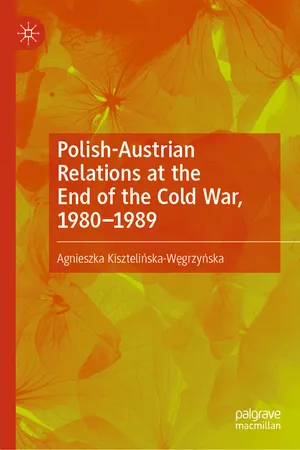
This book proposes a new historical framework for the analysis of the relationship between communist Poland and neutral Austria during the final decade of the Cold War. The tragic Polish crisis of 1980–1982 is examined within the context of Poland's relationship with the wealthy, neutral country of Austria. By exploring the political meetings and negotiations that took place around the introduction of martial law in Poland, this book sheds light on Polish-Austrian bilaterial relations as seen from the perspective of Polish diplomatic documents. Divided into three parts, the book begins by illustrating Austria's attitude to reforms in Poland in the early 1980s. The second part focuses specifically on the imposition of martial law in Poland, and the third part explores the cooperation between the two countries through the form of investments and environment protection. Particular emphasis is placed on Polish attempts to recruit Austrian politicians in order to overcome the political isolation in which Warsaw found itself after December 13, 1981. The author analyses the political boundaries that Austria could, and wanted to, cross, in order to help the Polish regime, offering insights into Austria's fears of financial loss as a result of the collapse of the regime.
eBook - ePub
Polish-Austrian Relations at the End of the Cold War, 1980–1989
- English
- ePUB (mobile friendly)
- Available on iOS & Android
eBook - ePub
Polish-Austrian Relations at the End of the Cold War, 1980–1989
About this book
Information
Table of contents
- Cover
- Front Matter
- 1. Introduction
- 2. Poland’s Place in the Austrian Neighborhood Policy in the 1970s
- 3. The Polish Crisis from the Austrian Perspective
- 4. Polish-Austrian Relations After the Introduction of Martial Law
- 5. Austria’s Reaction to Polish Efforts to Normalize Bilateral Relations in 1984–1989
- 6. Austria’s Role in the Development of Eastern Europe at the End of the Cold War. The Case of Poland
- 7. Conclusion
- Back Matter
Trusted by 375,005 students
Access to over 1.5 million titles for a fair monthly price.
Study more efficiently using our study tools.
Frequently asked questions
Yes, you can cancel anytime from the Subscription tab in your account settings on the Perlego website. Your subscription will stay active until the end of your current billing period. Learn how to cancel your subscription
No, books cannot be downloaded as external files, such as PDFs, for use outside of Perlego. However, you can download books within the Perlego app for offline reading on mobile or tablet. Learn how to download books offline
Perlego offers two plans: Essential and Complete
- Essential is ideal for learners and professionals who enjoy exploring a wide range of subjects. Access the Essential Library with 800,000+ trusted titles and best-sellers across business, personal growth, and the humanities. Includes unlimited reading time and Standard Read Aloud voice.
- Complete: Perfect for advanced learners and researchers needing full, unrestricted access. Unlock 1.5M+ books across hundreds of subjects, including academic and specialized titles. The Complete Plan also includes advanced features like Premium Read Aloud and Research Assistant.
We are an online textbook subscription service, where you can get access to an entire online library for less than the price of a single book per month. With over 1.5 million books across 990+ topics, we’ve got you covered! Learn about our mission
Look out for the read-aloud symbol on your next book to see if you can listen to it. The read-aloud tool reads text aloud for you, highlighting the text as it is being read. You can pause it, speed it up and slow it down. Learn more about Read Aloud
Yes! You can use the Perlego app on both iOS and Android devices to read anytime, anywhere — even offline. Perfect for commutes or when you’re on the go.
Please note we cannot support devices running on iOS 13 and Android 7 or earlier. Learn more about using the app
Please note we cannot support devices running on iOS 13 and Android 7 or earlier. Learn more about using the app
Yes, you can access Polish-Austrian Relations at the End of the Cold War, 1980–1989 by Agnieszka Kisztelińska-Węgrzyńska in PDF and/or ePUB format, as well as other popular books in History & European History. We have over 1.5 million books available in our catalogue for you to explore.