- English
- ePUB (mobile friendly)
- Available on iOS & Android
About this book
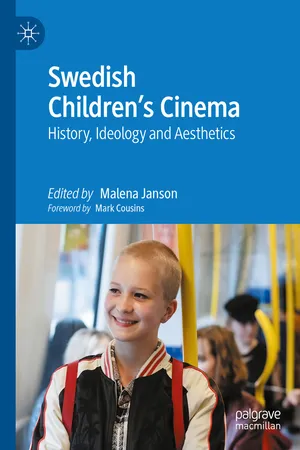
Swedish children's cinema has a long and rich history. It encompasses the rascal films of the 1920s, the realism of the 1940s, the ambitious artistic renewal of the 1970s, the child empowering films of the 1990s through the early 2000s, and the multiple, exceedingly popular, Astrid Lindgren adaptations across the decades. Devoted to exploring this cinematographic legacy, this book offers close readings across academic disciplines, probing various genres, eras, media debates, transmediations, and audience-receptions. Childhood studies, with its critical comprehension of society's changing notions of childhood, here serves as a key framework in fruitful combination with, inter alia, feminist, queer, intermedial, postcolonial, and eco-critical perspectives. This collection fills an important knowledge gap on Swedish film history as well as the distinctly Nordic tradition of children's culture, and thereby contributes to the burgeoning field of international children's cinema research. It is introduced with a foreword by Mark Cousins.
Frequently asked questions
- Essential is ideal for learners and professionals who enjoy exploring a wide range of subjects. Access the Essential Library with 800,000+ trusted titles and best-sellers across business, personal growth, and the humanities. Includes unlimited reading time and Standard Read Aloud voice.
- Complete: Perfect for advanced learners and researchers needing full, unrestricted access. Unlock 1.4M+ books across hundreds of subjects, including academic and specialized titles. The Complete Plan also includes advanced features like Premium Read Aloud and Research Assistant.
Please note we cannot support devices running on iOS 13 and Android 7 or earlier. Learn more about using the app.
Information
Table of contents
- Cover
- Front Matter
- 1. Introduction: On the History, Ideology, and Aesthetics of Swedish Children’s Cinema
- Part I. Histories of a Nation
- Part II. Ideologies of Childhoods
- Part III. Aesthetics and Methods of Children’s Cinema
- Back Matter