This book explores what it meant to be 'liberal ' in interwar Czech, Austrian, and Slovenian politics. Up until 1918, these countries shared the common political framework of Cisleithania (the Austrian part of the Habsburg Monarchy). Within this framework was the predominantly pejorative function of the label 'liberal,' and as a result after 1918, no major political party employed it to describe its own political orientation. Despite making considerable efforts to dissociate themselves from liberalism, many parties continued to be referred to as 'liberal ' by the contemporary public. This association with liberalism, the book argues, was primarily due to the parties' historical background rather than any ideological commitment to liberalism, and for that reason, the author refers to them as 'national liberal heirs.' Examining the (dis)continuities of liberal party traditions, the book presents three representative cases of national liberal heirs: the Czechoslovak National Democracy; the Greater German People's Party; and the Slovenian sections of the Yugoslav Democratic Party, the Independent Democratic Party, and the Yugoslav National Party. Forming a distinctive part of early twentieth-century party landscapes in Central Europe, the national liberal heirs had inherited organisational structures, parts of electorate, as well as rootedness in specific cultural and social milieus from their liberal predecessors. Following the political trajectories of the national liberal heirs, the author seeks to answer in which spheres, in which manners, and to what extent liberalism survived or even continued to develop in the interwar Czech lands, Austria, and Slovenia.
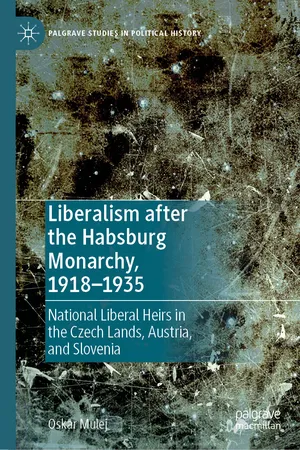
eBook - ePub
Liberalism after the Habsburg Monarchy, 1918–1935
National Liberal Heirs in the Czech Lands, Austria, and Slovenia
- English
- ePUB (mobile friendly)
- Available on iOS & Android
eBook - ePub
Liberalism after the Habsburg Monarchy, 1918–1935
National Liberal Heirs in the Czech Lands, Austria, and Slovenia
About this book
Information
Table of contents
- Cover
- Front Matter
- 1. What Kind of Liberalism Is This Book After?
- 2. From National Liberals Toward Their Heirs: Developmental Patterns in Central European Liberal Party Traditions, 1867–1918
- 3. Semantics of Liberalism: What Did It Mean to Be “Liberal” in Interwar Czech, Austrian and Slovene Contexts?
- 4. “National Liberal Heirs” as Region-Specific Type of Political Party
- 5. “National Liberals” Devoid of Liberalism? Nationalist Conceptions and Rhetoric—Continuities and Change
- 6. Limited Government vs. the “New Order”
- 7. A Glimpse Beyond Party Politics
- Back Matter
Trusted by 375,005 students
Access to over 1.5 million titles for a fair monthly price.
Study more efficiently using our study tools.
Frequently asked questions
Yes, you can cancel anytime from the Subscription tab in your account settings on the Perlego website. Your subscription will stay active until the end of your current billing period. Learn how to cancel your subscription
No, books cannot be downloaded as external files, such as PDFs, for use outside of Perlego. However, you can download books within the Perlego app for offline reading on mobile or tablet. Learn how to download books offline
Perlego offers two plans: Essential and Complete
- Essential is ideal for learners and professionals who enjoy exploring a wide range of subjects. Access the Essential Library with 800,000+ trusted titles and best-sellers across business, personal growth, and the humanities. Includes unlimited reading time and Standard Read Aloud voice.
- Complete: Perfect for advanced learners and researchers needing full, unrestricted access. Unlock 1.5M+ books across hundreds of subjects, including academic and specialized titles. The Complete Plan also includes advanced features like Premium Read Aloud and Research Assistant.
We are an online textbook subscription service, where you can get access to an entire online library for less than the price of a single book per month. With over 1.5 million books across 990+ topics, we’ve got you covered! Learn about our mission
Look out for the read-aloud symbol on your next book to see if you can listen to it. The read-aloud tool reads text aloud for you, highlighting the text as it is being read. You can pause it, speed it up and slow it down. Learn more about Read Aloud
Yes! You can use the Perlego app on both iOS and Android devices to read anytime, anywhere — even offline. Perfect for commutes or when you’re on the go.
Please note we cannot support devices running on iOS 13 and Android 7 or earlier. Learn more about using the app
Please note we cannot support devices running on iOS 13 and Android 7 or earlier. Learn more about using the app
Yes, you can access Liberalism after the Habsburg Monarchy, 1918–1935 by Oskar Mulej in PDF and/or ePUB format, as well as other popular books in History & European History. We have over 1.5 million books available in our catalogue for you to explore.