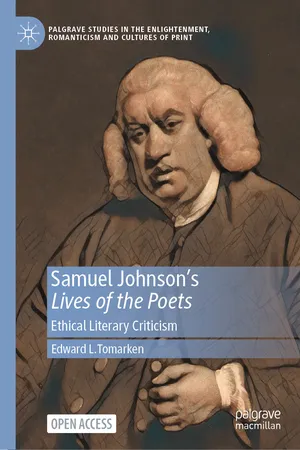
This open access book seeks to explain how the literary commentary of the Lives of the Poets speaks to us today because of its ethical goals. Edward Tomarken elucidates this element of Johnson's literary criticism by using Ralph Cohen's genre method, the topic of Chapter One, "Why Genre". Chapters two to five address the most prevalent genres of the Lives: tragedy, metaphysical poetry, the epic, the pastoral elegy, and the mock epic. Chapter six considers the rise of literary criticism as a genre. Chapter Seven demonstrates how ethical genre criticism relates literature to life. And the final chapter explains why, although Johnson considers 'moral' and 'ethical' as nearly interchangeable terms, Tomarken prefers 'ethical' because it relates genre criticism to present problems in literary and non-literary worlds.
- English
- ePUB (mobile friendly)
- Available on iOS & Android
eBook - ePub
About this book
Information
Table of contents
- Cover
- Front Matter
- 1. Why Genre
- 2. A Literary-Critical Tragedy: The Interpretive Turn in the Life of Savage
- 3. Metaphysical Poetry and Pastoral: Genre in Relation to Value Judgements and History
- 4. Genre Combination and Interpretation Johnson on Paradise Lost
- 5. Genre and Periodization: Macro- and Micro-history in the Life of Garth
- 6. The Rise of Literary Criticism as a Genre
- 7. Life and Literature
- 8. Conclusion: Ethical Value Judgements
- Back Matter
Trusted by 375,005 students
Access to over 1.5 million titles for a fair monthly price.
Study more efficiently using our study tools.
Frequently asked questions
Yes, you can cancel anytime from the Subscription tab in your account settings on the Perlego website. Your subscription will stay active until the end of your current billing period. Learn how to cancel your subscription
No, books cannot be downloaded as external files, such as PDFs, for use outside of Perlego. However, you can download books within the Perlego app for offline reading on mobile or tablet. Learn how to download books offline
Perlego offers two plans: Essential and Complete
- Essential is ideal for learners and professionals who enjoy exploring a wide range of subjects. Access the Essential Library with 800,000+ trusted titles and best-sellers across business, personal growth, and the humanities. Includes unlimited reading time and Standard Read Aloud voice.
- Complete: Perfect for advanced learners and researchers needing full, unrestricted access. Unlock 1.5M+ books across hundreds of subjects, including academic and specialized titles. The Complete Plan also includes advanced features like Premium Read Aloud and Research Assistant.
We are an online textbook subscription service, where you can get access to an entire online library for less than the price of a single book per month. With over 1.5 million books across 990+ topics, we’ve got you covered! Learn about our mission
Look out for the read-aloud symbol on your next book to see if you can listen to it. The read-aloud tool reads text aloud for you, highlighting the text as it is being read. You can pause it, speed it up and slow it down. Learn more about Read Aloud
Yes! You can use the Perlego app on both iOS and Android devices to read anytime, anywhere — even offline. Perfect for commutes or when you’re on the go.
Please note we cannot support devices running on iOS 13 and Android 7 or earlier. Learn more about using the app
Please note we cannot support devices running on iOS 13 and Android 7 or earlier. Learn more about using the app
Yes, you can access Samuel Johnson's Lives of the Poets by Edward L. Tomarken in PDF and/or ePUB format, as well as other popular books in Literature & Literary Criticism. We have over 1.5 million books available in our catalogue for you to explore.