This book offers a groundbreaking exploration of Galileo Galilei's engagement with the Almagest, Claudius Ptolemy's second-century scientific work on the motions of stars and planetary paths. Contrary to the belief that Galileo had little interest in Ptolemaic astronomy, the author investigates whether Ptolemy influenced Galileo's shift to Copernicanism, the theory that Earth and all other planets revolve around the Sun. This inquiry is pursued through a detailed examination of Galileo's early writings on motion, namely the so-called De motu antiquiora (c. 1589–1592). By contextualizing Galileo's initial reception of Ptolemy, the book reveals a fascinating historical backdrop, highlighting how the Almagest was intended to be read and studied in Galileo's milieu during the last decades of the sixteenth century. The author challenges the conventional 'Ptolemaic-Aristotelian' label by showing that early Galileo adhered to a Ptolemaic, yet non-Aristotelian, cosmology supported by an Archimedean-like rationale. Additionally, the book underscores the often-overlooked impact of Theon of Alexandria's commentary on the Almagest in the sixteenth- and seventeenth-century reception of Ptolemy, suggesting it as one of Galileo's potential sources. Offering valuable insights for historians of science and early modern astronomy, this book illuminates Galileo's intricate relationship with astronomical and philosophical ideas, emphasizing the need to re-examine his intellectual journey within a nuanced historical framework.
eBook - ePub
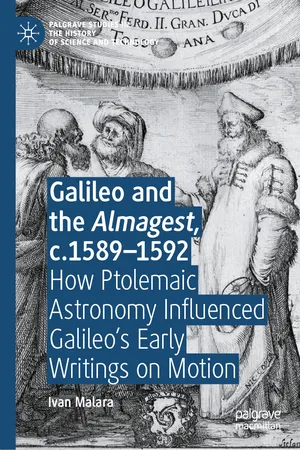
Galileo and the Almagest, c.1589–1592
How Ptolemaic Astronomy Influenced Galileo’s Early Writings on Motion
- English
- ePUB (mobile friendly)
- Available on iOS & Android
eBook - ePub
Galileo and the Almagest, c.1589–1592
How Ptolemaic Astronomy Influenced Galileo’s Early Writings on Motion
About this book
Information
Table of contents
- Cover
- Front Matter
- 1. Introduction
- 2. Why a Commentary?
- 3. Disentangling the Ptolemaic from the Aristotelian
- 4. Galileo as a Commentator on Almagest I.3
- 5. Concluding Remarks
- Back Matter
Trusted by 375,005 students
Access to over 1.5 million titles for a fair monthly price.
Study more efficiently using our study tools.
Frequently asked questions
Yes, you can cancel anytime from the Subscription tab in your account settings on the Perlego website. Your subscription will stay active until the end of your current billing period. Learn how to cancel your subscription
No, books cannot be downloaded as external files, such as PDFs, for use outside of Perlego. However, you can download books within the Perlego app for offline reading on mobile or tablet. Learn how to download books offline
Perlego offers two plans: Essential and Complete
- Essential is ideal for learners and professionals who enjoy exploring a wide range of subjects. Access the Essential Library with 800,000+ trusted titles and best-sellers across business, personal growth, and the humanities. Includes unlimited reading time and Standard Read Aloud voice.
- Complete: Perfect for advanced learners and researchers needing full, unrestricted access. Unlock 1.5M+ books across hundreds of subjects, including academic and specialized titles. The Complete Plan also includes advanced features like Premium Read Aloud and Research Assistant.
We are an online textbook subscription service, where you can get access to an entire online library for less than the price of a single book per month. With over 1.5 million books across 990+ topics, we’ve got you covered! Learn about our mission
Look out for the read-aloud symbol on your next book to see if you can listen to it. The read-aloud tool reads text aloud for you, highlighting the text as it is being read. You can pause it, speed it up and slow it down. Learn more about Read Aloud
Yes! You can use the Perlego app on both iOS and Android devices to read anytime, anywhere — even offline. Perfect for commutes or when you’re on the go.
Please note we cannot support devices running on iOS 13 and Android 7 or earlier. Learn more about using the app
Please note we cannot support devices running on iOS 13 and Android 7 or earlier. Learn more about using the app
Yes, you can access Galileo and the Almagest, c.1589–1592 by Ivan Malara in PDF and/or ePUB format, as well as other popular books in History & Ancient History. We have over 1.5 million books available in our catalogue for you to explore.