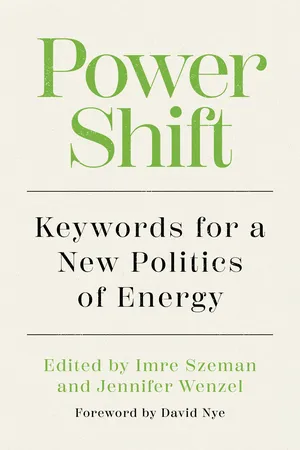
Power Shift traces recent social and cultural shifts in how we understand and imagine energy, the environment, and the challenges of global warming. Across the globe, the need to transition to renewables has become the guiding reality of our energy present and future, despite continuing resistance to change. But what does this moment of energy transition look like for those struggling to make it happen in a way that benefits every individual and all communities?
Featuring brief essays on 101 key terms by scholars, artists, and activists from around the world and across disciplines, Power Shift offers an expansive, kaleidoscopic guide to the history of petromodernity, recent technological and social developments, and pathways to new energy futures. The book offers new insights into the emergent politics of energy, contrasting today's environmental and climate movements with the geopolitical contests of the Cold War era. It explores the still unfolding story of energy transition by focusing on the ongoing struggles of communities and individuals against decisions made by corporations, governments, and international organizations.
- English
- ePUB (mobile friendly)
- Available on iOS & Android
eBook - ePub
About this book
Information
Print ISBN
9781959000495
9781959000518
Subtopic
EcologyTable of contents
- Cover
- Title Page
- Copyright
- Contents
- Foreword
- How to Use This Book
- Introduction
- 2040: What genre will the future be?
- Abandoned: Who is tending to the present?
- Action: What becomes possible when climate action fails?
- Africa: Energy for whom and at what cost?
- Air Conditioning: Has air conditioning become a technology of citizenship?
- Airplane: Why might we still need to fly?
- Alberta: How many nuclear bombs does it take to develop an oil field?
- Animals: How do animals organize?
- Art: How are art and energy related?
- Autonomy: Why do we want energy autonomy?
- Bankrupt: Is bankruptcy the crisis we need?
- Battery: Can batteries foster a radically just energy transition?
- Behavior: Why do appeals to values usually fail to change behavior?
- Black: What are the Black politics of energy?
- Blockade: Why are blockades an essential form of climate action?
- Carbon Management: Is carbon management a moral imperative or a moral hazard?
- Civil Disobedience: What rules must be broken to build a better world?
- Class: Why is climate change a class issue?
- Clean: What does clean energy really mean?
- Commons: What forms of governance could solve the tragedy of the commons?
- Communication: What are effective strategies for climate communication?
- Community: Is it still possible to trust other people?
- Coronavirus: What does the coronavirus reveal about the politics of climate crisis?
- Corporation: Will an energy transition help fossil fuel companies?
- Cuba: What can Cuba teach us about climate action?
- Cycling: Is cycling a solution?
- Decolonization: What can OPEC teach us about the link between energy and decolonization?
- Degrowth: Is degrowth inevitable?
- Democracy: To save the planet, do we need more democracy, or less?
- Design: What does design make possible?
- Development: Can development be green?
- Digital: How does the digital reshape the material realm?
- Documentary: Why is uncertainty useful?
- Economy: Is economic expertise important?
- Education: How should energy educators respond to youth climate activism?
- Electricity: How does electricity organize society?
- Evidence: How is climate evidence used?
- Expert: What counts as effective climate expertise?
- Extinction: Is there a relation between energy and extinction?
- Family: What is the environmental future of the family?
- Farm: Whose muscles power our food system?
- Finance: Can we create an economy based on care?
- Fire/Bushfire: What can we learn from fire?
- Gaslighting: How has gaslighting circumscribed our environmental imagination?
- Gender: Why is gender important to energy transition?
- Geoengineering: Is geoengineering inevitable?
- Globalization: How does energy matter to globalization?
- Green New Deal: Will the Green New Deal save us from extinction?
- Greta: Why is intersectional agility Greta Thunberg’s rhetorical superpower?
- Habit: What kinds of friction can disrupt the status quo?
- India: Can there be a just transition in India?
- Indigenous: How are Indigenous and extraction related?
- Indigenous Activism: What is the power of radical care?
- Industrial Revolution: What does a focus on jobs mean for energy transition?
- Ipcc: What can the IPCC tell us about the relationship between knowledge and action?
- Japan: Why do fears of energy scarcity obstruct energy transition?
- Justice: What kind of justice is energy justice?
- Keep It in the Ground: How can we build momentum to keep fossil fuels in the ground?
- Law: How can we change the law to address the climate crisis?
- Lifestyle: Are lifestyle changes a waste of time?
- Local: How do local climate politics work best?
- Mining: Why are the ways that we imagine mining important?
- Music: How are listening and energy related?
- Nationalism: What is the impact of transition on nationalism?
- Natural Gas: Can natural gas be made visible, or viable?
- Neoextractivism: What comes after neoextractivism?
- Net Zero: Do we really want to live in a net-zero world?
- Nonlinear: Can nonlinear imaginative practices help us survive nonlinear catastrophes?
- Normal: What will be normal after fossil fuels?
- North Dakota: How does oil extraction reshape space and time?
- Online: When we are online, what lines are we on?
- Organize: Can the master’s tools dismantle the master’s house?
- Paris Agreement: Does the Paris Agreement still matter?
- Permafrost: What do you do when the ground starts to melt beneath your feet?
- Pipeline: Why is opposition to pipelines important?
- Planet: What happens to politics on an increasingly unlivable planet?
- Populism: What can energy politics learn from populism?
- Protest: Why is protection more important than protest in Indigenous struggles?
- Renewable: What do renewables renew?
- Resource: Can waste serve as a resource for energy transition?
- Retrofit: What does it mean to breathe life into buildings?
- Sabotage: Can sabotage ever be more than a romantic gesture?
- Scale: What if scale were about equity rather than magnitude?
- Scales: What can the human voice tell us about the scale of climate change?
- Scenario Planning: Is the future a waste of time?
- Science: Do scientists believe that science matters?
- Settler Colonialism: How can modern energy systems be Indigenized?
- Shipping: What would actual free shipping look like?
- Solar Farm: Can solar farms foster energy justice, instead of obstructing it?
- Solidarity: How can solidarity catalyze energy democracy?
- Sport: Can sport be untangled from oil?
- Storytelling: What can storytelling really do?
- Sustainability: Does sustainability’s popularity indicate the failure of environmentalism?
- Trans: What is trans- about transition?
- Transitions: If transition is inevitable, will it be just?
- Treaty: How can treaties help states transition away from fossil fuels?
- Vegan: What does transition look like on your plate?
- Waste: What is at stake in using waste for energy?
- Water: How can microbe metabolism foster sustainable infrastructures?
- Wind: What color is the wind?
- Youth: Why is youth culture indispensable to energy transition?
- Acknowledgments
- Contributors
- Alternative Index
- Index
- Back Cover
Trusted by 375,005 students
Access to over 1.5 million titles for a fair monthly price.
Study more efficiently using our study tools.
Frequently asked questions
Yes, you can cancel anytime from the Subscription tab in your account settings on the Perlego website. Your subscription will stay active until the end of your current billing period. Learn how to cancel your subscription
No, books cannot be downloaded as external files, such as PDFs, for use outside of Perlego. However, you can download books within the Perlego app for offline reading on mobile or tablet. Learn how to download books offline
Perlego offers two plans: Essential and Complete
- Essential is ideal for learners and professionals who enjoy exploring a wide range of subjects. Access the Essential Library with 800,000+ trusted titles and best-sellers across business, personal growth, and the humanities. Includes unlimited reading time and Standard Read Aloud voice.
- Complete: Perfect for advanced learners and researchers needing full, unrestricted access. Unlock 1.5M+ books across hundreds of subjects, including academic and specialized titles. The Complete Plan also includes advanced features like Premium Read Aloud and Research Assistant.
We are an online textbook subscription service, where you can get access to an entire online library for less than the price of a single book per month. With over 1.5 million books across 990+ topics, we’ve got you covered! Learn about our mission
Look out for the read-aloud symbol on your next book to see if you can listen to it. The read-aloud tool reads text aloud for you, highlighting the text as it is being read. You can pause it, speed it up and slow it down. Learn more about Read Aloud
Yes! You can use the Perlego app on both iOS and Android devices to read anytime, anywhere — even offline. Perfect for commutes or when you’re on the go.
Please note we cannot support devices running on iOS 13 and Android 7 or earlier. Learn more about using the app
Please note we cannot support devices running on iOS 13 and Android 7 or earlier. Learn more about using the app
Yes, you can access Power Shift by Imre Szeman,Jennifer Wenzel in PDF and/or ePUB format. We have over 1.5 million books available in our catalogue for you to explore.