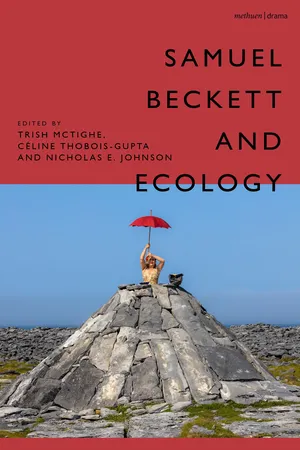
This is the first full-length book to investigate Samuel Beckett's work through contemporary ecological thinking, offering a wide range of artistic and scholarly responses to the ecological crises provoked, mediated or challenged by Beckett's work.
Beckett was not an environmental artist, but his oeuvre, poised between forms of precarity and hope, is a rich territory for the exploration of the most pressing issues of our time: the rift between the human species, its technological and economic advancement and the ecologies that sustain it all.
In recent years, Beckett's name, aphorisms and work have been invoked relative to environmental catastrophe, helping stimulate debates on ecology, the arts and the ecosystemic place of the human. The volume reflects on ecology as a productive term, as well as the varied practices and narratives in Beckettian intermedial ecologies. While some authors offer new insights into the connections between Beckett and the Anthropocene across translation, adaptation, performance and the visual arts, others also explore the potential of Happy Days (1961) for ecological thought and the role it has taken in recent ecodramaturgical experiments in the theatre. Woven throughout the volume are short bursts of writing, 'coups de gong', which testify to the variety of Beckett-inspired local responses to global climate instability.
- English
- ePUB (mobile friendly)
- Available on iOS & Android
eBook - ePub
Samuel Beckett and Ecology
About this book
Information
Table of contents
- Cover
- Half-Title Page
- Series Page
- Title Page
- Contents
- List of Illustrations
- Notes on Contributors
- Acknowledgements
- Introduction: ‘All this, when will all this have been … just play?’: Situating Beckett and Ecology
- Part 1 ‘The tree is pulled up and disappears in flies’ – Beckettian Ecologies: Epistemologies, Practices, Discourses
- 1 Samuel Beckett’s Theatre and Dark Ecology
- 2 A Dusty Coup from Argentina
- 3 ‘a specialist of neither more nor less importance than the other specialists involved’:
- 4 Cultural and Linguistic Ecologies: Reading Samuel Beckett in Saudi Arabia
- 5 Translating the Ecological Aspects of Beckett’s Drama into Japanese Theatre
- 6 The Translator as Cultural Mediator:
- 7 Samuel Beckett and Televisual Ecosystems: Dramas of the Vast Wasteland
- 8 Workshopping Beckett in Algeria for the Streets of the World
- Part 2 ‘And to think all that is organic waste!’ – Beckett and the Anthropocene / Beckett in the Anthropocene
- 9 Retrofitting Beckett: John Millington Synge, Druid Theatre and Waiting for Godot on Inis Meáin
- 10 ‘Old Wall’: Reading Endgame’s Pictographs with Australian Indigenous Rock Art
- 11 A Tree and a Stone in Waiting for Godot: Precarity in Beckett
- 12 Beckett to Gather the World?
- 13 Terra Incognita: Beckett’s Anthropo(s)cene in Contemporary Art
- 14 Rastreadoras Del Fuerte and the Unearthing of their Lost and Loved Ones: Beckettian Ecologies and the More-than-Human Eye
- 15 ‘Toute cette question du climat’: The More-than-Human World in Beckett’s Trilogy
- 16 Ecological Crises and Local Manifestations in Godot Aaya Kya?
- Part 3 ‘The earth is really tight today’: The Ecodramaturgy of Happy Days
- 17 Samuel Beckett and Terrain Vague: A Case Study on Happy Days
- 18 ‘Shall I myself not melt perhaps in the end, or burn …’: Samuel Beckett’s Happy Days in Times of Ecological Turmoil
- 19 Happy Days in Los Angeles: An Ecology of the Unhoused
- 20 Beckett’s Haunting of the Landscape and Language of Ireland
- 21 The Ecoscenography of Beckett sa Chreig: Laethanta Sona: From Imagination to Making to Monumentalizing
- 22 Hybrid Bodies: A Hydro- and Ecofeminist Reading of Company SJ’s Beckett sa Chreig: Laethanta Sona
- 23 Conclusion: Coup de pousse
- Bibliography
- Index
- Copyright
Trusted by 375,005 students
Access to over 1.5 million titles for a fair monthly price.
Study more efficiently using our study tools.
Frequently asked questions
Yes, you can cancel anytime from the Subscription tab in your account settings on the Perlego website. Your subscription will stay active until the end of your current billing period. Learn how to cancel your subscription
No, books cannot be downloaded as external files, such as PDFs, for use outside of Perlego. However, you can download books within the Perlego app for offline reading on mobile or tablet. Learn how to download books offline
Perlego offers two plans: Essential and Complete
- Essential is ideal for learners and professionals who enjoy exploring a wide range of subjects. Access the Essential Library with 800,000+ trusted titles and best-sellers across business, personal growth, and the humanities. Includes unlimited reading time and Standard Read Aloud voice.
- Complete: Perfect for advanced learners and researchers needing full, unrestricted access. Unlock 1.5M+ books across hundreds of subjects, including academic and specialized titles. The Complete Plan also includes advanced features like Premium Read Aloud and Research Assistant.
We are an online textbook subscription service, where you can get access to an entire online library for less than the price of a single book per month. With over 1.5 million books across 990+ topics, we’ve got you covered! Learn about our mission
Look out for the read-aloud symbol on your next book to see if you can listen to it. The read-aloud tool reads text aloud for you, highlighting the text as it is being read. You can pause it, speed it up and slow it down. Learn more about Read Aloud
Yes! You can use the Perlego app on both iOS and Android devices to read anytime, anywhere — even offline. Perfect for commutes or when you’re on the go.
Please note we cannot support devices running on iOS 13 and Android 7 or earlier. Learn more about using the app
Please note we cannot support devices running on iOS 13 and Android 7 or earlier. Learn more about using the app
Yes, you can access Samuel Beckett and Ecology by Nicholas E. Johnson,Trish McTighe,Céline Thobois-Gupta in PDF and/or ePUB format, as well as other popular books in Literature & Literary Criticism in Drama. We have over 1.5 million books available in our catalogue for you to explore.