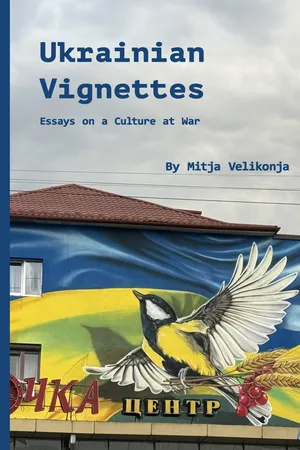
Ukraine at war in a unique chronicle that examines expressions of the Ukrainian people on the street, in graffiti, murals, and quotidian life.
On his travels to wartime Ukraine, where even the feeling of relaxation is dangerous, Mitja Velikonja observed thousands of images of the culture of war in what he saw on the street and everyday life, from bakeries, road signs, billboards and murals, to unsanctioned graffiti. This street iconography, invested with a patriotic vocabulary, was also informed by his conversations with people, the scenes of destruction, misery, and above all, the strong will to resist, from which everyday heroism emerges.
The author went twice to the war zones of Ukraine and took more than 3,000 photographs of the street iconography of the state of war. Although all nationalists are equally foreign to him, when he talks to people, he asks himself how he would feel in their shoes, how he would react. When war creeps up to our front door, it affects everyone: leftists and right-wingers, nationalists and pacifists, patriots and those who don't care what flag they live under.
"Thus, while driving or waiting anywhere, I took a small test: how long does it take to come across images of war, warrior iconography, vocabulary of emphatic patriotism, the sound of a national awakening song, footage from battlefields. Mostly it was a matter of seconds."
Through these pieces of the culture and a people holding themselves together against an invader through a self-defensive nationalism, Velikonja sees that nationalism hides poverty — the more severe, the bigger the flags. In Ukrainian Vignettes, Velikonja compiles the images, words, impressions and voices of everyday life in war, to help us understand how clearly politics and ideology are displayed directly on the street. His philosophical approach of essays as vignettes allows him to have a critical eye even as he struggles to understand tragic events, and despite his affection for those closest to him. The author remains critical of both sides in his analysis, despite his sympathy for those closer to him.