In early 2022, protests rocked Kazakhstan. Initially peaceful demonstrations soon turned violent after brutal government crackdowns, leaving at least 238 dead during ‘Bloody January’. But despite fears that Kazakhstan might split along ethno-linguistic lines, ethnicity played little role in the unrest: deep socio-economic problems and anti-regime grievances pushed protestors onto the streets.
More than thirty years since declaring independence, multi-ethnic Kazakhstan is still grappling with its nationhood. While secessionist movements provoked ethnic conflicts, territorial disputes and civil wars across the former USSR, Kazakhstan developed a relatively stable inter-ethnic policy, and predicted Russo–Kazakh tensions largely failed to materialise. Analysing the multiple narratives, actors and often contradictory feelings of national belonging in post-1991 Kazakhstan, Diana T. Kudaibergen investigates why Kazakhstani nation-building is so unusual. Has Kazakh society found a solution to divisive ethno-nationalism? How have ordinary citizens shaped their identities? And how will Moscow’s 2022 invasion of Ukraine, which has led to widespread Russian immigration into Kazakhstan, impact inter-ethnic dynamics?
Kudaibergen builds on unpublished archival materials and hundreds of interviews to explore the ‘hybrid’ nature of nation-building in this complex country. While regime elites promote a top-down civic identity, domestic unrest and pluralistic opposition movements are once again transforming the category ‘Kazakhstani’.
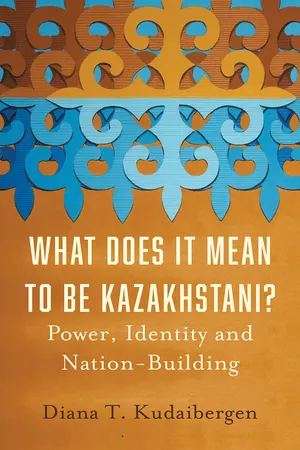
eBook - ePub
What Does It Mean to Be Kazakhstani?
Power, Identity and Nation-Building
- English
- ePUB (mobile friendly)
- Available on iOS & Android
eBook - ePub
About this book
Information
Table of contents
- Cover
- Half Title
- Title
- Copyright
- Contents
- List of Figures and Tables
- Note on Transliteration and Translation
- Preface
- Introduction
- 1. Kazakhstan: Its History and Its Vocabulary
- 2. The December 1986 Protests in Alma-Ata
- 3. Who are the Fourth Zhuz?: On Russians and Kazakhstani Multiculturalism
- 4. Mankurts versus Mambets (The ‘M’-Word): On Divisions and Hybrid Identities
- 5. ‘We are the Ordinary People’: The January 2022 Protests in Kazakhstan
- 6. The Long Post-January: Forming Civicness
- Afterword: Decolonising Kazakhstan Starts with De-Nazarbayefication
- Notes
- Bibliography
- Index
- Back Cover
Trusted by 375,005 students
Access to over 1.5 million titles for a fair monthly price.
Study more efficiently using our study tools.
Frequently asked questions
Yes, you can cancel anytime from the Subscription tab in your account settings on the Perlego website. Your subscription will stay active until the end of your current billing period. Learn how to cancel your subscription
No, books cannot be downloaded as external files, such as PDFs, for use outside of Perlego. However, you can download books within the Perlego app for offline reading on mobile or tablet. Learn how to download books offline
Perlego offers two plans: Essential and Complete
- Essential is ideal for learners and professionals who enjoy exploring a wide range of subjects. Access the Essential Library with 800,000+ trusted titles and best-sellers across business, personal growth, and the humanities. Includes unlimited reading time and Standard Read Aloud voice.
- Complete: Perfect for advanced learners and researchers needing full, unrestricted access. Unlock 1.5M+ books across hundreds of subjects, including academic and specialized titles. The Complete Plan also includes advanced features like Premium Read Aloud and Research Assistant.
We are an online textbook subscription service, where you can get access to an entire online library for less than the price of a single book per month. With over 1.5 million books across 990+ topics, we’ve got you covered! Learn about our mission
Look out for the read-aloud symbol on your next book to see if you can listen to it. The read-aloud tool reads text aloud for you, highlighting the text as it is being read. You can pause it, speed it up and slow it down. Learn more about Read Aloud
Yes! You can use the Perlego app on both iOS and Android devices to read anytime, anywhere — even offline. Perfect for commutes or when you’re on the go.
Please note we cannot support devices running on iOS 13 and Android 7 or earlier. Learn more about using the app
Please note we cannot support devices running on iOS 13 and Android 7 or earlier. Learn more about using the app
Yes, you can access What Does It Mean to Be Kazakhstani? by Diana T. Kudaibergen in PDF and/or ePUB format, as well as other popular books in Social Sciences & Anthropology. We have over 1.5 million books available in our catalogue for you to explore.