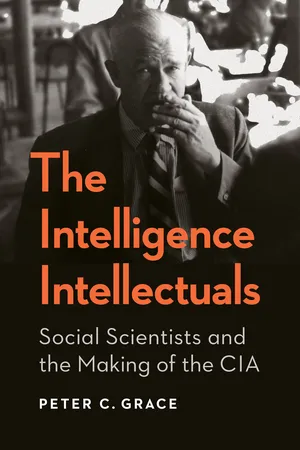
The Intelligence Intellectuals
Social Scientists and the Making of the CIA
- English
- ePUB (mobile friendly)
- Available on iOS & Android
About this book
The untold story of how America's brightest academic minds revolutionized intelligence analysis at the CIA
In the early days of the Cold War, the United States faced a crisis in intelligence analysis. A series of intelligence failures in 1949 and 1950, including the failure to warn about the North Korean invasion of South Korea, made it clear that gut instinct and traditional practices were no longer sufficient for intelligence analysis in the nuclear age. The new director of the Central Intelligence Agency, Walter Bedell Smith, had a mandate to reform it.
Based on new archival research in declassified documents and the participants' personal papers, The Intelligence Intellectuals reveals the neglected history of how America's brightest academic minds were recruited by the CIA to revolutionize intelligence analysis during this critical period. Peter C. Grace describes how the scientifically sound analysis methods that they introduced significantly helped the United States gain an advantage in the Cold War, and these new analysts legitimized the role of the recently created CIA in the national security community. Grace demonstrates how these professors—such as William Langer from Harvard, Sherman Kent from Yale, and Max Millikan from MIT—developed systematic approaches to intelligence analysis that shaped the CIA's methodology for decades to come.
Readers interested in the history of the Cold War and in intelligence, scholars of intelligence studies, Cold War historians, and intelligence practitioners seeking to understand their craft's foundations will all value this insightful history about the place of social science in national security.
Frequently asked questions
- Essential is ideal for learners and professionals who enjoy exploring a wide range of subjects. Access the Essential Library with 800,000+ trusted titles and best-sellers across business, personal growth, and the humanities. Includes unlimited reading time and Standard Read Aloud voice.
- Complete: Perfect for advanced learners and researchers needing full, unrestricted access. Unlock 1.4M+ books across hundreds of subjects, including academic and specialized titles. The Complete Plan also includes advanced features like Premium Read Aloud and Research Assistant.
Please note we cannot support devices running on iOS 13 and Android 7 or earlier. Learn more about using the app.
Information
Table of contents
- Cover
- Title Page
- Copyright
- Contents
- List of Illustrations
- Note on Archival Documentation
- Acknowledgments
- List of Abbreviations
- Introduction: Clear and Prescient Danger
- 1. The Promise of Social Science Before 1945
- 2. A Struggle for Existence, 1946–50
- 3. The Failure of the Office of Reports and Estimates, 1947–50
- 4. The Intel Intellectual as Administrator and the Reforms of 1950–53
- 5. The Intel Intellectuals and the Emergence of a Strategic Intelligence Discipline
- 6. The National Intelligence Estimates of Soviet Strategic Intentions and Capabilities
- 7. Soviet Economic Capabilities and the Inventory of Ignorance
- 8. The Princeton Consultants
- 9. Kent’s “Theory of the Fuck Up of the Imponderables” Conclusion: The Intel Intellectuals as Agents of Change
- Appendix: National Intelligence Estimate: Probable Soviet Courses of Action to Mid-1952
- Bibliography
- Index
- About the Author