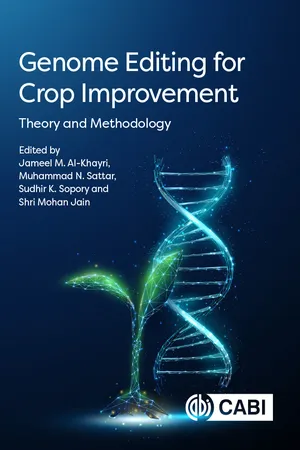
Genome editing offers a powerful tool to significantly accelerate crop-breeding programs in order to develop new and improved varieties. It allows precise modification of an organism's DNA sequence, often by creating targeted double-strand breaks at specific locations. The CRISPR-Cas system has emerged as the preferred method of gene editing and offers a powerful technology for crop improvement. The use of CRISPR in plant research has led to significant improvements in crop performance in terms of yield, nutrition, stress tolerance and resistance against agricultural pests and diseases. This book explores the cutting-edge field of genome editing, its applications and potential to revolutionize the genetic improvement of crops. It includes: Foundational concepts and historical context of genome editing (GE).Structure and mechanisms of various genome editing techniques.Application of GE for trait improvements in plants.Regulatory, biosafety, and ethical considerations.This is a valuable resource for researchers in crop genetic improvement, graduate and postgraduate students in molecular biology and biotechnology programs, and professionals in the field.
eBook - ePub
Genome Editing for Crop Improvement
Theory and Methodology
- English
- ePUB (mobile friendly)
- Available on iOS & Android
eBook - ePub
Genome Editing for Crop Improvement
Theory and Methodology
About this book
Information
Table of contents
- Cover
- Halftitle Page
- Title Page
- Copyright
- Contents
- Contributors
- Preface
- Acknowledgement
- 1 Historical Perspectives of Cutting-edge Genome Editing Techniques
- 2 Classification and Nomenclature of Different Site-specific Nucleases for Genome Editing
- 3 Structure and Mechanism of Zinc-finger Nucleases-mediated Genome Editing in Plants
- 4 Structure and Mechanism of Transcription Activator-like Effector Nuclease-mediated Genome Editing in Plants
- 5 Structure and Mechanism of Clustered Regularly Interspaced Short Palindromic Repeats (CRISPR) CRISPR-associated Nuclease 9 (Cas9)-mediated Genome Editing in Plants
- 6 Multiplex Genome Editing in Plants
- 7 Delivering Genome Editing Reagents into Plants: Agrobacterium- and Non-Agrobacterium-mediated Approaches
- 8 Recent Developments to Accelerate On-target and Minimize Off-target Mutations during Genome Editing in Plants
- 9 Estimation and Quantification Techniques to Analyze Targeted Mutations during Genome Editing
- 10 Application of CRISPR-Cas9 in Agriculture and Forestry
- 11 Application and Prospects of DNA-free Genome Modifications in Crop Plants through Genome Editing
- 12 Plant Genome Editing for Nutritional Improvement
- 13 Genome Editing to Accelerate Biotic Stress Resistance in Crop Plants
- 14 Genome Editing to Improve Abiotic Stress Tolerance in Crop Plants
- 15 Genome Editing for Herbicide Tolerance in Crop Plants
- 16 Genome Editing in Improving Photosynthesis in Crop Plants
- 17 Plant Genome Editing to Explain Metabolic Pathways in Plants
- 18 Regulatory, Biosafety, and Ethical Perspectives of Plant Genome Editing
- Index
Trusted by 375,005 students
Access to over 1.5 million titles for a fair monthly price.
Study more efficiently using our study tools.
Frequently asked questions
Yes, you can cancel anytime from the Subscription tab in your account settings on the Perlego website. Your subscription will stay active until the end of your current billing period. Learn how to cancel your subscription
No, books cannot be downloaded as external files, such as PDFs, for use outside of Perlego. However, you can download books within the Perlego app for offline reading on mobile or tablet. Learn how to download books offline
Perlego offers two plans: Essential and Complete
- Essential is ideal for learners and professionals who enjoy exploring a wide range of subjects. Access the Essential Library with 800,000+ trusted titles and best-sellers across business, personal growth, and the humanities. Includes unlimited reading time and Standard Read Aloud voice.
- Complete: Perfect for advanced learners and researchers needing full, unrestricted access. Unlock 1.5M+ books across hundreds of subjects, including academic and specialized titles. The Complete Plan also includes advanced features like Premium Read Aloud and Research Assistant.
We are an online textbook subscription service, where you can get access to an entire online library for less than the price of a single book per month. With over 1.5 million books across 990+ topics, we’ve got you covered! Learn about our mission
Look out for the read-aloud symbol on your next book to see if you can listen to it. The read-aloud tool reads text aloud for you, highlighting the text as it is being read. You can pause it, speed it up and slow it down. Learn more about Read Aloud
Yes! You can use the Perlego app on both iOS and Android devices to read anytime, anywhere — even offline. Perfect for commutes or when you’re on the go.
Please note we cannot support devices running on iOS 13 and Android 7 or earlier. Learn more about using the app
Please note we cannot support devices running on iOS 13 and Android 7 or earlier. Learn more about using the app
Yes, you can access Genome Editing for Crop Improvement by Jameel M Al-Khayri,Muhammad N Sattar,Sudhir K. Sopory,Shri Mohan Jain in PDF and/or ePUB format, as well as other popular books in Technology & Engineering & Botany. We have over 1.5 million books available in our catalogue for you to explore.