eBook - ePub
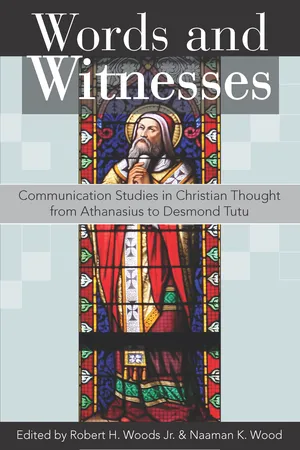
Words and Witnesses
Communication Studies in Christian Thought from Athanasius to Desmond Tutu
- English
- ePUB (mobile friendly)
- Available on iOS & Android
eBook - ePub
Words and Witnesses
Communication Studies in Christian Thought from Athanasius to Desmond Tutu
About this book
How should Christians address specific problems, controversies, and crises in communication today? By looking at influential Christian thinkers throughout history, we can identify wisdom that enriches us today in practical ways.
Words and Witnesses explores various influential Christian thinkers and theologians from across church history in order to expand our contemporary conversations in communication studies and media theory. Individual chapters written by contributing scholars focus on major Christian thinkers, starting with Athanasius, St. Augustine, and John Chrysostom, moving through the Middle Ages to address figures such as Anselm, Nicholas of Cusa, Teresa of Lisieux, and arriving in the present with reflections on the work of John Howard Yoder, C. S. Lewis, Martin Luther King Jr., Abraham Kuyper, and Desmond Tutu, among others.
Each chapter delves into how the contemporary church, and scholars of media, can turn to these influential Christian thinkers as resources for addressing specific problems in communication today. By analyzing church practices, doctrine, and biblical texts this book provides the church with resources and inspiration to communicate in distinctly Christian ways.
Words and Witnesses explores various influential Christian thinkers and theologians from across church history in order to expand our contemporary conversations in communication studies and media theory. Individual chapters written by contributing scholars focus on major Christian thinkers, starting with Athanasius, St. Augustine, and John Chrysostom, moving through the Middle Ages to address figures such as Anselm, Nicholas of Cusa, Teresa of Lisieux, and arriving in the present with reflections on the work of John Howard Yoder, C. S. Lewis, Martin Luther King Jr., Abraham Kuyper, and Desmond Tutu, among others.
Each chapter delves into how the contemporary church, and scholars of media, can turn to these influential Christian thinkers as resources for addressing specific problems in communication today. By analyzing church practices, doctrine, and biblical texts this book provides the church with resources and inspiration to communicate in distinctly Christian ways.
Frequently asked questions
Yes, you can cancel anytime from the Subscription tab in your account settings on the Perlego website. Your subscription will stay active until the end of your current billing period. Learn how to cancel your subscription.
No, books cannot be downloaded as external files, such as PDFs, for use outside of Perlego. However, you can download books within the Perlego app for offline reading on mobile or tablet. Learn more here.
Perlego offers two plans: Essential and Complete
- Essential is ideal for learners and professionals who enjoy exploring a wide range of subjects. Access the Essential Library with 800,000+ trusted titles and best-sellers across business, personal growth, and the humanities. Includes unlimited reading time and Standard Read Aloud voice.
- Complete: Perfect for advanced learners and researchers needing full, unrestricted access. Unlock 1.4M+ books across hundreds of subjects, including academic and specialized titles. The Complete Plan also includes advanced features like Premium Read Aloud and Research Assistant.
We are an online textbook subscription service, where you can get access to an entire online library for less than the price of a single book per month. With over 1 million books across 1000+ topics, we’ve got you covered! Learn more here.
Look out for the read-aloud symbol on your next book to see if you can listen to it. The read-aloud tool reads text aloud for you, highlighting the text as it is being read. You can pause it, speed it up and slow it down. Learn more here.
Yes! You can use the Perlego app on both iOS or Android devices to read anytime, anywhere — even offline. Perfect for commutes or when you’re on the go.
Please note we cannot support devices running on iOS 13 and Android 7 or earlier. Learn more about using the app.
Please note we cannot support devices running on iOS 13 and Android 7 or earlier. Learn more about using the app.
Yes, you can access Words and Witnesses by Naaman K. Wood, Robert H. Woods, Jr. in PDF and/or ePUB format, as well as other popular books in Theology & Religion & Communication Studies. We have over one million books available in our catalogue for you to explore.
Information
Topic
Theology & ReligionSubtopic
Communication StudiesTable of contents
- Copyright
- Acknowledgments
- Contributors
- Foreword
- IntroductionCommunication Studies and Christian Thought in Conversation: From Past to Present
- P A R T O N EEarly Church and Medieval Christian Thinkers and Theologians
- CHAPTER 1Justin Martyr: Articulating a “Faithful Witness” in Public and Political Life
- CHAPTER 2Saint Irenaeus of Lyon: Encouraging Patience in Learning and Humility within Christian Community
- CHAPTER 3Saint Athanasius of Alexandria: Communicating Creatively, Clearly, and with a Prophetic Voice to Hostile Audiences
- CHAPTER 4Gregory of Nyssa: Reimagining a Historical Narrative to Help Confront Institutional Oppression
- CHAPTER 5Saint Augustine of Hippo: Embracing the Practical Wisdom of Incarnate Communication in a Digital World
- CHAPTER 6Saint Benedict of Nursia: Learning to Live Well with Others in a World of Contradictions
- CHAPTER 7Saint Anselm of Canterbury: Cultivating Solemnity and Humility by Observing How Words Function
- CHAPTER 8John of Salisbury: Relying on a Tradition of Dialogue and Ethics as a Model of Education for a Post-Christian World
- CHAPTER 9Saint Angela of Foligno: Evangelizing through Kataphatic, or Realistic, Rhetoric
- P A R T T W ORenaissance, Reformation, and Early Modern Christian Thinkers and Theologians
- CHAPTER 10Nicholas of Cusa: Sharing Ordinary Things to Bridge “Knowledge Gaps”
- CHAPTER 11Martin Luther: Avoiding the Use of “Othering” to Construct Christian Self-Identity in a Pluralistic Society
- CHAPTER 12Saint Ignatius of Loyola: Embodying Civility in Contentious Times
- CHAPTER 13Archbishop Thomas Cranmer: Unifying and Reconciling through the Book of Common Prayer
- CHAPTER 14Menno Simons: Engaging Interpersonal Confrontation and Avoidance for Organizational Integrity
- CHAPTER 15John Calvin: Practicing Divine Accommodation to Manifest God’s Love
- CHAPTER 16Margaret Fell: Championing the Feminine Voice for Advocacy and Change
- CHAPTER 17Jeanne-Marie Bouvier de la Motte-Guyon: Nurturing Attentive Silence as a Counterpractice for a Digital Age
- CHAPTER 18John Wesley: Bearing Witness through Divine Gift, Sacred Choice, and Embodied Action
- CHAPTER 19Hans Nielsen Hauge: Offering a Prescription for Social Change
- CHAPTER 20William Carey: Adapting Messages to Audiences as a Redemptive Communication Strategy
- CHAPTER 21Søren Kierkegaard: Using Indirect Communication Strategies to Challenge the Complacent
- CHAPTER 22Alexander Campbell: Crusading for Pacifism and Abolition in a Time of War and Slavery
- CHAPTER 23John Henry Newman: Persuading through a Holistic Rhetoric of Belief
- CHAPTER 24Catherine Booth: Disturbing the Present to Promote Gender Equality
- CHAPTER 25Saint Thérèse of Lisieux: Demonstrating Hospitality to Difficult People in Practical Ways
- CHAPTER 26Walter Rauschenbusch: Providing a Road Map for Social Critique
- CHAPTER 27Abraham Kuyper: Rejecting Approaches That Blur Epistemic, Academic, and Theological Boundaries
- P A R T T H R E EModern and Contemporary Christian Thinkers and Theologians
- CHAPTER 28Charles M. Sheldon: Promoting Accuracy and Advocacy in an Age of Constantly Competing Voices
- CHAPTER 29C. S. Lewis: Constructing Relational Messages to Steal Past Prejudices against Christians
- CHAPTER 30Thomas Merton: Rediscovering Communication as a Message of Love for Communion
- CHAPTER 31Martin Luther King Jr.: Loving Your Enemies by Developing “Agape in the Soul”
- CHAPTER 32Reinhold Niebuhr: Placing Reason and Revelation in Historical Dialogue
- CHAPTER 33Frank Sheed: Initiating Dialogue about Belief
- CHAPTER 34Hans Urs von Balthasar: “Kneeling Rhetoric” in Dark Times
- CHAPTER 35Jacques Ellul: Communicating Wisely with Hospitable Resistance in a Technological World
- CHAPTER 36John Howard Yoder: Advocating Patient Proclamation through the Use of Middle Axioms
- CHAPTER 37Carl F. H. Henry: Indicting Evangelical Inaction on Social Problems
- CHAPTER 38Chiara Lubich: Mediating Unity and Love
- CHAPTER 39Desmond Tutu: Communicating Forgiveness through Ubuntu
- CHAPTER 40Walter Brueggemann: Confronting the Dominant Culture through Prophetic Imagination
- CHAPTER 41Peter Kreeft: Perspective-Taking to Promote Religious Dialogue
- CHAPTER 42James H. Cone: Analyzing Public Symbols to Expose Social Injustices
- CHAPTER 43Stanley Hauerwas: Using Narrative as the Catalyst and Context for Moral Reasoning in Faith Communities
- Endorsements