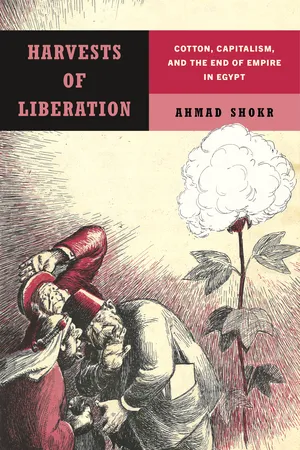
Harvests of Liberation
eBook - ePub

Harvests of Liberation

Cotton, Capitalism, and the End of Empire in Egypt

  1. English
  2. ePUB (mobile friendly)
  3. Available on iOS & Android
eBook - ePub

Harvests of Liberation

Cotton, Capitalism, and the End of Empire in Egypt

About this book

In the first half of the twentieth century, a major change occurred in Egyptian nationalist understandings of imperialism and economic sovereignty. Where once the volatilities of foreign markets and capital were seen as the main threat, over time large landowners and their imperial allies were targeted as the principal obstacles to the country's industrial progress. The perceived locus of imperial domination shifted from the realm of circulation to the realm of production. Harvests of Liberation situates this transformation in the midcentury dynamics of agrarian capitalism in Egypt.

Ahmad Shokr tells a story of decolonization through the lens of cotton, Egypt's prized export. He follows a range of actors—colonial advisors, nationalist leaders, agrarian reformers, merchant-financiers, landowners, and rural workers—whose interactions moved the levers of the cotton trade from institutions that facilitated accumulation on an imperial scale to new sites of control within the nation-state. Amidst depression and war, the transformation of Egypt's cotton economy prompted nationalists to embrace policies of land reform and industrialization and adopt a new conception of history. Ultimately, Shokr argues, these efforts set the stage for the construction of a postcolonial republic under Gamal Abdel Nasser, where national liberation became equated with national development.

Frequently asked questions

Yes, you can cancel anytime from the Subscription tab in your account settings on the Perlego website. Your subscription will stay active until the end of your current billing period. Learn how to cancel your subscription.
At the moment all of our mobile-responsive ePub books are available to download via the app. Most of our PDFs are also available to download and we're working on making the final remaining ones downloadable now. Learn more here.
Perlego offers two plans: Essential and Complete
  • Essential is ideal for learners and professionals who enjoy exploring a wide range of subjects. Access the Essential Library with 800,000+ trusted titles and best-sellers across business, personal growth, and the humanities. Includes unlimited reading time and Standard Read Aloud voice.
  • Complete: Perfect for advanced learners and researchers needing full, unrestricted access. Unlock 1.4M+ books across hundreds of subjects, including academic and specialized titles. The Complete Plan also includes advanced features like Premium Read Aloud and Research Assistant.
Both plans are available with monthly, semester, or annual billing cycles.
We are an online textbook subscription service, where you can get access to an entire online library for less than the price of a single book per month. With over 1 million books across 1000+ topics, we’ve got you covered! Learn more here.
Look out for the read-aloud symbol on your next book to see if you can listen to it. The read-aloud tool reads text aloud for you, highlighting the text as it is being read. You can pause it, speed it up and slow it down. Learn more here.
Yes! You can use the Perlego app on both iOS or Android devices to read anytime, anywhere — even offline. Perfect for commutes or when you’re on the go.
Please note we cannot support devices running on iOS 13 and Android 7 or earlier. Learn more about using the app.
Yes, you can access Harvests of Liberation by Ahmad Shokr in PDF and/or ePUB format, as well as other popular books in History & 20th Century History. We have over one million books available in our catalogue for you to explore.

Table of contents

  1. Cover
  2. Title Page
  3. Copyright
  4. Contents
  5. Acknowledgments
  6. Introduction
  7. One: Anatomy of a Global Plantation
  8. Two: Cotton Nationalism and the Crisis of Empire
  9. Three: Global Depression in the Nile Valley
  10. Four: Rural Reconstruction and the New Peasant
  11. Five: Reimagining Development
  12. Six: Growth Politics and the Officers’ Republic
  13. Epilogue
  14. Notes
  15. Bibliography
  16. Index