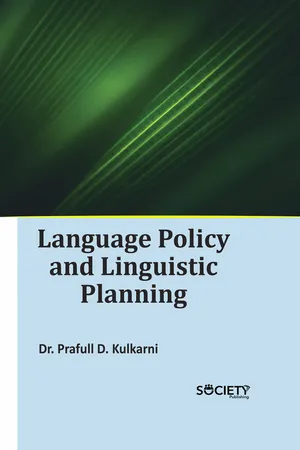
This book, Language Policy and Linguistic Planning, by Dr. Prafull D. Kulkarni, offers a comprehensive exploration of language policy and its planning in academics as well as in administrative circles, which addresses various aspects and strategies involved in managing and developing languages within diverse sociocultural contexts.Modern Language Policy and Linguistic Planning encompasses several key areas, including language standardization, preservation, and education. Standardization efforts focus on creating uniformity in language use, often through developing official grammar, dictionaries, and spelling systems. This is particularly important in multilingual societies, where linguistic diversity can lead to communication barriers. For example, in countries like India and Nigeria, standardization helps unify diverse linguistic communities under a common framework for education and administration.Education policies all around do play a significant role in the development and implementation of the language policy and its planning, as language instructions influence the literacy and cognitive development of the learners. Multilingual education policies, which incorporate local languages alongside global languages, are increasingly being adopted to improve educational outcomes and respect linguistic diversity. Countries like India, Switzerland and Canada, with their multilingual policies, provide models for integrating multiple languages into the educational system.The present book by Dr. Prafull D. Kulkarni is an endeavour to acquaint with readers and scholars with the basic knowledge and in-depth perspectives of learning in the academic as well as the significance of forming the language learning policies in its administrative realms. The author and the publisher of this book will be delighted to contribute more on this topic and address a few more issues relating to the implementation of the policies mentioned herein. We hope that the book is quite useful to the students and scholars of the domain to add to their knowledge and enhance their skills further in the domain.
- 322 pages
- English
- PDF
- Available on iOS & Android
eBook - PDF
Language Policy and Linguistic Planning
About this book
Information
Table of contents
- Cover
- Title Page
- Copyright
- ABOUT THE AUTHOR
- TABLE OF CONTENTS
- List of Figures
- List of Tables
- Preface
- Chapter 1 The Art of Language
- Chapter 2 Language Planning
- Chapter 3 Language Planning for Linguistics
- Chapter 4 Planning for Language Change
- Chapter 5 Sociolinguistics and Language Change
- Chapter 6 The Structural Planning of English Language
- Chapter 7 Socio-Affective Planning for Language Learning
- Chapter 8 Language Variations
- Chapter 9 Language Variations and Education Policy
- Index
- Back Cover
Trusted by 375,005 students
Access to over 1.5 million titles for a fair monthly price.
Study more efficiently using our study tools.
Frequently asked questions
Yes, you can cancel anytime from the Subscription tab in your account settings on the Perlego website. Your subscription will stay active until the end of your current billing period. Learn how to cancel your subscription
No, books cannot be downloaded as external files, such as PDFs, for use outside of Perlego. However, you can download books within the Perlego app for offline reading on mobile or tablet. Learn how to download books offline
Perlego offers two plans: Essential and Complete
- Essential is ideal for learners and professionals who enjoy exploring a wide range of subjects. Access the Essential Library with 800,000+ trusted titles and best-sellers across business, personal growth, and the humanities. Includes unlimited reading time and Standard Read Aloud voice.
- Complete: Perfect for advanced learners and researchers needing full, unrestricted access. Unlock 1.5M+ books across hundreds of subjects, including academic and specialized titles. The Complete Plan also includes advanced features like Premium Read Aloud and Research Assistant.
We are an online textbook subscription service, where you can get access to an entire online library for less than the price of a single book per month. With over 1.5 million books across 990+ topics, we’ve got you covered! Learn about our mission
Look out for the read-aloud symbol on your next book to see if you can listen to it. The read-aloud tool reads text aloud for you, highlighting the text as it is being read. You can pause it, speed it up and slow it down. Learn more about Read Aloud
Yes! You can use the Perlego app on both iOS and Android devices to read anytime, anywhere — even offline. Perfect for commutes or when you’re on the go.
Please note we cannot support devices running on iOS 13 and Android 7 or earlier. Learn more about using the app
Please note we cannot support devices running on iOS 13 and Android 7 or earlier. Learn more about using the app
Yes, you can access Language Policy and Linguistic Planning by Prafull D. Kulkarni in PDF and/or ePUB format, as well as other popular books in Languages & Linguistics & Linguistics. We have over 1.5 million books available in our catalogue for you to explore.