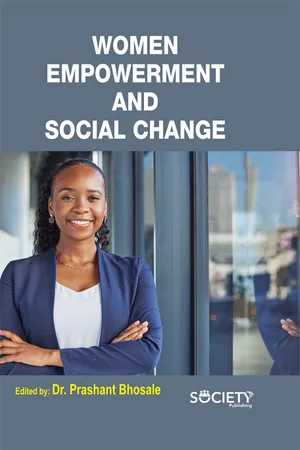
The book explores the multifaceted dimensions of women's empowerment and its critical role in driving social change. It begins with a historical overview of women's rights movements, particularly the suffrage movement, and examines the struggles women faced in the 19th and 20th centuries to secure voting rights, property ownership, and workplace equality. It underscores that despite these achievements, gender inequality persists, with significant issues like the gender pay gap, limited leadership opportunities for women, and the need for more supportive work-life balance policies. Book highlights the powerful influence of gender stereotypes and socialization in shaping societal views of gender roles. It emphasizes how media portrayals, educational systems, and family dynamics perpetuate traditional gender roles that disadvantage women and restrict men. By addressing and dismantling these stereotypes, society can move toward a more equitable structure, allowing individuals of all genders to realize their full potential. A key theme of the study is economic empowerment. Study explores the impact of entrepreneurship, microfinance, and self-help groups on improving women's financial independence. It argues that economic empowerment is essential for broader societal development, as financially empowered women are more likely to invest in the health and education of their families and communities. Nonetheless, women still face barriers such as limited access to capital and deeply ingrained gender biases that inhibit their economic progress. The critical issues related to women's health and well-being, particularly reproductive rights, maternal health, and the impact of domestic violence. It underscores the need for improved access to healthcare services, especially for reproductive health, as a cornerstone of women's empowerment. The importance of male involvement in maternal and child health is also discussed, highlighting the benefits of shared responsibility in family welfare. Women's political empowerment and the importance of increasing female participation in leadership roles. Despite progress in some regions, women remain underrepresented in politics and decision-making positions worldwide. The study concludes that women's empowerment is a driving force behind sustainable development and societal progress, and calls for comprehensive efforts to dismantle gender stereotypes, increase economic opportunities, improve healthcare, and promote political participation. By integrating education and technology, society can achieve meaningful and lasting change in gender equality.
- 238 pages
- English
- PDF
- Available on iOS & Android
eBook - PDF
Women Empowerment And Social Change
About this book
Information
Table of contents
- Cover
- Title Page
- Copyright
- About the Editor
- Table of Contents
- List of Figures
- Abstract
- Preface
- Chapter 1 Historical Perspectives on Women’s Empowerment
- Chapter 2 Gender Stereotypes and Socialization
- Chapter 3 Economic Empowerment of Women
- Chapter 4 Women’s Health and Well-Being
- Chapter 5 Women’s Leadership and Decision-Making
- Chapter 6 Women’s Empowerment Through Education
- Chapter 7 Sustainable Development and Women’s Empowerment
- Chapter 8 Information and Communication Technologies (ICT) and Women’s Empowerment
- Chapter 9 Climate Change and Gender
- Chapter 10 Future Trends in Women’s Empowerment
- Bibliography
- Index
- Back Cover
Trusted by 375,005 students
Access to over 1.5 million titles for a fair monthly price.
Study more efficiently using our study tools.
Frequently asked questions
Yes, you can cancel anytime from the Subscription tab in your account settings on the Perlego website. Your subscription will stay active until the end of your current billing period. Learn how to cancel your subscription
No, books cannot be downloaded as external files, such as PDFs, for use outside of Perlego. However, you can download books within the Perlego app for offline reading on mobile or tablet. Learn how to download books offline
Perlego offers two plans: Essential and Complete
- Essential is ideal for learners and professionals who enjoy exploring a wide range of subjects. Access the Essential Library with 800,000+ trusted titles and best-sellers across business, personal growth, and the humanities. Includes unlimited reading time and Standard Read Aloud voice.
- Complete: Perfect for advanced learners and researchers needing full, unrestricted access. Unlock 1.5M+ books across hundreds of subjects, including academic and specialized titles. The Complete Plan also includes advanced features like Premium Read Aloud and Research Assistant.
We are an online textbook subscription service, where you can get access to an entire online library for less than the price of a single book per month. With over 1.5 million books across 990+ topics, we’ve got you covered! Learn about our mission
Look out for the read-aloud symbol on your next book to see if you can listen to it. The read-aloud tool reads text aloud for you, highlighting the text as it is being read. You can pause it, speed it up and slow it down. Learn more about Read Aloud
Yes! You can use the Perlego app on both iOS and Android devices to read anytime, anywhere — even offline. Perfect for commutes or when you’re on the go.
Please note we cannot support devices running on iOS 13 and Android 7 or earlier. Learn more about using the app
Please note we cannot support devices running on iOS 13 and Android 7 or earlier. Learn more about using the app
Yes, you can access Women Empowerment And Social Change by Prashant Bhosale in PDF and/or ePUB format, as well as other popular books in Social Sciences & Gender Studies. We have over 1.5 million books available in our catalogue for you to explore.