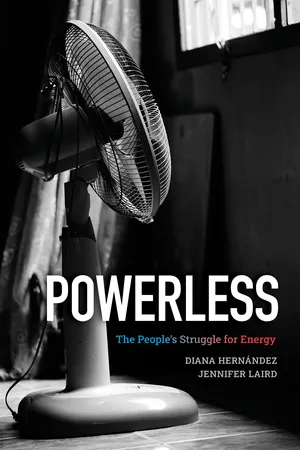
Energy serves as the lifeblood of our daily experiences. It permeates virtually every aspect of our existence, facilitating nourishment, safety, and productivity. When affordability threatens energy's availability, a family's living situation can become untenable—too cold, too hot, too dark, and too often, unhealthy and unsafe. In Powerless, sociologists Diana Hernández and Jennifer Laird reveal the hidden hardship of "energy insecurity" – the inability to adequately meet household energy needs.
Approximately one in ten households in the U.S. are energy insecure and four in ten are at risk for energy insecurity. These statistics alone do not convey the acute pain of utility shutoffs, or the relentless toll of chronic energy hardships marked by difficult choices and harsh living conditions. Drawing on survey data and interviews with one hundred energy-insecure individuals and families, Hernández and Laird detail the experience of energy insecurity. Individuals and families suffering from energy insecurity endure economic hardships, such as difficulty paying utility bills, utility debt, and disconnection from utility services. They also struggle with physical challenges, such as poor housing conditions and poor or dysfunctional heating and cooling systems. They are often forced to make difficult choices about what bills to pay. These decisions are sometimes referred to as "heat or eat?" choices, as families cannot afford to pay for heating and food at the same time. Energy insecure individuals and families employ a variety of strategies to keep energy costs down to avoid having to make these hard choices. This includes deliberate underconsumption of energy, enduring physical discomfort, and using dangerous alternatives such as open flames, ovens, or space heaters to try to maintain a comfortable temperature in their home. To be energy insecure is to suffer. Despite the heavy toll of energy insecurity, most people confront these difficulties behind closed doors, believing it is a private matter. Thus, the enormous social crisis of energy insecurity goes unnoticed.
Hernández and Laird argue that household energy is a basic human right and detail policies and practices that would expand access to consistent, safe, clean, and affordable energy. Their proposals include improving the current energy safety net, which is limited and often does not serve the most energy insecure due to stringent program requirements and administrative burdens. They also suggest redesigning rates to accommodate income, promoting enrollment and expansion of discount programs, reforming utility disconnection policies, improving energy literacy, and ensuring an equitable shift to renewable energy resources.
Powerless creates a comprehensive picture of the complex social and environmental issue of energy insecurity and shows how energy equity is not just an aspiration but an achievable reality.
- English
- ePUB (mobile friendly)
- Available on iOS & Android
eBook - ePub
About this book
Information
Table of contents
- Cover Page
- Title Page
- Copyright Page
- Dedication
- Contents
- List of Illustrations
- About the Authors
- Preface
- Acknowledgments
- Introduction
- Part I. Essential Elements and Prevalence
- Part II. Core Dimensions
- Part III. Crisis Points, Cumulative Burdens, and Consequences
- Part IV. Climate Change and the Transition to Energy Security for All
- Methodological Appendix
- Notes
- References
- Index
Trusted by 375,005 students
Access to over 1.5 million titles for a fair monthly price.
Study more efficiently using our study tools.
Frequently asked questions
Yes, you can cancel anytime from the Subscription tab in your account settings on the Perlego website. Your subscription will stay active until the end of your current billing period. Learn how to cancel your subscription
No, books cannot be downloaded as external files, such as PDFs, for use outside of Perlego. However, you can download books within the Perlego app for offline reading on mobile or tablet. Learn how to download books offline
Perlego offers two plans: Essential and Complete
- Essential is ideal for learners and professionals who enjoy exploring a wide range of subjects. Access the Essential Library with 800,000+ trusted titles and best-sellers across business, personal growth, and the humanities. Includes unlimited reading time and Standard Read Aloud voice.
- Complete: Perfect for advanced learners and researchers needing full, unrestricted access. Unlock 1.5M+ books across hundreds of subjects, including academic and specialized titles. The Complete Plan also includes advanced features like Premium Read Aloud and Research Assistant.
We are an online textbook subscription service, where you can get access to an entire online library for less than the price of a single book per month. With over 1.5 million books across 990+ topics, we’ve got you covered! Learn about our mission
Look out for the read-aloud symbol on your next book to see if you can listen to it. The read-aloud tool reads text aloud for you, highlighting the text as it is being read. You can pause it, speed it up and slow it down. Learn more about Read Aloud
Yes! You can use the Perlego app on both iOS and Android devices to read anytime, anywhere — even offline. Perfect for commutes or when you’re on the go.
Please note we cannot support devices running on iOS 13 and Android 7 or earlier. Learn more about using the app
Please note we cannot support devices running on iOS 13 and Android 7 or earlier. Learn more about using the app
Yes, you can access Powerless by Diana Hernández,Jennifer Laird in PDF and/or ePUB format, as well as other popular books in Social Sciences & Discrimination & Race Relations. We have over 1.5 million books available in our catalogue for you to explore.