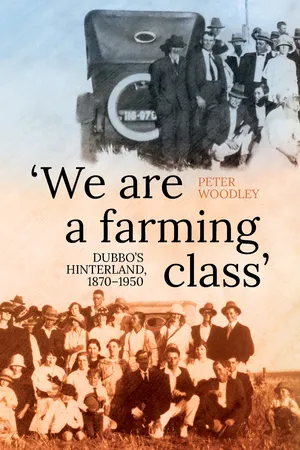
Notions of an arcadian farming life permeate settler-Australian understandings of themselves and their nation. Qualities of hard work, perseverance, resourcefulness, and a steady devotion to family and community—the historian John Hirst's Pioneer Legend—are idealised in this nation. But the people from whom the legend is derived have rarely been studied in depth. They are more the stuff of myth and fond imagining than of concerted examination. To what extent is the legend built on lived experience? How have farming people thought of themselves and their contribution to a wider national mythos? 'We are a farming class' examines the lives of people in the farmlands surrounding Dubbo in the New South Wales central west between the 1870s and the 1950s, from free selection and the establishment of agriculture to the dawning of postwar prosperity and change. What emerges is a closely documented, ethnographically rich portrait of a way of life and culture at once distinctive and surprising, recognisable and unknown.
- 366 pages
- English
- PDF
- Available on iOS & Android
eBook - PDF
About this book
Information
Table of contents
- Acknowledgements
- List of figures
- Abbreviations
- Conversions and conventions
- Prologue
- Introduction
- 1. ‘Poor struggling men’: The slow emergence of a farming class to 1880
- 2. ‘And we are shunned and out in the cold’: Schools and the making of community and class
- 3. ‘Making a poor man poorer’: Credit and debt
- 4. ‘A decent sort of a chap’: Farmers and labour, 1880–1930
- 5. ‘The farmers have been most loyal’: Political allegiance in the farmlands
- 6. ‘Tethered to the world’: Transport, communication and imagining the farmlands
- 7. ‘All thoughts of depression were banished’: Voluntary associations and the making of social spaces and communities
- 8. ‘The tales of the pioneers are told’: The place of the past in local consciousness
- Conclusion
- Bibliography
- Index
Trusted by 375,005 students
Access to over 1.5 million titles for a fair monthly price.
Study more efficiently using our study tools.
Frequently asked questions
Yes, you can cancel anytime from the Subscription tab in your account settings on the Perlego website. Your subscription will stay active until the end of your current billing period. Learn how to cancel your subscription
No, books cannot be downloaded as external files, such as PDFs, for use outside of Perlego. However, you can download books within the Perlego app for offline reading on mobile or tablet. Learn how to download books offline
Perlego offers two plans: Essential and Complete
- Essential is ideal for learners and professionals who enjoy exploring a wide range of subjects. Access the Essential Library with 800,000+ trusted titles and best-sellers across business, personal growth, and the humanities. Includes unlimited reading time and Standard Read Aloud voice.
- Complete: Perfect for advanced learners and researchers needing full, unrestricted access. Unlock 1.5M+ books across hundreds of subjects, including academic and specialized titles. The Complete Plan also includes advanced features like Premium Read Aloud and Research Assistant.
We are an online textbook subscription service, where you can get access to an entire online library for less than the price of a single book per month. With over 1.5 million books across 990+ topics, we’ve got you covered! Learn about our mission
Look out for the read-aloud symbol on your next book to see if you can listen to it. The read-aloud tool reads text aloud for you, highlighting the text as it is being read. You can pause it, speed it up and slow it down. Learn more about Read Aloud
Yes! You can use the Perlego app on both iOS and Android devices to read anytime, anywhere — even offline. Perfect for commutes or when you’re on the go.
Please note we cannot support devices running on iOS 13 and Android 7 or earlier. Learn more about using the app
Please note we cannot support devices running on iOS 13 and Android 7 or earlier. Learn more about using the app
Yes, you can access 'We are a farming class' by Peter Woodley in PDF and/or ePUB format, as well as other popular books in Social Sciences & Regional Studies. We have over 1.5 million books available in our catalogue for you to explore.