The process of mineral extraction results in substantial damage of the topsoil, which leads to soil degradation in the form of deterioration of the soil structure, susceptibility to soil erosion, excessive leaching of nutrients, soil compaction, decrease in soil pH, accumulation of heavy metals in soil, depletion of organic matter, reduced accessibility of nutrients for plants, diminished capacity for cation exchange, the decline in microbial activity, and ultimately, a consequent decline in soil fertility. Effective management of topsoil is indispensable in the execution of a reclamation strategy, as it serves to minimize nutrient depletion and ultimately expedite the process of restoring soil health and quality.
Ghana is among the top ten gold producing countries in the world and its actions towards achieving environmental sustainability in the mining sector must be shared with the world. There are some great success stories as well as challenges in the mining sector sustainability from Ghana's case, which are left undocumented and are limited in investigations in a scientific book. Such enviable feats chalked by some mining companies must be documented so that lessons can be borrowed for replications in restoring similar degraded mining sites elsewhere across the globe. Additionally, companies can learn from the success stories and challenges encountered in mine land reclamation and revegetation in this book.
Revegetation may present a sustainable option for the reclamation and restoration of mine soil degradation. The restoration process involves many strategies aimed at improving the quality of soil, such as augmenting the quantity of soil organic matter, enhancing nutrient availability, increasing cation exchange capacity, stimulating biological activities, and optimizing the physical qualities of the soil.
Researchers, scientists and consultants in the subject of soil pollution and remediation have conducted a great deal of study using a variety of techniques and approaches. However, a fragmented reporting of techniques and results has resulted from the documentation and dissemination of success stories, challenges and findings mostly through individual technical reports and publication in scholarly journals. This book provides an in-depth analysis of the many scientific methodologies used to identify environmental risks related to potentially toxic elements (PTEs) in mining sites and revegetation as a strategy to ameliorating contaminated and degraded mining sites. The book covers application of these methods in identifying soil-human health risks and planning towards reclamation of such derelict ecosystems.
The book combines reviews of relevant literature, laboratory investigation on PTEs from representative mine-contaminated soil and spoil samples as well as appraisal of case studies on successful reclamation and revegetation of mine-degraded lands. Applications of the total element concentration method, size fractionation experiments, sequential extraction analyses, risk assessment indices, geospatial analysis, redox chemistry experiments, synchrotron radiation science, incubation experiments, and pot experimental trials in soil remediation works were documented first hand in a single piece in this book.
The book is organized into nineteen chapters, each dedicated to soil contamination caused by mining and revegetation as a sustainable solution. The initial parts of the book deal with various techniques for identifying soil-human health risks. They include some topics such as the consequences of heavy metal presence and build-up, the sources from which heavy metal pollutants originate, and the possible hazards they bring to plant, human, and soil health. The second parts begin with the concept of mining sector sustainability and explore revegetation as a strategy for reclaiming and remediating mining-contaminated lands, with the objective of restoring ecosystem functionality, improving soil characteristics, and cleaning metal-contaminated soils.
The book may serve as a valuable resource for individuals occupying various professional roles and engaging in academic pursuits, such as project officers operating within the environmental, safety, and health divisions of mining enterprises, consultants specializing in land reclamation, lecturers specializing in environmental and soil sciences, students, and individuals with a strong interest in environmental protection.
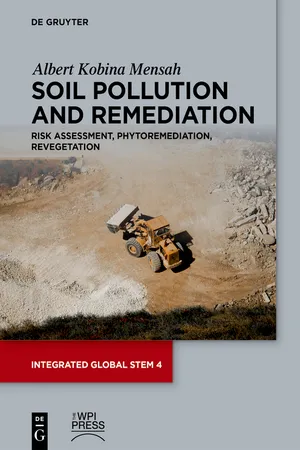
eBook - ePub
Soil Pollution and Remediation
Risk Assessment, Phytoremediation, Revegetation
- English
- ePUB (mobile friendly)
- Available on iOS & Android
eBook - ePub
About this book
Information
Table of contents
- Title Page
- Copyright
- Contents
- DEDICATION
- Chapter 1 Evolution of land reclamation practices and introducing mine land degradation and revegetation in Ghana
- Chapter 2 Methods used in soil and human health risk assessment
- Chapter 3 Identifying risks using sequential extraction analyses, size fractionation, and acid neutralization capacity experiments
- Chapter 4 Risk identification using remediation incubation experiments, redox microcosm, geospatial analyses, and synchrotron radiation science
- Chapter 5 Impacts of mining on soil quality
- Chapter 6 Topsoil and its management during stockpiling
- Chapter 7 Effects of mining on the accumulation and pollution with potentially toxic elements
- Chapter 8 The power of plants in cleaning and stabilising potentially toxic elements in mine-contaminated soils
- Chapter 9 Achieving mining sector sustainability
- Chapter 10 Rehabilitation and restoration of degraded mined sites and soils
- Chapter 11 Case studies in mine land revegetation and remediation employing various approaches
- Chapter 12 Plant species used in revegetation and their corresponding impacts
- Chapter 13 Concurrent rehabilitation/revegetation
- Chapter 14 Arsenic in a highly contaminated gold mine spoil in Ghana: mobilization and potential of soil amendments to reduce the water-soluble arsenic content and improve soil quality
- Chapter 15 Significance of revegetation of degraded mining sites
- Chapter 16 Measuring and monitoring success of post-reclamation efforts
- Chapter 17 Critical factors for driving successful restoration of degraded mine lands
- Chapter 18 Management of restored mine sites
- Chapter 19 The challenges and strategies for post-mine land restoration efforts in Ghana
- Chapter 20 A best-fit conceptual framework to enhance phytoremediation scaling
- Chapter 21 Phytostabilization of Co, Hg, Mo, and Ni by ryegrass with manure and iron oxides reduced environmental concerns
- Chapter 22 Identifying research gaps for future reclamation studies
- Chapter 23 General conclusions and summaries
- References
- Index
Trusted by 375,005 students
Access to over 1.5 million titles for a fair monthly price.
Study more efficiently using our study tools.
Frequently asked questions
Yes, you can cancel anytime from the Subscription tab in your account settings on the Perlego website. Your subscription will stay active until the end of your current billing period. Learn how to cancel your subscription
No, books cannot be downloaded as external files, such as PDFs, for use outside of Perlego. However, you can download books within the Perlego app for offline reading on mobile or tablet. Learn how to download books offline
Perlego offers two plans: Essential and Complete
- Essential is ideal for learners and professionals who enjoy exploring a wide range of subjects. Access the Essential Library with 800,000+ trusted titles and best-sellers across business, personal growth, and the humanities. Includes unlimited reading time and Standard Read Aloud voice.
- Complete: Perfect for advanced learners and researchers needing full, unrestricted access. Unlock 1.5M+ books across hundreds of subjects, including academic and specialized titles. The Complete Plan also includes advanced features like Premium Read Aloud and Research Assistant.
We are an online textbook subscription service, where you can get access to an entire online library for less than the price of a single book per month. With over 1.5 million books across 990+ topics, we’ve got you covered! Learn about our mission
Look out for the read-aloud symbol on your next book to see if you can listen to it. The read-aloud tool reads text aloud for you, highlighting the text as it is being read. You can pause it, speed it up and slow it down. Learn more about Read Aloud
Yes! You can use the Perlego app on both iOS and Android devices to read anytime, anywhere — even offline. Perfect for commutes or when you’re on the go.
Please note we cannot support devices running on iOS 13 and Android 7 or earlier. Learn more about using the app
Please note we cannot support devices running on iOS 13 and Android 7 or earlier. Learn more about using the app
Yes, you can access Soil Pollution and Remediation by Albert Kobina Mensah in PDF and/or ePUB format, as well as other popular books in Technology & Engineering & Public Health, Administration & Care. We have over 1.5 million books available in our catalogue for you to explore.