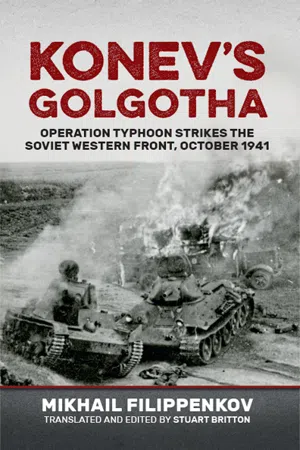
This book is a historical study of the events of October 1941 in the Viaz'ma pocket, based on documents found in the Russian Federation's Central Archive of the Ministry of Defense, the German Bundesarchiv, and the US National Archives.Mikhail Filippenkov describes the events that took place through the simultaneous, comparative analysis of Soviet and German combat reports according to time, and in the manner of reporting from the places of those events as they happened. The author writes about these events with chronological accuracy, not on the level of army headquarters and higher, but exclusively on the level of the combat units down to the division-level, and with concrete geographical reference to the combat maps of those times.Particular attention is paid to the events that took place in the vicinity of Sychevka in Smolensk Oblast', because what happened there has never been deeply researched or examined by anyone in Russia. Unfortunately, research must rely primarily on the combat reports and combat documents of the units of the Wehrmacht's Panzergruppe 3., since almost no documents on the Soviet side have been preserved. They were either destroyed together with the units and formations trapped within the Viaz'ma pocket, or destroyed at an order from above to those units and formations which managed to escape encirclement more or less intact, in order to erase any record of the disaster.
- 176 pages
- English
- ePUB (mobile friendly)
- Available on iOS & Android
eBook - ePub
Konev's Golgotha
About this book
Information
Subtopic
Russian HistoryIndex
History1
The Black October of 1941
Reality and fantasy
After the destruction of the main forces of the Soviet Western Front in the Bialystok and Minsk pockets, the German command, wasting no time, made the decision to launch a new offensive on the Moscow axis with mobile formations alone, without waiting for the infantry divisions to come up. On this occasion, as had happened repeatedly in history, Smolensk wound up in the foe’s path. There, between 10 July and 10 September 1941, savage fighting continued, in the course of which already on 17-18 July, separate sectors of the city repeatedly changed hands, By the morning of 19 July, the Germans nevertheless succeeded in taking the majority of the city, and on 28 July 1941, the Red Army fully abandoned Smolensk. Despite this, the battle for Smolensk became an important stage in disrupting the timetable of advance of the German forces toward Moscow. Soviet troops suffered enormous losses, but the German were also left bloodied and exhausted, having conducted heavy fighting for this major urban center.
Despite the fact that the city itself had been abandoned, this did not signify the end of the Battle of Smolensk, and already on 30 July 1941, the Wehrmacht high command ordered Heeresgruppe Mitte to go over to the defense with its main forces. Heavy fighting east of Smolensk continued until 10 September, and on 12 September Colonel General I.S. Konev was appointed as commander of the Western Front, in place of Marshal S.K. Timoshenko. He took command of the forces at the end of the Battle of Smolensk and adopted a defense on a line running from Lake Seliger to El’nia, at a time when the German command, having brought up supplementary forces and conducting a regrouping, had already readied a new offensive on the Moscow axis under the code name “Typhoon”.
Having learned about the offensive being prepared by the Germans, the Western Front command began to bring up its reserves to the threatened sector, and on 30 September an operational group of commanders headed by the Front’s deputy commander Lieutenant General I.V. Boldin was formed and sent to Vadino, in order to assume direct leadership of the forces on the Vadino direction. With this same aim, a signals hub was organized in Vadino, through which communications could be maintained with all the armies of the Western Front. The Western Front’s main communications center at the Kasnia railroad station, because of the threat of Luftwaffe attacks, was removed from a single premise and scattered into bunkers on the directions of activity.1
Until 30 September, not only units of the Red Army that remained after the Battle of Smolensk underwent regrouping east of Smolensk. In addition, there were units from other areas that had been directed there after 22 June 1941 in order to build a line of defense.
At the height of the Battle of Smolensk, the full-strength 251st Rifle Division arrived in Baturino (Kholm-Zhirkovskii District in the north of Smolensk Oblast, 12 kilometers south of its border with Tver’ Oblast) and became part of the 30th Army back on 15 July 1941. Together with other units that were under the 30th Army’s command, it set to work constructing defensive positions on the Smolensk – Belyi line and giving combat training to the personnel. The 251st Rifle Division had been formed on 30 June 1941 out of units of the USSR NKVD [People’s Commissariat of Internal Affairs] and reserve troops from Moscow Oblast. Colonel Stenin commanded it, and his chief of staff was Colonel Starovoitov. Having assumed a defense on the Viaz’ma axis, it was busy with constructing defensive fortifications and the training of its personnel; special attention was given to radio communications. All of the division’s technical property was timely put in order.
From 30 September 1941, replacements began to arrive, which consisted, as it turned out, of completely raw new recruits. On this day, the 923rd Rifle Regiment alone received 1,000 men of a completely untrained replacement unit from Udmurtia, who had no idea that soon they alone would be one of the first to take on the powerful blow of the new German offensive.2 We will find out about the actions of this regiment and its commander Major N.A. Guliaev a little later.
From the testimony of prisoners, it became known to Western Front headquarters that the Germans were preparing a general offensive toward Moscow, and 100 infantry divisions, 3,000 tanks and 1,000 aircraft were to take part in the operation. However in reality, according to the situation on 1 October 1941, the operational density of the two sides on a sector of the front 347 kilometers wide was assessed by the command of the Red Army’s Western Front as follows (see Table 1):
The fact that already by the beginning of October the Germans had a superiority in force was explained by the command of the Western Front as the Soviet divisions’ deficit in personnel (11% to 54% below their authorized strength), and by the average two-fold superiority of the Germans in combat equipment, especially in machine guns, anti-tank guns and artillery of all calibers, and tanks. After the start of the offensive it became clear that the Germans had assembled their main forces opposite the boundary between the Soviet 30th and 19th Armies. Here, the correlation of force was such that the Germans had twice the infantry, three times the artillery and tanks, and approximately 2.5 times the amount of aircraft than their Soviet counterpart. Considering such a concentration of Wehrmacht strength, the Western Front command nevertheless counted upon stopping its offensive.3
Table 1 Relative strength of the opposing sides as estimated by the Western Front command
USSR | Germany | |
Number of divisions | 27 rifle divisions | 34 infantry divisions |
Frontage in kilometers of each rifle or infantry division | approximately 13 | 11.9 |
Density of guns (excluding anti-tank guns) of all calibers per kilometer of front | 5.9 | 11.9 |
Density of anti-tank guns per kilometer of front | 1.6 | 3.0 |
Density of armor per kilometer of front | 1.2 | 2.0 |
So that the reader will not be confused in the future by the numeric designations of the armies and units, below I present the total composition of the opposing sides:
The Wehrmacht:
Heeresgruppe Mitte (Generalfeldmarschall Fedor von Bock)
9. Armee (Generaloberst Adolf Strauß)
On the left (northern flank) of Panzergruppe 3:
XXIII Armeekorps (General der Infanterie A. Schubert): 251., 102., 256. and 206. Infanterie-Divisionen
Panzergruppe 3 (Generaloberst Hermann Hoth)
VI Armeekorps (General der Pioniere O.-W. Förster): 110. and 26. Infanterie-Divisionen
XXXXI Panzerkorps (General der Panzertruppe Georg-Hans Reinhardt): 36. Infanterie-Division (mot.), 1. Panzer-Division and 6. Infanterie-Division
LVI Panzerkorps (General der Panzertruppe Ferdinand Schaal): 6. and 7. Panzer-Divisionen, 129. Infanterie-Division
V Armeekorps (General der Infanterie Richard Ruoff): 5., 35. and 106. Infanterie-Divisionen
On the right (southern flank) of Panzergruppe 3:
VIII Armeekorps (General der Artillerie Walter Heitz): 8., 28. and 87. Infanterie-Divisionen
XXVII Armeekorps (General der Infanterie A. Wager): 86., 162. and 255. Infanterie-Divisionen
9. Armee Reserve: 161. and 14. Infanterie-Divisionen (mot.)
4. Armee (Generalfeldmarshall Günther von Kluge)
IX Armeekorps (General der Infanterie G. Gejer): 137., 263., 183. and 292. Infanterie-Divisionen
XX Armeekorps (General der Infanterie F. Materna): 268., 15. and 78. Infanterie-Divisionen
VII Armeekorps (General der Artillerie W. Farmbacher): 7., 23., 197. and 167. Infanterie-Divisionen
Panzergruppe 4 (Generaloberst Erich Hoepner):
LVII Panzerkorps (General der Panzertruppe A. Kunzen): 20. Panzer-Division, 3. Infanterie-Division (mot.) and the SS Division Das Reich
XXXXVI Panzerkorps (General der Panzertruppe Heinrich Gottfried Otto Richard von Vietinghoff): 5. and 11. Panzer-Divisionen, 252. Infanterie-Division
XXXX Panzerkorps (General der Panzertruppe Georg Stumme): 2. and 10. Panzer-Divisionen, 252. Infanterie-Division
XII Armeekorps (General der Infanterie W. Schrot): 98. and 34. Infanterie-Divisionen
2. Armee (Generaloberst Maximilian von Weichs)
XIII Armeekorps (General der Infanterie G. Felber): 17. and 260. Infanterie-Divisionen
XXXXIII Armeekorps (General der Infanterie Gotthard Heinrici): 52. and 131. Infanterie-Divisionen
LIII Armeekorps (General der Infanterie W. Weisenberger): 56., 31. and 167. Infanterie-Divisionen
2. Armee Reserve: 112. Infanterie-Division
Panzergruppe 2 (Generaloberst Heinz Wilhelm Guderian)
XXXXVII Panzerkorps (General der Panzertruppe Joachim Lemelsen): 17. and 18. Panzer-Divisionen, 29. Infanterie-Division (mot.)
XXIV Panzerkorps (General der Panzertruppe L. Geyr von Schweppenburg): 3. and 4. Panzer-Divisionen, 10. Infanterie-Division (mot.)
XXXXVIII Panzerkorps (General der Panzertruppe Werner Kempf): 9. Panzer-Division, 16. and 25. Infanterie-Divisionen (mot.)
Gruppe 34 (General der Infanterie G. Mez): 45. and 134. Infanterie-Divisionen
Gruppe 35 (General der Artillerie R. Kempfe): 95., 196., 262., 293. Infanterie-Divisionen, 1. Kavallerie-Division
Heeresgruppe Mitte Reserve: 19. Panzer-Division, 900. Lehr-Brigade (mot.) and Regiment Grossdeutschland (mot.)
Rear Security of Heeresgruppe Mitte: 339. and 707. Infanterie-Divisionen; 221. 286., 403. and 454. Sicherungs-Divisionen [Security Divisions], SS-Kavallerie-Brigade
Luftflotte 2: Generalfeldmarschall Albert Kesselring
The Workers’ and Peasants’ Red Army
Western Front: (Colonel General I.S. Konev)
22nd Army (Major General V.A. Iushkevich)
29th Army (Lieutenant General I.I. Maslennikov)
30th Army (Major General V.A. Khomenko)
19th Army (Lieutenant General M.F. Lukin)
16th Army (Lieutenant General K.K. Rokossovsky)
20th Army (Lieutenant General A.A. Vlasov)
Reserve Front (Marshal of the Soviet Union S.M. Budennyi)
In the first echelon:
24th Army (Major General K.I. Rakutin)
43rd Army (Major General P.P. Sobennikov)
In the second echelon:
31st Army (Major General V.N. Dalmatov)
49th Army (Lieutenant General I.G. Zakharin)
32nd Army (Major General S.V. Vishnevsky
33rd Army (Brigade Commander4 D.N. Onuprienko
Briansk Front (Colonel General Ia.T. Cherevichenko)
50th Army (Major General M.P. Petrov)
3rd Army (Major General Ia.G. Kreizer)
13th Army (Major General A.M. Gorodiansky)
Operational Group of Major General A.N. Ermakov
However, not all of the above formations and commanders will be of interest to us, but only those that were directly involved in the combat operations on the Sychevka axis. They were the Wehrmacht’s Panzergruppe 3 (and to a great extent only its 1. Panzer-Division, which took Sychevka), and correspondingly the units of the Red Army’s 29th, 30th and 31st Armies that opposed it.
Subsequently, the fronts would change, the armies would be repeatedly re-subordinated, and the commanders reshuffled, but since none of this is the aim of our study, we will not be drawing the readers’ attention to it.
Panzergruppe 3 prepares
Colonel General Hermann Hoth’s Panzergruppe 3 was to attack along the Viaz’ma axis, having the seizure of the important communications hub of Sychevka as one of its main tasks. ...
Table of contents
- Cover
- Title Page
- Copyright
- Contents
- List of Illustrations
- List of Maps
- Glossary of German Units and Formations
- Preface
- Foreword
- Introduction
- Chapter 1: The Black October of 1941
- Chapter 2: The Wehrmacht Readies Itself for the Next Offensive
- Chapter 3: The Wehrmacht Strikes
- Chapter 4: The Defense of Sychevka
- Chapter 5: The Front Continues to Roll to the East
- Chapter 6: The Fall of Sychevka
- Notes
Trusted by 375,005 students
Access to over 1.5 million titles for a fair monthly price.
Study more efficiently using our study tools.
Frequently asked questions
Yes, you can cancel anytime from the Subscription tab in your account settings on the Perlego website. Your subscription will stay active until the end of your current billing period. Learn how to cancel your subscription
No, books cannot be downloaded as external files, such as PDFs, for use outside of Perlego. However, you can download books within the Perlego app for offline reading on mobile or tablet. Learn how to download books offline
Perlego offers two plans: Essential and Complete
- Essential is ideal for learners and professionals who enjoy exploring a wide range of subjects. Access the Essential Library with 800,000+ trusted titles and best-sellers across business, personal growth, and the humanities. Includes unlimited reading time and Standard Read Aloud voice.
- Complete: Perfect for advanced learners and researchers needing full, unrestricted access. Unlock 1.5M+ books across hundreds of subjects, including academic and specialized titles. The Complete Plan also includes advanced features like Premium Read Aloud and Research Assistant.
We are an online textbook subscription service, where you can get access to an entire online library for less than the price of a single book per month. With over 1.5 million books across 990+ topics, we’ve got you covered! Learn about our mission
Look out for the read-aloud symbol on your next book to see if you can listen to it. The read-aloud tool reads text aloud for you, highlighting the text as it is being read. You can pause it, speed it up and slow it down. Learn more about Read Aloud
Yes! You can use the Perlego app on both iOS and Android devices to read anytime, anywhere — even offline. Perfect for commutes or when you’re on the go.
Please note we cannot support devices running on iOS 13 and Android 7 or earlier. Learn more about using the app
Please note we cannot support devices running on iOS 13 and Android 7 or earlier. Learn more about using the app
Yes, you can access Konev's Golgotha by Michael Filippenkov in PDF and/or ePUB format, as well as other popular books in History & Russian History. We have over 1.5 million books available in our catalogue for you to explore.