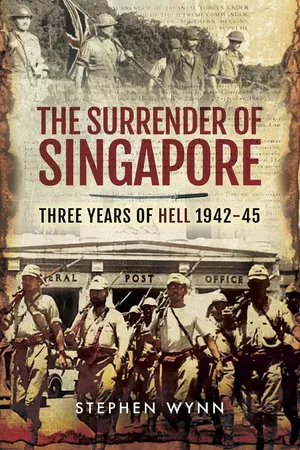
Until the late 1930s, Singapore was noted as a popular stop-off point for wealthy European travellers on their way to countries such as Australia and New Zealand. All of that changed with the outbreak of the Second World War.Despite Major-General William Dobbie, the General Officer Commanding Malaya between 8 November 1935 and August 1939, warning that Singapore could be conquered by the Japanese, his concerns went unheeded. As far as the British authorities were concerned, Singapore was an impregnable fortress.There were many reasons which led to the fall of Singapore. The apparent arrogance of some senior British military personnel and politicians; a misconception that Japanese soldiers were inferior to their American and Commonwealth counterparts; a belief that Japan would not militarily engage both America and Britain at the same time; and that as far as the Allies were concerned, victory in Europe was a priority over defeating the Japanese throughout Asia and the Pacific.Singapore fell to the Japanese in 1942 and was then controlled by them for the next three years, a time in which Chinese civilians and Commonwealth soldiers were murdered at their hands, in such incidents as the Sook Ching massacre and the Burma Railway death march.Included in this account is one mans never before told story of his time as a PoW in Changi prison. The book explores how he miraculously survived the horrors of working on the Burma railway, only to be sent back to Changi, and reveals how the Japanese authorities held letters that his wife sent him for three years.Winston Churchill decided against a public enquiry into the circumstances surrounding the fall of Singapore, and no subsequent British Government has seen fit to change that decision. This remarkable book seeks to remedy that by using an array of sources to tell the fascinating and largely forgotten story of the fall of Singapore.
- 224 pages
- English
- ePUB (mobile friendly)
- Available on iOS & Android
eBook - ePub
The Surrender of Singapore
About this book
Information
Subtopic
Asian HistoryIndex
HistoryCHAPTER ONE
A BRIEF HISTORY OF SINGAPORE
Singapore today is a major centre for trade and commerce, a holiday destination, and a natural stop-off point for people travelling between Australasia and Europe.
Although Singapore has a history dating back to the third century, its modern history began in 1819 when Sir Stamford Raffles established a port on the island which helped it rapidly grow into a major trade route through South East Asia.
Starting in the sixteenth century large parts of South East Asia became colonised by some of the more affluent European countries such as Holland, Portugal and, to a lesser extent, Britain.
In 1818 Raffles became the Lieutenant Governor of the British held colony of Bencoolen on the island of Sumatra and became determined that Britain would replace the Dutch as the dominant power in the region. The saying that ‘necessity is the mother of all invention’ readily comes to mind, as it was because of the tactics employed by the Dutch in preventing British ships from either stopping at Dutch controlled ports or by charging them excessively high tax tariffs to do so that Raffles went off in search of a new location where a port could be built which would allow British ships to sail to and from China as well as what was then British India.
Raffles landed in Singapore on 28 January 1819 and quickly realized that this was exactly the type of location he was looking for. The island had a fresh water supply, enough trees whose timber could be used for the repairing of ships, as well as a deep enough water estuary which would allow for trading ships easily to stop there.
After some political gamesmanship on Raffles’ part he acquired himself a formal treaty to establish a British trading post on the island, which was signed on 6 February 1919.
When Raffles first arrived in Singapore, the island had a population of about 1,000, mostly Malays and Chinese. Within the space of just fifty years that number had grown to over 100,000. Immigrant workers poured into Singapore from all over Asia to work in the newly established rubber plantations and tin mines.
One of the first decisions that Raffles made was to make the port of Singapore ‘free’, which meant that ships stopping there would not have to pay a tax levy on goods that they were either picking up or dropping off. Not surprisingly this quickly drew a lot of attention amongst traders who had previously had to pay taxes when entering a Dutch port in the region, so instead they now came pouring into Singapore free of charge.
Raffles left the island in what he thought were the capable hands of Major William Farquhar, along with a regiment of Indian soldiers and a few artillery pieces, and returned to Bencoolen. It would be three years before Raffles returned to Singapore and he wasn’t totally happy with what he found on his return, so he replaced Farquhar with John Crawfurd, who was a physician, a diplomat and a colonial administrator. As the Governor of the island, he signed a new treaty with the island’s leaders, on 7 June 1823, which in effect gave Britain complete administrative control and brought the island under British law.
Raffles left Singapore in October 1823 for what would be the final time and returned to England. He died there in 1826 at the age of 44.
The next one hundred years would see many changes taking place in Singapore. Those in charge would have to deal with many varied social issues, from protecting Chinese women who were forced into prostitution, to dealing with poor health and living standards and an acute housing shortage which got worse as more and more workers made their way to Singapore looking for work and a better life for themselves and their families.
Singapore didn’t really have a part to play in the First World War as it was mainly a European conflict. The only thing of any real note which happened during that period was the 1915 mutiny by British Muslim Indian sepoys who were soldiers with the 5th Native Light Infantry and who were garrisoned in Singapore. Rumours started to spread amongst their ranks that they were soon to be sent to fight against the Ottoman Empire (today’s Turkey) at Gallipoli. The Indian soldiers did not like the sound of that one bit, so they revolted, killing all of their officers as well as several civilians. The mutiny began on 15 February (the same day the Japanese occupied Singapore in 1942) and went on for several days before British, French, Russian and Japanese forces helped put down the rebellion. Forty-seven British soldiers and civilians lost their lives during seven days of mutiny.
A court of enquiry was quickly put in place on 23 February 1915, the day after the mutiny had been put down. A total of 200 of the sepoys were tried by court martial, 47 of whom were subsequently executed by firing squad at Outram Prison, a scene which was witnessed by an estimated crowd of some 15,000 people. The executions were carried out by men of the King’s Shropshire Light Infantry and the Singapore Volunteer Corps. Another 73 of those found guilty received prison sentences ranging from 7 to 20 years.
On 15 February 1942, during the Second World War, Singapore came under the control of the Imperial Japanese Army, and would remain so for the next three and a half painful years.
After the war the island’s economy would take several years to reach the levels it had been at prior to the Second World War, and it did so thanks to world demand for tin and rubber. In the eyes of most Singaporeans, Britain as a colonial leader, having failed to defend the island against the Japanese invasion, had lost all credibility. This directly led to an increase in nationalistic and anti-colonial fervour, eventually leading to Singapore gaining full independence on 9 August 1965. It had been a long journey, not without the odd hiccup along the way, including an amalgamation with Malaya to become Malaysia on 16 September 1963.
The country’s first Prime Minister was Lee Kuan Yew who held the position for 31 years between 3 June 1959 and 28 November 1990.
CHAPTER TWO
SINGAPORE NAVAL BASE
Before the Second World War the naval base on Singapore had been something of a political hot potato for a number of years, with opinion divided on whether to strengthen the base or simply leave it well alone. As was the case with such matters, politics played a big part as to what did and did not happen. The following points are taken from the minutes of British Cabinet and British War Cabinet meetings.
At a War Cabinet meeting which took place on 3 October 1940, and which was chaired by the Prime Minister the Right Honourable Winston S Churchill, there were three items on the agenda for discussion which involved the Far East, not all of which were about Singapore, but they still had a relevance to the situation in the region.
Point five on the agenda was a discussion about the Burma Road Agreement and it was highlighted that the question wasn’t really about whether Britain should reopen the Burma Road, more a question about when it should be done. The concern in the room appeared to be how to achieve this without announcing it in such a manner that it might appear provocative to the Japanese. The minutes of the meeting went on to say that the Prime Minister agreed that this was the right decision and that he did not believe that the Japanese would declare war upon Britain as a result.
Point six on the same agenda was a discussion about the general attitude of Japan. The Dutch Foreign Minister did not think that the Japanese were in a position to embark on any important new military adventures. Remember, if you will, this was two months away from the systematic planned attacks by Japan at Pearl Harbor, Hong Kong, Malaya, the Philippines and Thailand. How wrong was it possible for somebody to be?
There also appeared to be some doubt as to Britain’s support of America in relation to her future involvement in a war with Japan. The Secretary of State for Foreign Affairs, The Right Honourable Viscount Halifax, clarified the matter, categorically stating that if the United States were at war with Japan, then Britain would declare war on her as well.
The suggestion had been made that a visit by the United States Naval Force to the naval base at Singapore would be viewed as a positive step.
Ten years earlier, on Wednesday, 28 May 1930, at a Cabinet meeting held at number ten Downing Street, the fourth item on that day’s agenda was entitled ‘The Singapore Base’,
the conclusion of which was that the present slowed down programme should be allowed to continue and that arrangements should be made to obtain at the forthcoming Imperial Conference a definite and permanent settlement of the question of the Singapore Base.
The Cabinet were reminded that it would be necessary to pay back to the Dominions and Colonies concerned any quota of their contributions towards the cost of the Singapore Base that might be received between the present time and the Imperial Conference.
The Singapore Naval Base is situated at the northern tip of the island of Singapore and was both a British Royal Navy shore establishment and a major part of Britain’s Far East defence policy between the First and Second World Wars.
With the clear rise in the military ambitions of the Japanese Empire throughout the Far East at the end of the First World War, the British Government decided that it made sound military sense to make available sufficient funds to begin building a naval base in Singapore. Not only did such an investment help safeguard Britain’s own interests in the region but the hope was that it would also act as a visible deterrent to the Japanese.
The build was first announced in 1923, but at first it did not proceed with any apparent urgency – that was until the Japanese invasion of Manchuria in 1931. The naval base was finally completed in 1939 at a cost of some £60 million pounds. An equivalent cost today would be in excess of £3 billion pounds, a really staggering sum of money.
The new dock covered an area of twenty-one square miles and provided what was then the largest dry dock facility anywhere in the world. It had a floating dock and sufficient fuel tanks comfortably to support the entire British Navy for up to six months. It was a formidable structure and its defence was well supported by heavy fifteen-inch naval guns which were stationed at the nearby batteries at Johore, Changi, and Buona Vista. These in turn were supported by smaller batteries at Forts Siloso, Canning and Labrador, while the air defences for the base came from the nearby Royal Air Force bases at Tengah and Sembawang.
CHAPTER THREE
HMS PRINCE OF WALES – HMS REPULSE
HMS Prince of Wales was a battleship of the Royal Navy, a King George V class. It had been commissioned for service on 19 January 1941 out of the Cammell Laird shipyards in Birkenhead on the Wirral, Merseyside.
Although the Prince of Wales had a short service life, she had an interesting and varied one. On 22 May 1942, along with the battlecruiser Hood and six destroyers, she was ordered to the Atlantic, just south of Iceland, her intended target being the German Battleship Bismarck.
The Bismarck was spotted the very next day in company with the German heavy cruiser Prinz Eugen heading south westward in the area known as the Denmark Strait. Vice Admiral Lancelot Holland, who was on board HMS Hood, had ordered HMS Prince of Wales, HMS Repulse, six destroyers, and the cruisers Norfolk and Suffolk to make twenty-seven knots. Holland’s plan was for his flagship, the Hood, along with the Prince of Wales, to concentrate on attacking the Bismarck while Norfolk and Suffolk were to concentrate on the Prinz Eugen. A potential problem for the Hood was that by now she was already twenty-five years old and it was questionable if her defensive armour was adequate for the type of enemy ships she would now be up against, even though she had undergone a major overhaul in March 1941. Accordingly, one of the tactics which she needed to employ was to get in close to prevent her being vulnerable to plunging enemy shellfire – which in turn potentially made her more vulnerable.
In the hours of darkness, and in what can only be described as inclement weather, with high seas, being engaged in a naval battle was not that straightforward an exercise. Hood, in all the confusion, actually opened up on the Prinz Eugen rather than the Bismarck, and the Suffolk and Norfolk were unclear as to what their roles were in the attack.
The battle commenced just before six o’clock in the morning, with the Prinz Eugen quickly striking the Hood with her eight-inch shells. The first salvo from the Prince of Wales was way off the mark, but two of her salvos finally struck the Bismarck, one striking her bow and the other entering her side armour belt and exploding, damaging the ship’s boilers so extensively that she would have to return to port.
The Hood was sunk in the contact, having been struck by both the Bismarck and the Prinz Eugen. At the time of her sinking the Hood was the biggest battlecruiser in the world. Only three of her crew survived, the other 1,419 going to a watery grave.
The Pr...
Table of contents
- Cover
- AUTHOR’S BIOGRAPHY
- Title
- Copyright
- CONTENTS
- Acknowledgements
- Dedication
- Prologue
- 1. A Brief History of Singapore
- 2. Singapore Naval Base
- 3. HMS Prince of Wales – HMS Repulse
- 4. Parit Sulong Massacre
- 5. Battle of Singapore
- 6. Lieutenant Adnan bin Saidi
- 7. Alexandra Military Hospital Massacre
- 8. The Battle Box
- 9. British Surrender at Singapore
- 10. Bangka Island Massacre
- 11. The Sook Ching Massacre
- 12. Singapore in the Eyes of the Press 1942–45
- 13. Raffles Hotel
- 14. The International Red Cross – Wartime
- 15. War Cabinet Report on the Fall of Singapore
- 16. The Defence of Singapore
- 17. Victoria Crosses Malaya/Singapore 1941–45
- 18. Lim Bo Seng
- 19. Elizabeth Choy – Singapore War Heroine
- 20. Operation Rimau
- 21. Japanese Surrender in Singapore
- 22. Singapore War Crimes Trials and the Aftermath
- 23. The International Red Cross – Post War
- 24. Reparations and Apology
- 25. Kranji War Cemetery
- 26. British War Cabinet Meetings
- 27. Operation Zipper
- 28. Patrick Vaughan Stanley Heenan
- 29. First Battalion Manchester Regiment
- 30. Private 5775484 Maurice Orchant
- 31. The Diary of Private Cecil John Samuel Norris
- Plate section
Trusted by 375,005 students
Access to over 1.5 million titles for a fair monthly price.
Study more efficiently using our study tools.
Frequently asked questions
Yes, you can cancel anytime from the Subscription tab in your account settings on the Perlego website. Your subscription will stay active until the end of your current billing period. Learn how to cancel your subscription
No, books cannot be downloaded as external files, such as PDFs, for use outside of Perlego. However, you can download books within the Perlego app for offline reading on mobile or tablet. Learn how to download books offline
We are an online textbook subscription service, where you can get access to an entire online library for less than the price of a single book per month. With over 1.5 million books across 990+ topics, we’ve got you covered! Learn about our mission
Look out for the read-aloud symbol on your next book to see if you can listen to it. The read-aloud tool reads text aloud for you, highlighting the text as it is being read. You can pause it, speed it up and slow it down. Learn more about Read Aloud
Yes! You can use the Perlego app on both iOS and Android devices to read anytime, anywhere — even offline. Perfect for commutes or when you’re on the go.
Please note we cannot support devices running on iOS 13 and Android 7 or earlier. Learn more about using the app
Please note we cannot support devices running on iOS 13 and Android 7 or earlier. Learn more about using the app
Yes, you can access The Surrender of Singapore by Stephen Wynn in PDF and/or ePUB format, as well as other popular books in History & Asian History. We have over 1.5 million books available in our catalogue for you to explore.