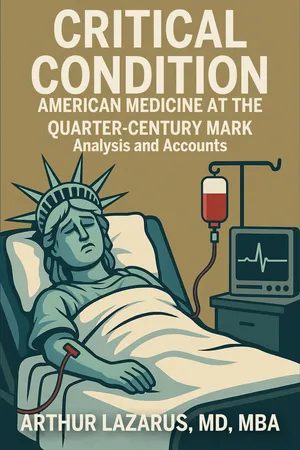
Critical Condition
eBook - PDF

Critical Condition

American Medicine at the Quarter-Century Mark

  1. 262 pages
  2. English
  3. PDF
  4. Available on iOS & Android
eBook - PDF

Critical Condition

American Medicine at the Quarter-Century Mark

About this book

Uncover the turbulent past and uncertain future of medical practice in Critical Condition: American Medicine at the Quarter-Century Mark by Arthur Lazarus, MD, MBA—a gripping exploration of the forces reshaping healthcare today.

This book is divided into two sections:

Section 1: Analysis

Section 2: Accounts

Explore 48 incisive essays that cut to the heart of the most urgent lessons for navigating today's healthcare landscape—not as abstract statistics or policy debates, but as the lived experiences of patients, doctors, and healthcare workers nationwide. Together, they expose the crises at hand while offering a vision for the future of medicine.

Whether you are a physician struggling to stay afloat, a policymaker grappling with reform, or simply an American trying to navigate a healthcare system in flux, Critical Condition: American Medicine at the Quarter-Century Mark is for you. Our system may be in critical condition, but it is not beyond saving. The question remains: Do we have the will to heal it?

Frequently asked questions

Yes, you can cancel anytime from the Subscription tab in your account settings on the Perlego website. Your subscription will stay active until the end of your current billing period. Learn how to cancel your subscription.
At the moment all of our mobile-responsive ePub books are available to download via the app. Most of our PDFs are also available to download and we're working on making the final remaining ones downloadable now. Learn more here.
Perlego offers two plans: Essential and Complete
  • Essential is ideal for learners and professionals who enjoy exploring a wide range of subjects. Access the Essential Library with 800,000+ trusted titles and best-sellers across business, personal growth, and the humanities. Includes unlimited reading time and Standard Read Aloud voice.
  • Complete: Perfect for advanced learners and researchers needing full, unrestricted access. Unlock 1.4M+ books across hundreds of subjects, including academic and specialized titles. The Complete Plan also includes advanced features like Premium Read Aloud and Research Assistant.
Both plans are available with monthly, semester, or annual billing cycles.
We are an online textbook subscription service, where you can get access to an entire online library for less than the price of a single book per month. With over 1 million books across 1000+ topics, we’ve got you covered! Learn more here.
Look out for the read-aloud symbol on your next book to see if you can listen to it. The read-aloud tool reads text aloud for you, highlighting the text as it is being read. You can pause it, speed it up and slow it down. Learn more here.
Yes! You can use the Perlego app on both iOS or Android devices to read anytime, anywhere — even offline. Perfect for commutes or when you’re on the go.
Please note we cannot support devices running on iOS 13 and Android 7 or earlier. Learn more about using the app.
Yes, you can access Critical Condition by Arthur L. Lazarus in PDF and/or ePUB format. We have over one million books available in our catalogue for you to explore.

Information

Table of contents

  1. Critical Condition:American Medicineat the Quarter-Century Mark
  2. Analysis and Accounts
  3. Arthur Lazarus, MD, MBA
  4. Critical Condition:American Medicineat the Quarter-Century Mark
  5. Analysis and Accounts
  6. Arthur Lazarus, MD, MBA
  7. Academica PressWashington
  8. Library of Congress Cataloging-in-Publication Data 
  9. Names: Lazarus, Arthur L. (author)
  10. Title: Critical condition : american medicine at the quarter-century mark | Lazarus, Arthur L.
  11. Description: Washington : Academica Press, 2025. | Includes references.
  12. Identifiers: LCCN 2025940932 | ISBN 9781680534023 (hardcover) | 9781680534030 (e-book)
  13. Copyright 2025 Arthur L. Lazarus
  14. Disclaimer
  15. No content in this book should be used as a substitute for medical advice from a doctor or other qualified clinician.
  16. Also by Arthur Lazarus
  17. Neuroleptic Malignant Syndromeand Related Conditions (co-author)
  18. Controversies in Managed Mental Health Care
  19. Career Pathways in Psychiatry:Transition in Changing Times
  20. MD/MBA: Physicianson the New Frontier of Medical Management
  21. Every Story Counts: Exploring ContemporaryPractice Through Narrative Medicine
  22. Medicine on Fire: A Narrative Travelogue
  23. Narrative Medicine: The Fifth Vital Sign
  24. Narrative Medicine: Harnessingthe Power of Storytelling through Essays
  25. Story Treasures: Medical Essaysand Insights in the Narrative Tradition
  26. 21st Century Schizoid Health Care: Essays andReflections to Keep You Sane on Your Medical Travels
  27. Narrative Rx: A Quick Guide to Narrative Medicinefor Students, Residents, and Attendings
  28. Narrative Medicine: New and Selected Essays
  29. Narrative Frontiers: Essays at the Edgeof Medicine and the Multiverse
  30. For those fighting to heal—patients, physicians,and all who oppose a broken system
  31. Contents
  32. Preface xvii
  33. Introduction 1
  34. Analysis 5
  35. 1. How Should Medical Institutions Respond to Attacks on DEI? 7
  36. 2. Only a Fool Fights in a Burning House 11
  37. 3. Writing on the Edge of Controversy 17
  38. 4. Small Town Health Care 21
  39. 5. The Encroachment of AI Into Clinical Practice 27
  40. 6. Lessons in Darkness:The Enduring Warnings of Nazi Medical Atrocities 33
  41. 7. The Power of Connection 39
  42. 8. Developmental Trauma in Clinical Practice 43
  43. 9. The Vanishing Art of Empathy 47
  44. 10. What Happens to Physicians Who Follow the Path of Dr. Faustus? 51
  45. 11. Whom the Gods Would Destroy 55
  46. 12. Overdiagnosed, Overdefended, and Overburdened 59
  47. 13. Self-Treatment and Treatment of Family Members 63
  48. 14. The Occupational Hazards of Health Care Employment 69
  49. 15. Do Better: A Lesson for Physicians 75
  50. 16. Reimagining Medical Education 79
  51. 17. Career Myths That Hold Doctors Stuck 85
  52. 18. The Faces of Toxic Leadership 93
  53. 19. The Faces of Great Leadership 99
  54. 20. Recognize the Signs of Burnout Before It’s Too Late 105
  55. 21. White Coat, Blue Collar 111
  56. 22. The Hidden Architecture of Healthcare Denial 115
  57. 23. The Future of Diversity in Medical Schools is Under Threat 121
  58. 24. “Chainsaw” Politics Cuts Deeply Into the Fabric of Health Care 127
  59. 25. Medical Malpractice on Trial 133
  60. 26. The Alchemy of Narrative Medicine: Healing Through Story 137
  61. Accounts 141
  62. 27. The Hidden Burdens of a Healer 143
  63. 28. When Science Whispers and Stigma Shouts 147
  64. 29. A Doctor’s Commitment to Playing in the Band 151
  65. 30. The “Quiet” Room: How Therapy Culture Lost Its Way 155
  66. 31. A Taste of Medicine 159
  67. 32. The Rant That Shouldn’t Be Necessary 163
  68. 33. Dr. Fagen’s Lament: An Archivist of Suffering 167
  69. 34. Unequal Measures 173
  70. 35. The Verdict 177
  71. 36. The Vanishing Cure for Lyme Disease 181
  72. 37. The Final Cut 185
  73. 38. The Sound of Silence 191
  74. 39. The Weight of Words 195
  75. 40. Blurred Lines: A Resident’s Dilemma in the Digital Age 199
  76. 41. Devalued, Dismissed, Disconnected 203
  77. 42. Doctor in the Arena 207
  78. 43. The Unscripted Doctor 213
  79. 44. Bound by Borders, Freed by Choice 217
  80. 45. The More I Learn About People… 221
  81. 46. The Last Slice 225
  82. 47. Metrics Madness 229
  83. 48. House Call 233
  84. Notes and Sources 237
  85. About the Author 241
  86. Medicine, the only profession that laborsincessantly to destroy the reason for its existence.— James Bryce
  87. Preface
  88. As the United States enters the second quarter of the 21st century, American medicine is approaching a critical juncture. The orces shaping modern healthcare – technological advancements, economic pressures, policy shifts, and the evolving role of the physician – have brought the system to a state of critical condition. While the scientific achievements of our time are nothing short of extraordinary, the delivery of care remains fraught with dysfunction, inequities, and ethical dilemmas.
  89. This book, Critical Condition: American Medicine at the Quarter-Century Mark, is a reflection on the current state of healthca e in America. It is both an analysis and an account – a collection of essays that critically examine the triumphs and failures of modern medicine, as well as narratives that illuminate the lived experiences of those within it.
  90. The “Analysis” section dissects some of the most pressing challenges in medicine today: the burnout epidemic among physicians, the increasing encroachment of artificial intelligence into clinical decision-making, the erosion of patient trust, and the politicization of healthcare policy. These essays aim to diagnose the structural issues undermining American health care, offering insight into their origins and consequences.
  91. The “Accounts” section shifts focus to the personal. It captures the voices of doctors, patients, and medical professionals wo king in a system in flux. While all essays in this section are works of fiction, they are rooted in truth – each drawn from a conglomeration of real experiences I have encountered in recent years, either personally or through extensive reading. Many are an extension of clinical themes discussed in “Analysis.” These fictional narratives do not depict any actual person or event, yet they are shaped by the realities of contemporary practice, serving as a lens through which to examine the moral and emotional burdens borne by physicians and the everyday struggles of those seeking care in an increasingly fragmented system.
  92. In conceiving the “Accounts,” I experimented with a different form of writing – one that falls within the realm of “realistic medical fiction” or “narrative medical fiction.” These vignettes blend elements of narrative medicine, which emphasizes storytelling and reflective writing in health care, with inspired fiction drawn from real-world experiences. Elements of my personal feelings and emotions are interwoven in these stories, though they are not strictly autobiographical.
  93. If there is one unifying thread throughout this collection, it is the urgent need for reform – reform not only in healthcare policy and administration but in the culture of medicine itself. As a profession, we must reclaim the values that drew us to medicine in the first place: compassion, curiosity, and a commitment to healing. This requires challenging the status quo, questioning the motives of those who dictate the terms of healthcare delivery, and advocating for a system that prioritizes the well-being of both patients and practitioners.
  94. This book is intended for physicians, policymakers, students, and anyone invested in the future of American health care. My hope is that it serves as both a critique and a call to action – an acknowledgment of the system’s failings but also a reminder of its possibilities. Medicine remains a noble profession, but it is at risk of losing its soul. Whether we can revive it depends on our willingness to confront uncomfortable truths and reimagine a better way forward.
  95. Twenty-five years henceforth, American medicine will either have rebuilt itself into a patient-centered, equitable system that honors both science and humanity, or it will have collapsed under the weight of unchecked bureaucracy, corporate greed, and technological overreach. Our choices today will determine which future prevails.
  96. Introduction
  97. The American healthcare system stands at a precarious crossroads in 2025. Despite groundbreaking medical advances and an abundance of technological innovation, the system itself is crumbling under the weight of inefficiencies, skyrocketing costs, health inequities, and damaging public health policies. While health care in the U.S. has always been a complicated blend of excellence and dysfunction, today’s landscape suggests that the dysfunction has reached a tipping point. Physicians are burned out, hospitals are closing, insurance premiums are unaffordable, and the average American is left wondering whether they can afford care when they need it most. At this quarter-century mark, it is critical to take stock of the state of our healthcare system – not just to diagnose its failings, but to consider how we might mend a system that appears to be on life support.
  98. Over the past two decades, employer healthcare costs have skyrocketed by 160%, with the average cost now exceeding $14,000 per employee. This inflationary surge has placed an immense burden on businesses and employees alike, leading to wage stagnation and reduced economic mobility. For many, health care is no longer a workplace benefit – it is a financial liability that eats away at disposable income, leaving fewer resources for education, housing, and retirement savings.
  99. Meanwhile, proposed reductions of up to $800 billion in Medicaid funding have put healthcare coverage for millions at risk. Wo k requirements and stricter eligibility guidelines have compounded the issue, particularly in states that refused to expand Medicaid under the Affordable Care Act. This has created a two-tiered system in which the most vulnerable populations – low-income families, individuals with disabilities, and the elderly – are disproportionately affected. The safety net is fraying, and many are left to fend for themselves in an increasingly expensive healthcare system.
  100. Since 1975, more than 1,000 hospitals – many in rural communities – have shut down due to financial pressures, and nearly 700 more are currently at risk of closure. The result? Expanding medical deserts where millions of Americans must travel hours to access basic healthcare services. Emergency care, maternity wards, and chronic disease management have all become harder to find outside of urban centers. The stark reality is that geography now plays a greater role than ever in determining the quality and accessibility of health care.
  101. Compounding the crisis is the severe physician shortage, with projections indicating a deficit of up to 86,000 doctors by 2036. While medical schools continue to churn out new graduates, many young doctors face overwhelming debt, grueling working conditions, and burnout that forces them to leave clinical practice early. As a result, more patients are left in the care of overworked physicians, contributing to long wait times, rushed appointments, and declining trust in the medical profession.
  102. Speaking of trust – Americans are losing faith in their doctors. In 2024, only 53% of Americans rated physicians highly for ho esty and ethics, a sharp decline from 67% just a few years earlier. Patients report feeling dismissed, unheard, and treated as numbers rather than individuals. In an era where misinformation about healthcare runs rampant, this erosion of trust has dangerous consequences, from vaccine hesitancy to patients foregoing necessary treatments.
  103. Even for those who can access care, the availability of life-saving medications is no longer guaranteed. In 2024, the U.S. faced a record 300 drug shortages, affecting everything from anesthesia to cancer treatments. Manufacturing disruptions, global supply chain issues, and pricing pressures have all contributed to a fragile pharmaceutical landscape. Patients are forced to scramble for alternatives, delay treatments, or risk worsening health outcomes due to medication unavailability.
  104. The demographic shift toward an older population is placing additional strain on the healthcare system. By 2030, 20% of Americans will be of retirement age, increasing demand for geriatric specialists, long-term care, and chronic disease management. Yet, our healthcare infrastructure is woefully unprepared for this surge. Without major reform, the mismatch between demand and available services will only deepen existing disparities.
  105. In 2025, the Trump administration’s healthcare directives have accelerated failures evident during the first term (2016-2020), deepening inequities and destabilizing public health infrastructure. “Make America Healthy Again” aims to undercut routine health care for seniors and children alike. Draconian legislation resulting in the suppression of evidenced-based medical practice coupled with the dismantling of government agencies will exacerbate health disparities. Many of the administration’s executive orders, if fully implemented, will leave a lasting negative impact, setting the stage for a more fragmented and inaccessible healthcare system founded on quasi-scientific principles. These orders, which can be used to implement but not override laws, run contrary to U.S. health and security interests. Litigation is ongoing, but it’s clear the U.S. is failing to protect public and global health.
  106. Where do we go from here? Some would argue that the system is beyond repair, doomed by corporate interests, bureaucratic red tape, and an unwillingness to embrace transformative change. Others remain hopeful, believing that innovation, policy reform, and a renewed commitment to patient-centered care can pull American medicine back from the brink.
  107. Critical Condition: American Medicine at the Quarter-Century Mark aims to examine these pressing issues – not just as statistics and policy debates, but as lived realities for patients, doctors, and healthcare workers across the country. This book seeks to illuminate the crises at hand while offering insights into the future of medicine. Our system may be in critical condition, ut it is not beyond saving. The question remains: Do we have the will to heal it – and how can we transform the challenges we face into opportunities for meaningful change?
  108. Analysis
  109. 1. How Should Medical Institutions Respond to Attacks on DEI?
  110. Ideology and excellence don’t have to be mutually exclusive.
  111. Medical institutions across the U.S. – including associations, medical schools, and health systems – are facing a defining moment as political shifts threaten to reshape their approach to diversity, equity, and inclusion (DEI) initiatives. With President Trump’s executive orders poised to curtail federally funded DEI programs and gender ideology in health care, these institutio s must make a consequential decision. Will they persist in advancing DEI-driven policies despite growing resistance, or will they pivot toward a renewed emphasis on merit, excellence, and evidence-based scholarship with no regard for diversity? The answe may determine not only the future of these associations but also the quality of medical care itself.
  112. Proponents of DEI argue that these initiatives address systemic inequities in healthcare, increase representation among marginalized groups, and ultimately lead to better patient outcomes – improved patient compliance, enhanced problem solving, and increased trust and engagement. The emphasis on cultural competence and diverse perspectives is often framed as a means to mitigate health disparities, improve physician-patient relationships, and create a more inclusive medical workforce.
  113. Organizations such as the American Medical Association (AMA) and the Association of American Medical Colleges (AAMC) have emraced these ideals, implementing policies to diversify admissions, faculty hiring, and research funding. Their stance has been that a medical system attuned to social determinants of health is a more effective and just one.
  114. However, critics contend that DEI policies have strayed too far from the core principles of medicine: scientific rigor, meritocracy, and evidence-based practice. They argue that medical schools and residency programs should prioritize selecting the best candidates based on ability rather than demographic quotas. They also contend that affirmative action admission policies in medical schools contravene the 2023 Supreme Court ruling in Students for Fair Admissions v. Harvard.
  115. Moreover, opponents raised concerns that ideological commitments to DEI have led to the suppression of scientific inquiry, with physicians and researchers discouraged from questioning dominant narratives on topics such as gender-affirming care and race-based treatment protocols. A prime example of this tension is the backlash physicians face when they express concern about the potential long-term side effects of hormone therapy for minors, where medical outcomes are equivocal.
  116. The conflict between DEI and meritocracy is further illustrated by recent controversies in medical education. Some institutions have reduced the emphasis on standardized testing, such as the MCAT and USMLE Step 1 scores, arguing that these exams disadvantage underrepresented applicants. While well-intentioned, this shift has sparked concerns about declining competency standards and the long-term impact on patient safety. If the medical profession moves away from objective measures of skill and knowledge in favor of subjective considerations, it risks eroding public trust and weakening the profession’s commitment to excellence.
  117. Yet, it is worth asking whether DEI and meritocracy must be mutually exclusive. A well-designed system could ensure fairness while maintaining rigorous standards. For example, initiatives that expand educational opportunities for disadvantaged students without lowering the bar for medical competence could strike a balance between inclusivity and excellence. Programs that mentor aspiring physicians from underrepresented backgrounds while holding all applicants to the same academic and clinical benchmarks might achieve diversity without compromising quality. The challenge lies in implementing policies that uplift rather than dilute the profession’s core values.
  118. Medical organizations must also consider the broader societal and legal landscape when determining how staunchly they will adhere to DEI-driven policies. In November 2024, Walmart announced it would be scaling back its DEI programs, a move that signaled a broader shift among some major corporations. Other businesses have followed suit, recognizing the growing resistance to DEI-based hiring and promotion strategies. The pharmaceutical giant Pfizer recently settled a legal dispute with the “Do No Harm” organization over its “Breakthrough” fellowship, which had excluded white and Asian American applicants. Facing a federal civil rights lawsuit, Pfizer ultimately opened the program to candidates of all racial backgrounds.
  119. These developments highlight the increasing legal and financial risks associated with maintaining rigid DEI policies, particularly those that explicitly favor certain groups over others. As corporations retreat from these initiatives in response to government, public, and legal pressure, medical associations and institutions must decide whether to do the same or to hold firm to DEI principles, despite potential backlash (see essay 23).
  120. As medical associations, schools, and health systems reassess their strategy, they must confront a difficult reality: doubling down on DEI in its current form may alienate physicians, policymakers, and the public who see these initiatives as ideologically driven rather than pragmatically necessary. On the other hand, abandoning DEI entirely could be perceived as ignoring genuine inequities that persist in healthcare access and outcomes. In fact, in the wake of the Supreme Court decision, medical school matriculants in MD-granting schools from groups that are historically underrepresented in medicine declined across the board in 024 compared to 2023. What might this mean for care of minority populations?
  121. The path forward requires a recalibration – one that reaffirms a commitment to scientific integrity and high standards while acknowledging the need for a diverse and inclusive medical workforce. Whether associations and institutions will take this balanced approach -- and whether it can be achieved – remains to be seen, but the stakes for the future of American medicine could no be higher.
  122. 2. Only a Fool Fights in a Burning House
  123. Peaceful conflict resolution in medicine may lie in the wisdom of laughter.
  124. In Star Trek: The Original Series episode “The Day of the Dove,” Captain Kirk, his crew, and a group of Klingons led by Commander Kang, are trapped aboard the Enterprise by a mysterious alien entity that thrives on hatred and violence. The being manipulates both sides into perpetual conflict, even healing their injuries to prolong the battle and stoking their rage.
  125. As Kirk and Kang engage in combat, with the entity hovering nearby, pulsating a bright red, Kirk urges Kang to cease fighting, warning that they risk becoming the alien’s puppets for countless lifetimes if they persist. Recognizing the futility of their battle, Kang heeds Kirk’s caution. Both leaders instruct their crews to put down their weapons. To deprive the entity of sustenance, Kirk and Kang prompt their teams to interact with joy and laughter.
  126. At a pivotal moment, Kang delivers his famous line that hastens the entity’s departure from the Enterprise: “We need no urging to hate Humans. But for the present, only a fool fights in a burning house.”
  127. The crew’s continued laughter abolishes the alien.
  128. This poignant metaphor serves as a fitting lens through which to view the current state of the U.S. healthcare system. In an e vironment fraught with longstanding challenges, compounded by recent policy changes by the Trump administration, Kang’s quote reminds us of the futility of engaging in conflict when immediate crises demand our attention. The most pressing crisis, of course, is the welfare of our patients – and our personal well-being.
  129. The healthcare system, already strained by issues of accessibility, affordability, and quality, now faces further complications due to administrative overreach, workforce shortages, and the erosion of patient-centered care. Physicians must focus on patient care while navigating in these turbulent waters rather than become ensnared in conflicts that detract from their mission.
  130. The healthcare system today can indeed be likened to a burning house, plagued by persistent issues that threaten its very foundation. Accessibility remains a significant hurdle, with many individuals unable to obtain necessary care due to geographic, financial, ethnic, or racial barriers. For example, as mentioned in the Introduction, rural hospitals continue to close at alarming rates, forcing patients to travel great distances for essential services.
  131. Affordability is another critical concern, with soaring prescription drug costs and hospital fees leaving both patients and providers in precarious positions. A cancer patient, for instance, may delay or forgo life-saving treatment due to financial constraints, worsening their prognosis. The recent death of a patient with asthma was allegedly caused by a sudden $500 increase in he cost of his medication, which he was unable to afford.
  132. Quality of care, too, is uneven, influenced by disparities in resources, workforce distribution, and infrastructure. The increasing reliance on productivity metrics and electronic health record documentation has burdened physicians with clerical tasks, detracting from direct patient care. Physicians have become caught in the crosshairs of warring factions of Congress: one party discusses wellness incentives and health savings accounts while the other focuses on Medicaid and Medicare cuts.
  133. Physicians find themselves in a challenging position, struggling to balance patient care with increasing administrative burdens and misguided policies that could potentially harm the public. Insurance pre-authorizations, rigid clinical guidelines, and billing documentation consume valuable time, reducing opportunities for meaningful patient interactions. Executive orders issued y the Trump administration may eliminate the teaching of DEI, social determinants of health, and social justice. The moral dilemmas faced by physicians are profound: How can they provide the best possible treatment when politicians and businessmen create obstacles that limit their options?
  134. Consider a physician faced with a critically ill patient who requires an expensive medication that is not covered by insurance. The bureaucratic hurdles delay treatment, forcing the physician to navigate a labyrinth of appeals while the patient’s condition deteriorates.
  135. What about the case of a newly diagnosed patient with type 2 diabetes treated at an urban university emergency department (ED) crowded to 250%. The patient’s medical care is conducted in a hallway, compromising confidentiality and causing a medical erro contributing to his death, resulting in disciplinary action and possibly the loss of the emergency medicine physician’s license.
  136. In my specialty (psychiatry) the boarding of psychiatric patients in EDs is pervasive. Boarding exacerbates mental health symptoms, delays therapy, and increases the risk of violence towards staff.
  137. These and numerous other scenarios are encountered daily by physicians and intensify burnout and frustration, opening fresh wounds inflicted by moral injury during the COVID pandemic.
  138. In the face of restrictive policies and clinical constraints, physicians must channel their moral outrage into constructive ac ion rather than allowing it to lead to resignation or burnout. This involves transforming indignation into a catalyst for change by actively engaging in policy discussions and healthcare reform initiatives.
  139. Resilience and adaptability are essential traits for physicians as they deal with the evolving changes in their specialty. By emaining flexible and resourceful, doctors can find ways to overcome obstacles and continue their vital work.
  140. To continue delivering effective care, physicians must prioritize patient safety and well-being above all else. This means focusing on immediate needs and triaging effectively to ensure that critical cases receive the attention they require.
  141. On a larger scale, addressing the complex factors contributing to the “burning house” will require coordination and commitment from healthcare providers, healthcare systems, policymakers, and patient advocates. Advocacy, in particular, becomes crucial in this context, as physicians must unite to voice their concerns and push for meaningful changes (see essay 42). Collective action through medical associations, unions, and professional organizations can help address flaws in the system, driving change from within.
  142. Physician-led advocacy efforts have successfully influenced policies, such as the expansion of Medicaid in certain states – no its curtailment – leading to improved healthcare access for vulnerable populations.
  143. In July 2023, the New Hampshire Department of Health and Human Services, along with several New Hampshire hospitals, resolved a five-year legal conflict concerning the practice of psychiatric boarding in hospital EDs. The hospitals effectively argued that this practice infringes upon both their rights and those of the patients.
  144. Innovation offers a beacon of hope amid the turmoil. Telemedicine, for example, has expanded access to care, particularly for patients in remote areas or those with mobility limitations. A stroke patient, for instance, can receive an urgent neurological consultation via telemedicine, enabling timely intervention and improved outcomes.
  145. Integrated care models, which emphasize coordination among healthcare providers, can enhance efficiency and improve patient ou comes. The patient-centered medical home model, for instance, fosters collaboration between primary care physicians, specialists, and mental health professionals, ensuring holistic care for individuals with complex medical needs.
  146. In a healthcare system beset by challenges, the wisdom of avoiding conflict in favor of collective and constructive action becomes clear. Physicians must focus on solutions and cooperation, directing their energies toward healing rather than engaging in futile battles.
  147. The aliens who have descended upon us – lobbyists, Washington insiders, private investors, lawmakers, policy wonks, and hospital administrators, among others – should be laughed out of our exam rooms. Let’s work together to extinguish the flames and create a brighter future for our patients – and for ourselves.
  148. 3. Writing on the Edge of Controversy
  149. A colleague recently reached out to me with a dilemma that is becoming increasingly common in medicine. He wrote, “For the las couple of months, I’ve been pondering the way things are in the world at this time, and I feel very passionate about a few issues. Unfortunately, some of them may be deemed controversial and unsafe to approach, such as DEI, violence in healthcare, or me tal health, especially given the field that we’re in. I’m currently a primary care provider in [a politically conservative state]. I’m a little over three years out of residency. There’s so much that I want to sit down and write about, but there’s also so much that I worry about – specifically, any retribution or, of course, putting myself and my career in trouble. How do I go about addressing the need to express myself without necessarily putting my safety or my career in jeopardy?”
  150. This is an important and complex question. Physicians are trained to think critically and communicate clearly, yet in today’s climate, discussing certain topics can feel perilous. Medicine, like the rest of society, is not immune to controversy. Issues such as diversity, equity, and inclusion (DEI); the rising violence in healthcare settings; and the worsening crisis of physician and patient mental health all warrant discussion, yet speaking out can feel like walking a tightrope. The risk of professional consequences, institutional backlash, or even social media outrage can make many doctors hesitate. I know, because I feel like there are times when I have been punished for speaking out.
  151. I encouraged my colleague to begin by clarifying his purpose. Understanding why he feels compelled to write – whether to educa e, advocate, or explore his own thoughts – can help him frame his work in a way that aligns with his personal and professional values. Writing with the goal of facilitating dialogue rather than confrontation can also make difficult topics more approachable.
  152. Tone matters. Physicians who wish to engage in meaningful discourse should aim for a voice that is analytical, evidence-based, and solutions-oriented rather than inflammatory. Framing concerns as questions for discussion rather than absolute positions can open the door for thoughtful engagement rather than reflexive opposition.
  153. For those deeply concerned about professional risk, there are alternative paths. Some writers choose pseudonyms or anonymous submissions to platforms that allow for discretion. Others contribute to professional newsletters, medical journals, or reputable blogs that focus on health policy, ethics, and narrative medicine – spaces that provide a buffer of credibility and professionalism. Keeping a clear boundary between personal reflections and professional roles is also essential. Including a disclaimer such as “The views expressed here are my own and do not represent those of my employer” can help, though it is not a perfect shield.
  154. Easing into controversial topics can also be a strategic way to start. Rather than addressing a contentious issue head-on, physicians can first explore adjacent or foundational topics. For example, before tackling violence in healthcare directly, one might begin by writing about physician burnout, workplace safety, or the emotional toll of patient care. This approach allows for a gradual introduction to difficult subjects while establishing credibility and context.
  155. Feedback is invaluable. Sharing drafts with trusted colleagues or mentors before publication can help refine an argument and a ticipate potential backlash. A fresh set of eyes can identify areas where a message could be misinterpreted and suggest ways to enhance clarity and impact.
  156. Physicians should also be aware of their institutional and legal policies. Understanding workplace regulations and professional guidelines can help ensure that writing remains within acceptable boundaries. Perhaps your organization employs a compliance officer you can consult. Protecting patient confidentiality and avoiding direct criticism of employers are critical consideratio s.
  157. Not all powerful messages need to be framed as opinion pieces. Narrative medicine offers alternative formats – fiction, poetry, storytelling, and reflective essays – that allow physicians to explore complex themes in ways that are thought-provoking but less overtly polemical. Sometimes, the most compelling arguments emerge from well-crafted stories rather than declarative statements. After reading the second section of this book (“Accounts”), I hope you agree!
  158. Ultimately, writing about difficult topics in medicine requires courage. Many of the most influential voices in healthcare – Osler, Peabody, Berwick, Gawande – have challenged the status quo while maintaining professionalism and integrity. If a physician feels strongly about an issue, their voice has value. The key is to be thoughtful, strategic, and measured in how that voice is expressed. Above all, use your “authentic” voice.
  159. I encouraged my colleague to write. The world needs more physicians willing to engage with complex topics in a unique, compassionate, and thoughtful way. The medical profession is richer when doctors share their insights – not just in clinical practice but in the broader conversations that shape the future of healthcare.
  160. 4. Small Town Health Care
  161. Local leaders look to recruit a doctor amid nationwide shortage.
  162. /
  163. John Mellencamp’s song “Small Town” captures the deep sense of identity, belonging, and nostalgia tied to rural life. The lyrics evoke a world where community bonds run deep and people “let me be just what I want to be.” But in many small towns, health care is no longer something that simply happens because there’s always been a doctor in town. The profession is shifting. The traditional image of a town doctor is fading, and communities must adapt to a new reality where care comes from medical professionals with increased specialization and geographical separation from small town America.
  164. Yet, for decades, small towns across the U.S. have relied on the unwavering presence of a local doctor – a figure as integral o the community as the town square or the high school football team. Havana, Florida, (population 1750) has been fortunate in this regard, with one local physician tending to patients for 30 years. But his recent retirement has left the town scrambling o fill his shoes, highlighting the broader crisis of physician shortages in rural areas. Despite offering free office space, essential medical equipment, and financial incentives, Havana’s leaders are struggling to attract a replacement.
  165. This predicament is not unique to Havana. Across the country, small towns face dwindling numbers of primary care physicians. Many young doctors gravitate toward urban centers where salaries are higher, resources are abundant, and work-life balance is more manageable. Meanwhile, rural communities must compete for a shrinking pool of practitioners, often without the infrastructure or financial backing to make the job appealing. Increasingly, telehealth is the only option for treatment.
  166. The reality is that as rural healthcare is evolving, physician shortages persist. Advanced practice providers (APPs) – nurse practitioners (NPs) and physician assistants (PAs) – are increasingly stepping in to fill the gap. Many experienced APPs are more than willing to provide primary care, yet restrictive state laws in places like Florida prevent them from practicing indepe dently. Critics argue that by refusing to grant full practice authority to APPs, southern states, which are particularly reluctant to let APPs practice independently, are inadvertently exacerbating their healthcare crises. Why turn away willing, competen professionals when patients need care now?
  167. The question of competence is a significant one. While APPs play a crucial role in healthcare delivery, their training differs substantially from that of medical doctors. Physicians undergo a rigorous education, including four years of medical school, followed by residency programs lasting between three and seven years, often with thousands of hours of supervised clinical experience. In contrast, many NP programs require only a fraction of that clinical training, sometimes as little as 500 to 1,000 hours, and the didactics pale in comparison to the education offered in medical school.
  168. Studies have raised concerns about the quality of care and cost implications of expanding APPs’ scope of practice, which the AMA refers to as “scope creep.” Research suggests that while APPs can effectively manage routine cases, they may order more tests, refer more patients to specialists, and prescribe more medications than their physician counterparts, potentially leading to higher overall healthcare costs. Patient outcomes in complex cases tend to be better when managed by physicians rather than APPs, further complicating the debate over independent practice.
  169. Additionally, research from the AMA – backed up by independent studies – shows that regardless of scope of practice laws, NPs end to practice in the same areas of the state as physicians. Data just doesn’t support the argument that changing laws to allow APPs to practice without physician supervision increases access to health care for patients in rural and other areas underserved by limited access to health care. The notion that APPs are easing shortages in underserved areas is essentially a fallacy. Research also shows that, in addition to setting up practice in the same geographic locations as physicians, many APPs are opting to pursue non-primary care specialties.
  170. In the view of the AMA and other physician organizations, “scope creep” presents a dangerous precedent: it encourages “all comers” to have a slice of the medical pie. A variety of non-physician providers have already laid claim to medical practice and procedures. Optometrists can perform limited ophthalmologic surgery. Podiatrists can operate on the foot and ankle, once considered the sole domain of orthopedic surgeons. Procedures performed by oral surgeons have infringed on anatomical areas once held sacred by otolaryngologists and head and neck surgeons. Nurse anesthetists are petitioning to be called nurse “anesthesiologists.” In my specialty, psychologists can prescribe psychiatric medications in about a half-dozen states, as long as they undergo additional training.
  171. Advocates suggest that psychologists should be allowed to write prescriptions for a number of different reasons:
  172.  Increase accessibility to mental health care
  173.  Allow patients faster access to treatments
  174.  Help rural patients access treatments more readily
  175.  Decrease wait time for treatments; many states face a shortage of psychiatrists, making it difficult for patients to access mental health care in a timely manner.
  176.  Increase access to medication for those on Medicaid.
  177. Opponents cite many reasons why psychologists should not be able to write prescriptions, including:
  178.  Insufficient training in general medicine and pharmacology.
  179.  Risks of side effects of medications and inability to manage them.
  180.  Mistaking medical disorders for mental disorders
  181.  Failure to recognize and treat coexisting medical conditions.
  182.  Inadequately trained to determine when and if medications are needed.
  183. APPs who infringe on doctors’ practices is a slippery slope. It presents a challenge to the integrity of medical care, as the differences in training and experience between physicians and APPs can impact patient safety and treatment outcomes. While APPs can provide valuable care within their scope, blurring the lines between their roles and those of fully trained physicians risks creating a two-tiered system where some patients unknowingly receive care from less-experienced providers.
  184. Policymakers must weigh the convenience and accessibility of APP-led care against the long-term consequences of diluting the expertise traditionally associated with medical doctors. The AMA has strenuously warned and campaigned against APPs who have non-medical doctorate degrees (e.g., Doctor of Nursing Practice) yet hold themselves out as “doctors,” as this could confuse or deceive the public. The same goes for podiatrists who advertise themselves as podiatric “surgeons,” chiropractors claiming to be chiropractic “physicians,” and naturopaths declaring themselves naturopathic “doctors.”
  185. Patients deserve to know with whom they are dealing in every healthcare interaction – including whether the person providing services to them is a physician or a nonphysician. Needlessly blurring that distinction muddies the healthcare waters at a time when clarity and accuracy are vitally important.
  186. Some in the medical profession have argued that if a reasonable person in a healthcare setting thinks the person caring for them is a physician and said person does nothing to disabuse the patient, the standard of care is that of a physician. Attorneys might get behind this concept and it would stop the “scope creep” battle dead in its tracks.
  187. Meanwhile, the next line of Havana’s story could echo Mellencamp’s sentiment – someone who grew up there, educated in that small town, returns to serve the people who shaped them. In fact, the townspeople have identified a “local hero” now completing his family medicine residency and who may answer the town’s call. If he does, it won’t just be a victory for Havana, but a reaffirmation of the small-town spirit: looking out for one another, adapting to challenges, and keeping health care close to home, even as the definition of a “provider” expands to include lesser trained individuals.
  188. 5. The Encroachment of AI Into Clinical Practice
  189. Will the unethical use of AI undermine the profession?
  190. The evolution of medicine in the modern era is shaped by rapid scientific advancements, shifting societal expectations, and emerging ethical dilemmas. A key theme explored in contemporary discourse is the growing tension between medical professionalism and the increasing corporatization of healthcare. Physicians, traditionally viewed as stewards of patient welfare, now find themselves as pawns in a system where economic imperatives often conflict with the ethical foundations of their profession. This tension is further exacerbated by the encroachment of artificial intelligence (AI) into clinical practice, raising fundamental questions about the future of human-centered care.
  191. Medical professionalism, long predicated on the principles of competence, integrity, and patient-first ethics, faces significa t challenges as financial incentives and administrative pressures shape medical decision-making. Historically, physicians have adhered to an ethical ideal that prioritizes patient care over economic gain. However, the commodification of healthcare – where patient care is treated as a marketable product – has created conflicts between traditional medical values and corporate interests. Physicians increasingly find their worth measured in terms of efficiency and revenue generation rather than clinical excellence and compassionate caregiving.
  192. As AI technologies gain traction in medicine, they bring both promise and peril. AI applications in diagnostics, administrative tasks, and clinical decision-making have the potential to enhance efficiency and accuracy. Algorithms trained on vast datasets can identify patterns in medical imaging, assist in disease prediction, and streamline routine tasks, allowing physicians to focus on more complex patient interactions. However, AI also introduces risks, particularly regarding its impact on the physician-patient relationship. Medicine has long been a deeply human endeavor, reliant on empathy, trust, and interpersonal understandi g – qualities that machines cannot fully replicate. The introduction of AI into medical practice raises pressing questions: Will AI augment physicians’ capabilities or render them obsolete? Will patients feel truly cared for in a system increasingly mediated by technology?
  193. Beyond clinical applications, AI’s integration into healthcare intersects with broader issues of corporate influence. Technology companies, often motivated by profit, are driving AI’s expansion in medicine with limited regulatory oversight. The influence of private interests in shaping AI’s role in healthcare prompts concerns about data privacy, algorithmic bias, and the erosion of medical autonomy. If AI systems prioritize cost-effectiveness over individualized patient care, they risk exacerbating existing inequities in healthcare access and outcomes. Moreover, as AI systems become more sophisticated, they may encroach on professional judgment, potentially reducing physicians to mere implementers of algorithm-driven recommendations.
  194. Recent discussions in medical ethics highlight AI’s dual role as both a tool for progress and a potential disruptor of core medical values. AI’s ability to rapidly analyze vast amounts of data introduces challenges related to bias, transparency, and accountability. Ethical concerns arise when AI-based tools, trained on incomplete or skewed datasets, perpetuate existing healthcare disparities.
  195. Several real-world cases illustrate the ethical risks and challenges of AI in medicine. In breast cancer research, an AI-drive prognostic model developed by the University of Cambridge was trained exclusively on female patients due to the rarity of male breast cancer, raising questions about inclusivity and applicability. Similarly, Google’s DermAssist app, designed to diagnose skin conditions, was criticized for its poor accuracy in darker-skinned patients due to biased training datasets. Another example involves AI-driven high-risk care management programs, where algorithms used healthcare spending as a proxy for patient need. This approach systematically underestimated the needs of Black patients, reinforcing existing racial disparities in healthcare access.
  196. These cases highlight critical concerns, including the perpetuation of bias, the subversion of the doctor-patient relationship, and the undermining of autonomy and consent. As AI becomes more deeply embedded in healthcare, ensuring ethical AI design and oversight will be crucial in mitigating these harms.
  197. AI’s adoption must be guided by ethical considerations. Physicians must remain at the forefront of AI implementation, ensuring that these technologies serve as tools to enhance, rather than undermine, the humanistic core of medicine. Safeguarding the integrity of medical professionalism in an era of technological disruption requires physicians to advocate for ethical AI development, resist excessive corporatization, and reaffirm their commitment to compassionate, patient-centered care.
  198. One of the key strategies to preserve professional integrity in the face of AI expansion is the implementation of strong regulatory frameworks. AI applications should undergo rigorous validation, similar to clinical trials for pharmaceuticals, to ensure reliability and effectiveness across diverse populations. Ethical AI governance should emphasize fairness, transparency, and accountability, preventing AI from becoming an unchecked force that undermines human oversight in clinical decision-making. Physicians must also cultivate a critical understanding of AI technologies, equipping themselves to interpret and challenge AI-genera ed recommendations where necessary.
  199. To ensure that medicine remains a deeply human profession, we must prioritize the preservation of the doctor-patient relationship. This requires a deliberate effort to integrate AI in ways that support, rather than replace, human connection. Physicians must advocate for policies that prevent AI from becoming a tool of depersonalized, profit-driven medicine. Instead, AI should be leveraged to enhance patient care by reducing administrative burdens, improving diagnostics, and augmenting clinical decision-making without eroding the personal touch that defines medical practice.
  200. Medical education must also evolve to equip future physicians with the knowledge and skills to engage with AI ethically and efectively. Training should emphasize the importance of empathy, communication, and critical thinking alongside technological proficiency. By integrating human insight with AI’s capabilities, we can cultivate a medical workforce that remains committed to e hical care and professional integrity.
  201. Additionally, strong regulatory frameworks must be established to oversee AI’s role in healthcare. (See, for example, “World Health Organization: Regulatory Considerations on Artificial Intelligence for Health.”) Policies should mandate transparency in AI decision- making, prevent algorithmic bias, and ensure that AI-driven interventions align with core medical ethics. By placing ethical considerations at the forefront of AI development and implementation, we can prevent the erosion of professional values and maintain the sanctity of patient-centered care.
  202. Ultimately, the future of medicine will be defined by how well the profession balances technology, ethics, and corporate influence. While AI offers unprecedented opportunities for innovation, its unchecked proliferation threatens to erode the fundamental values that have long defined the practice of medicine. The medical community must take an active role in shaping AI’s role in healthcare, ensuring that human expertise, empathy, and ethical responsibility remain central to the healing profession. The challenge ahead is not merely one of technological integration but of preserving the essence of medicine in an increasingly mecha ized world.
  203. 6. Lessons in Darkness: The Enduring Warnings of Nazi Medical Atrocities
  204. The Holocaust represents an unparallel teaching opportunity,the most striking demonstration of medical science corruptedby racist ideology and political power.
  205. The Holocaust stands as one of the most horrific events in modern history, defined by systematic genocide and unspeakable huma rights abuses perpetrated under Nazi Germany. Uniquely, this era was marked by the deep and troubling involvement of medical professionals who violated the core tenets of healing and care. In recent years, historians, educators, and clinicians have called for an urgent, structured effort to teach the history of Holocaust medicine to every new generation of health professionals. This essay examines how German physicians became complicit in state-sponsored atrocities, explores the ramifications of their u ethical experimentation, and addresses how these lessons shape the ethical commitments of medical students, residents, and even seasoned practitioners.
  206. One of the most unsettling truths from this period is how many physicians eagerly joined the Nazi party rather than being coerced into it. Evidence shows that over half of German doctors voluntarily affiliated themselves with Nazism sooner and in greater numbers than other professional groups, drawn by an ideology that offered them unparalleled authority and the chance to reshape society according to unscientific racial theories. Medicine, in effect, became a tool for state propaganda, buttressing theories of “applied biology” wherein physicians justified forced sterilizations and the murder of people living with physical or men al disabilities under the euphemistic label of “euthanasia.” These measures were not fringe acts but state-backed policies that reflected how public health itself was manipulated by a racist, totalitarian regime.
  207. Just as troubling, these crimes did not originate spontaneously with the outbreak of World War II. Rather, they were preceded y decades of eugenics discourse – both in Europe and the United States – laying the foundation for coerced sterilizations, restrictions on reproductive rights, and the eventual medicalization of genocide. Many of these laws and programs had been outlined long before the war, cloaked under the rubric of “hereditary health” or “racial hygiene.” Several Nazi doctors held prestigious positions in hospitals, universities, and government agencies, demonstrating that even the most scientifically advanced societies are not immune to morally perverse ideologies.
  208. The most notorious medical crimes of this era include forced experimentation on concentration camp inmates and other vulnerable populations. Victims often endured torture, disfigurement, and death through so-called experiments on hypothermia, infectious diseases, sterilization, and biochemical warfare agents. These practices were performed without consent and with full knowledge that the subjects’ lives were forfeit. Far from being the work of lone, deranged individuals, some experiments were published in medical journals of the time, underscoring a chilling normalcy with which prominent physicians treated these atrocities.
  209. In parallel, the T4 “euthanasia” program – a code-name that came from the street address of the program’s coordinating office in Berlin: Tiergartenstrasse 4 – systematically targeted individuals with mental and physical disabilities. These patients were deemed “lives unworthy of living,” and many were killed by lethal injection or in gas chambers staffed by medical professionals trained for their roles. Even children did not escape this machinery; pediatric hospitals participated in killing programs under the rationale of lessening family and state burdens. These episodes of eugenic terror collectively illustrate how scientific authority can be weaponized to serve abhorrent political ends.
  210. Newly uncovered history highlights additional layers of this disturbing era. One especially telling case involves the late Donald W. Seldin, MD (1920-2018), a renowned nephrologist who served in the U.S. Army’s 98th General Hospital in Munich after World War II. As detailed in a recently published article in the Alpha Omega Alpha Pharos (see notes and sources), Dr. Seldin testified as an expert witness at one of the Dachau Trials, in which Nazi war criminals were tried under the jurisdiction of the U.S. military. While Dr. Seldin had long believed he testified against Dr. Klaus Schilling, a prominent malaria researcher who was ultimately executed, historical records show he had in fact testified against Dr. Rudolf A. Brachtel – an SS physician implicated in lethal liver biopsies on camp prisoners.
  211. During the war, Brachtel assisted with forced malaria experiments at Dachau under the auspices of Schilling, who forcibly infected more than a thousand prisoners and performed numerous nonconsensual, often fatal procedures. Although Schilling was convicted and executed, Brachtel was tried separately in 1947, just months after the better-known Doctors’ Trial at Nuremberg. Evidence revealed that Brachtel performed scores of unsedated liver biopsies on prisoners, some of whom died from hemorrhage. Dr. Seldin testified on the medical standards of liver biopsy at the time, underscoring how such procedures (especially in severely ill patients) were not only reckless but tantamount to homicide if done repeatedly without anesthesia or consent.
  212. Astonishingly, despite Seldin’s testimony and the considerable evidence of his involvement in atrocities, Brachtel was acquitted. Scholars have pointed to broader geopolitical and legal factors: for instance, the U.S. Army itself had sanctioned malaria research on prisoners in America, albeit with more official attempts at consent. Yet this parallel was used by the defense to argue that the Dachau malaria experiments might not differ so greatly from U.S. practices. As a result, Brachtel was acquitted several days after Seldin’s testimony, although the final review of the verdict and formal acquittal did not occur for many months. It is quite possible that Seldin was never aware of the final verdict. Brachtel went on to practice medicine in Germany until his death in 1988.
  213. Modern bioethics owes much of its urgency and structure to revelations from the Holocaust. Foundational codes such as the Nuremberg Code emerged directly in the aftermath of Nazi research abuses, emphasizing informed consent and the protection of vulnerable subjects. Yet the Holocaust taught us lessons that extend far beyond research ethics. It exposed the fragility of professio al oaths when confronted by state power and illustrated the capacity of educated, respected figures to rationalize horrific acts. For students and residents, this painful history offers a stark reminder of why advocacy for patient autonomy, integrity, and dignity must remain paramount. It also serves as a warning that the scientific progress of any age can be twisted to inflict harm, especially when combined with authoritarianism and systemic prejudice.
  214. Learning about these atrocities is not a matter of historical curiosity alone. In modern medicine, we confront ongoing dilemmas around genetic screening, end-of-life care, resource allocation, and research ethics. The Holocaust teaches that technical expertise does not immunize us from moral failure; it can even abet that failure if we uncritically accept discriminatory norms or yield to state coercion. By grappling with this past, today’s health professionals develop a keener awareness of how discriminatory policies and cultural biases could distort the doctor-patient relationship.
  215. Medical educators are increasingly calling for the integration of Holocaust history into core curricula, recognizing it as a powerful case study in professional identity formation. These lessons promote deeper reflection on the role of social forces, discriminatory policies, and peer pressure in shaping clinical decisions. They also illuminate the importance of courage, as some physicians did resist, risking their own careers or lives and those of their families. Their stories demonstrate the power of moral fortitude and the capacity for good, even in circumstances of great evil.
  216. The Holocaust stands as an indelible warning: scientific and medical prowess, detached from respect for human dignity, becomes a vehicle for unconscionable harm. Contemporary bioethics owes much to the lessons gleaned from Nazi medicine and the subsequent war-crimes tribunals. Yet the revelations about Dr. Donald Seldin’s “misremembered” testimony at Dachau – and how Dr. Rudolf A. Brachtel avoided conviction – demonstrate that the historical record remains complex. Such complexities only reinforce the essential lesson: knowledge alone is insufficient. A steady moral compass and adherence to ethical principles must guide every practitioner, ensuring that medicine forever remains a healing art, rather than a tool of oppression.
  217. The Holocaust also represents the darkest possible example of how medicine can be perverted by ideology, prejudice, and unchecked authority. Yet by teaching these hard truths, we can remind each new generation of practitioners why our profession demands humility, vigilance, and unwavering ethical commitments. We owe it to the victims – both those who survived and those who did not – to recognize that the physician’s responsibility is more than the application of scientific knowledge: it is a moral calling, one vulnerable to the worst human impulses if not protected by compassionate vigilance.
  218. By revisiting this history, medical students, residents, and attendings alike learn to guard against abuses of power and to champion the ideals of equity, respect, and human dignity. Equally important, we train new generations of physicians to exercise empathy, critical judgment, and moral courage – so that the practice of healing can never again be twisted into an instrument of devastation.
  219. 7. The Power of Connection
  220. Human connection forges relationships, cultivates empathy and mutual understanding, and bridges gaps between diverse individuals and communities. The importance of connections in medicine cannot be overstated. These connections – whether between doctors and patients, among colleagues, or within interdisciplinary teams – form the backbone of effective healthcare delivery and professional growth. The ability nurture meaningful relationships is as crucial as clinical expertise and often defines the trajectory of one’s career in medicine.
  221. During a recent interview with Tudor Francu, MD, an anesthesiologist, entrepreneur, and host of the podcast “Stellar Success,” I had the opportunity to reflect on my career journey. The discussion centered around the triumphs, setbacks, and pivotal moments that shaped my professional life. Dr. Francu and I explored the delicate balance of work, love, and play – a recipe for success. While Sigmund Freud famously emphasized the importance of work and love, the addition of “play” completes the equation, highlighting the need for joy and rejuvenation in our lives.
  222. Reflecting further, I realized that much of my success is attributable to the advice of business professor Ronald N. Yeaple, PhD, as outlined in his book, The Success Principle. Yeaple advocates for viewing oneself as the CEO of a “company of one,” with a board of mentors and a portfolio of core competencies. This mindset encourages strategic skill acquisition, including analytical abilities, technological competence, marketing, and most importantly, the skills necessary for connecting with others.
  223. Storytelling emerged as a powerful theme during my conversation with Dr. Francu. Stories are a universal language; they connec us to others and help us understand diverse perspectives. In medicine, storytelling is not just about recounting patient histories or case studies. It is about building trust and empathy, ensuring collaboration, and sharing knowledge in ways that resona e with both peers and patients.
  224. Connections in medicine are cultivated in many ways, not solely through storytelling. They can be seen through the networks we build within professional organizations, the collaborations we form across specialties, and the partnerships we create with communities. These connections enable us to share insights, innovate, and adapt to the changing demands of health care.
  225. Moreover, the digital age has transformed the way we connect. Telemedicine, online forums, and social media platforms have expanded our reach, allowing us to engage with a broader audience and access a wealth of information and support. However, it is crucial to balance these digital interactions with face-to-face communication to maintain the empathy and compassion that are the hallmarks of medical practice.
  226. Connections in medicine form the bedrock of compassionate care, collaboration, and lifelong learning. The ability to develop relationships with patients allows for trust, better adherence to treatment plans, and ultimately improved outcomes. Patients who feel heard and valued are more likely to engage actively in their own care.
  227. Similarly, peer-to-peer connections in medicine are vital. Mentorship plays a crucial role in shaping the careers of young physicians, offering guidance, emotional support, and wisdom from experience. Medicine is a dynamic, ever-evolving field, and maintaining strong collegial relationships creates an environment where physicians can exchange knowledge, challenge each other’s pe spectives, and refine their clinical decision-making.
  228. Furthermore, interprofessional collaboration is increasingly recognized as essential to modern health care. Physicians, nurses, therapists, social workers, and other healthcare professionals must work as a cohesive unit to provide holistic, patient-centered care. The ability to communicate effectively and appreciate the unique contributions of each team member directly impacts patient safety and quality of care.
  229. Even beyond clinical practice, storytelling and connection play an indispensable role in medical education and leadership. Nar ative medicine, for example, harnesses the power of storytelling to enhance empathy and reflection among physicians. A well-told patient story can bring to light ethical dilemmas, the social determinants of health, and the humanity that underpins every diagnosis and treatment plan.
  230. Ultimately, while medicine is rooted in science, it thrives on human connection. The most skilled physician in the world canno be truly effective without the ability to connect, listen, and engage. Whether it is through mentorship, patient relationships, teamwork, or storytelling, the connections we build define our success and our legacy in the field of medicine. As we sail th ough the turbulent waters of contemporary medical practice, let us remember that our greatest strength lies in our ability to connect with others – listening, sharing, and learning from each other to build a healthier, more connected world – a sentiment hat calls for a story fit for an ending.
  231. While on vacation with family, I struggled to step away from my devices and engage in the moment. I realized just how deeply medical training and professional demands had conditioned me to be constantly alert, making relaxation challenging. My son said, “Let’s go for a cup of coffee,” driving me to his favorite café. Once we arrived, he proclaimed, “Everyone here is connected.” He then pointed to a sign above the cash register, which read, “Sorry, no WiFi 4 U.”
  232. In that moment, I was truly connected.
  233. 8. Developmental Trauma in Clinical Practice
  234. Developmental trauma, also known as complex trauma or adverse childhood experiences (ACEs), has far-reaching consequences on an individual’s emotional, cognitive, behavioral, and physical well-being. In clinical practice, the incidence of developmental trauma is considered very high, with studies often reporting that a significant majority (around 80-90%) of patients in clinical settings have experienced some form of childhood trauma – sexual or physical violence or abuse, witnessed violence, traumatic death of a loved one, motor vehicle accident, natural disaster, internet-assisted victimization, and other potentially traumatic events – indicating a widespread prevalence of developmental trauma across various patient populations.
  235. Physicians play a critical role in recognizing signs of developmental trauma, inquiring about its impact with sensitivity, and guiding patients toward effective therapeutic interventions. Understanding developmental trauma through a trauma-informed lens can improve patient outcomes and lead to a more compassionate approach to care.
  236. Patients with a history of developmental trauma may not always present with a clear-cut narrative of abuse, neglect, or instability. Instead, they may exhibit symptoms that are often misattributed to other psychiatric or medical conditions. Physicians should be alert to emotional regulation difficulties, which may manifest as persistent mood swings, emotional numbness, or difficulty experiencing joy and connection (refer to the previous essay).
  237. Interpersonal struggles are also common. Patients may describe issues with trust, difficulty maintaining stable relationships, and a tendency toward people-pleasing or avoidance of intimacy. Behavioral patterns such as chronic self-sabotaging behaviors, dissociation, hypervigilance, or a history of impulsive decisions may be present as well.
  238. Physical health complaints often accompany developmental trauma, including a higher incidence of chronic illnesses, unexplained somatic symptoms, and sleep disturbances. Cognitive and existential concerns, such as memory impairment, difficulty concentrating, negative self-image, loss of meaning in life, or spiritual disconnection, may surface in clinical encounters.
  239. Approaching discussions about trauma requires tact, patience, and a nonjudgmental attitude. Patients may not readily disclose raumatic experiences, particularly if they have repressed the memory or faced invalidation or stigma in the past. Creating a safe environment is essential. Establishing trust through open-ended, non-threatening questions can encourage disclosure. A simple phrase such as, “Many people find that their early life experiences shape their health in adulthood. Have you noticed anything like that?” can open the conversation.
  240. Using validated screening tools, such as the ACEs questionnaire, can provide insight into childhood adversity, though physicia s should be prepared to handle difficult emotions that may arise. Recognizing nonverbal cues is equally important. Body language, avoidance of eye contact, or vague descriptions of symptoms may indicate underlying trauma. Allowing the patient to set the pace ensures that they do not feel pressured to disclose more than they are comfortable sharing. Simple acknowledgments, such as “That sounds like it was very difficult for you,” can validate their experience without forcing disclosure.
  241. Once developmental trauma is suspected, physicians should provide informed and compassionate recommendations for therapy. Trauma-informed therapy, including Cognitive Behavioral Therapy (CBT), Eye Movement Desensitization and Reprocessing (EMDR), Somatic Experiencing, and Internal Family Systems (IFS) therapy, can help patients process trauma. Referring patients to trauma-specialized therapists ensures they receive the care they need, as generic therapy may not address the complexity of these issues.
  242. Encouraging participation in support groups can be valuable. Group settings, such as those for survivors of childhood trauma, provide validation and community. Mindfulness and self-care practices, including journaling, art, music, and yoga, can help regulate emotions. Discussing pharmacologic interventions may also be appropriate when symptoms of trauma-related depression, anxie y, or sleep disturbances significantly impact daily life. There are FDA-approved medications for PTSD – mainly SSRIs – and several under investigation in clinical trials.
  243. 1. A woman in her early thirties presents with chronic gastrointestinal distress, fatigue, and difficulty sleeping. Despite multiple tests, no clear medical cause is identified. On further inquiry, she discloses a history of childhood neglect and emotional abuse. She describes difficulty trusting others, persistent self-doubt, and a tendency to overwork herself to avoid feeling emotions. Instead of labeling her symptoms as purely psychosomatic, the physician validates her experience and suggests exploring trauma-informed therapy. A referral is made to a therapist specializing in developmental trauma, and she is encouraged to explore mindfulness techniques alongside medical treatment.
  244. 2. A middle-aged man seeks medical attention for high blood pressure and frequent headaches. He has adhered to dietary and exe cise recommendations, yet his symptoms persist. During a conversation about stressors, he mentions growing up in a household where he witnessed domestic violence regularly. He recalls being constantly on edge and feeling responsible for protecting his younger siblings. The physician acknowledges the potential link between early trauma and his current health concerns, encouraging him to explore therapy while continuing his medical treatment.
  245. 3. A young professional experiences severe anxiety in social settings, to the point of avoiding important work-related events. She reports a fear of being judged and often feels as if she is being watched or criticized. When gently asked about past experiences, she mentions a highly critical and emotionally distant parent who frequently dismissed her feelings. The physician introduces the concept of developmental trauma and how early relational patterns can shape adult interactions. A referral is made to a therapist specializing in attachment-focused therapy, providing her with an opportunity to explore these underlying issues i a supportive environment.
  246. 4. A veteran in his late forties presents with chronic nightmares, flashbacks, and an overwhelming sense of dread. He has difficulty sleeping, experiences heightened irritability, and avoids situations that remind him of his childhood, during which he endured severe physical and emotional abuse. He acknowledges that these symptoms have been ongoing for decades but have worsened ollowing a recent job loss. The physician recognizes symptoms of PTSD related to his ACEs and discusses both psychotherapy and medication options. An SSRI is prescribed to help alleviate his heightened anxiety and intrusive thoughts while he begins trauma-focused therapy. His progress is monitored closely, with adjustments made to his treatment plan as necessary.
  247. Developmental trauma is often an unspoken burden carried by many patients. Physicians, by recognizing its manifestations and addressing it with care, can play an essential role in the healing journey. Integrating trauma-informed care into medical practice creates a deeper connection with patients and promotes long-term well-being. A compassionate, patient-centered approach ensures that those affected by early adversity receive the support and guidance necessary for recovery and resilience.
  248. 9. The Vanishing Art of Empathy
  249. Physicians must become more attuned to the plight of their patients and provide empathetic care that addresses both their physical and emotional needs.
  250. Empathy is universally recognized as an essential trait for physicians, yet the practice of medicine often seems designed to e ode it. The term is used liberally in medical training, held up as an ideal, but rarely given the time or space to flourish in clinical practice. Numerous studies have shown that empathy begins to decline as early as the third year of medical school, coi ciding with increased clinical responsibilities, emotional exhaustion, and the everyday pressures of modern healthcare. While medical educators encourage empathy, the reality of rushed appointments, electronic documentation burdens, and the emotional toll of witnessing suffering leaves little opportunity to engage in the kind of deep, meaningful connections that patients deserve.⤀
  251. In the Star Trek original series episode “The Empath,” first broadcast on December 6, 1968, Kirk, Spock, and McCoy encounter a silent, otherworldly mutant whose very existence revolves around absorbing the pain and injuries of others. She is more than just compassionate; she experiences suffering as though it were her own, taking it into herself in a way that heals the afflicted. Unlike mere sympathy or detached concern, her empathy is visceral, sacrificial, and immensely healing. Watching this, one cannot help but wonder: what if physicians were truly able to embody such empathy? And what happens when they cannot?
  252. Medicine often requires a balancing act between feeling and detachment. Some might argue that a physician who takes on the sufering of their patients too deeply would be paralyzed, unable to function effectively. And yet, the opposite – complete emotional detachment – leads to the kind of physician burnout, cynicism, and moral injury that plague the profession today. Medical students enter their training bright-eyed and idealistic, eager to comfort the sick, only to be conditioned into efficiency-driven automatons who check boxes, dictate notes, and triage suffering into manageable units. Somewhere along the way, the deep, instinctive human connection that makes healing possible is lost.
  253. The empath offers a stark contrast. She does not selectively ration her compassion; she embraces suffering fully, at great cos to herself. Physicians, too, are often expected to bear witness to pain, yet they are trained to suppress emotional responses for the sake of maintaining composure and objectivity. Unlike the empath, they do not have the luxury of supernatural healing ailities. If they absorb too much pain, they risk emotional collapse; if they shield themselves too well, they risk becoming indifferent. This tension defines the modern clinician’s struggle: how to care deeply without being consumed by the suffering of o hers.
  254. I was caught in this quandary early in my career. Bearing the full weight of patient care on my shoulders caused considerable anxiety. I sought help from my mentors. Assurance that I was a good doctor was insufficient. Guidance from faculty members didn’t sink in. Textbooks and self-help books seemed inadequate. I dismissed advice to distance myself from patients – and, alternatively, to not fear getting too close to them. Unable to find liberation, I eventually left practice for industry.
  255. The loss of empathy in medicine is not merely an individual failing but a system-wide issue. The pressures of productivity, the dehumanizing nature of electronic health records, and the relentless demands of an overburdened system leave little room for the kind of presence and attunement that true empathy requires. It is not that physicians do not care; it is that they are stretched so thin, drained by bureaucratic demands and institutional constraints, that their capacity to care is diminished. Empathy, once abundant, is gradually eroded, leaving behind a hollowed-out version of the healer they once aspired to be.
  256. When Kirk, Spock, and McCoy return to the Enterprise at the show’s end, reflecting on their encounter with the empath, “Scotty” listens to their discussion about whether they would ever meet someone like her again. He remarks that she must have been “a pearl of great price,” and they agree. The phrase, drawn from biblical parable, suggests that something of such profound worth is rare, invaluable, and not easily found. Perhaps McCoy understood this from the beginning when he gave the empath her name: Gem. Whether he was aware of it or not, he recognized her extraordinary nature – her rarity, her beauty, her intrinsic worth, and he self-sacrificial empathy that made her unlike any being they had encountered. Like a precious stone formed under pressure, her ability to take on the pain of others without hesitation was something remarkable, something not easily duplicated.
  257. The same could be said of true empathy in medicine today. It is precious, yet elusive. Those physicians who still carry it – who still manage to preserve their ability to connect deeply with patients despite all the forces working against it – are as rare as Gem herself. Their presence is a gift to their patients, their colleagues, and the profession as a whole. Perhaps McCoy, i naming her, was offering an unspoken acknowledgment of the very thing he feared losing within himself: the practiced art of a doctor.
  258. The lesson of “The Empath” is not that physicians should aspire to take on their patients’ suffering wholesale but rather that they must fight to preserve the ability to connect in a way that is both meaningful and sustainable. This means making space for reflective practices, ensuring that medical training does not strip away the very humanity it seeks to cultivate, and advocating for health system changes that allow physicians to practice medicine with both competence and compassion. The ability to heal is not merely about technical expertise but about presence, listening, and bearing witness to suffering in a way that acknowledges pain without being devoured by it.
  259. In the end, physicians may never be like Gem, absorbing wounds and making them vanish. But they can – and must – work to reclaim the lost art of empathy, to resist the forces that strip medicine of its humanity. To heal others, they must retain, above all else, their humanity.
  260. 10. What Happens to Physicians Who Follow the Path of Dr. Faustus?
  261. The steep cost of physician employment.
  262. The legend of Dr. Faustus, a scholar who barters his soul for limitless knowledge and power, has long served as a cautionary tale about the dangers of sacrificing long-term values for short-term gain. The narrative, popularized by Christopher Marlowe’s play, explores the consequences of such a bargain – initial euphoria followed by an inescapable descent into regret. While Faustus’s story is centuries old, its themes remain relevant, particularly in the context of modern medical practice.
  263. The transformation of physicians from independent practitioners to employees of large health systems bears striking similarities to Faustus’s fateful deal. For generations, physicians operated with a high degree of autonomy, managing their own practices, making patient-first decisions, and remaining largely insulated from corporate pressures. Their identity as healers was intertwined with professional independence. Yet, as the healthcare landscape has shifted toward consolidation and corporatization, an increasing number of doctors have opted for employment in hospitals and large medical groups, lured by promises of financial security, reduced administrative burdens, and a more predictable work-life balance.
  264. At first glance, this arrangement appears beneficial. Employed physicians receive steady salaries, access to cutting-edge medical technologies, research opportunities, and relief from the logistical headaches of running a private practice. Freed from the burdens of billing, staffing, and regulatory compliance, they can ostensibly focus more on patient care. It is an enticing proposition – one that many find difficult to resist.
  265. However, these benefits come with significant trade-offs. Institutional policies and productivity metrics often dictate the way doctors practice medicine, constraining their ability to exercise independent clinical judgment. Many physicians find themselves pressured to see more patients in less time, adhere to rigid efficiency models, and prioritize institutional goals over individualized patient care. The loss of control over scheduling, treatment plans, and even advocacy for patients can lead to frustration and burnout.
  266. The shift also alters the sacred patient-physician relationship. When medical decisions are shaped by financial and operational priorities rather than the needs of individual patients, the humanistic core of medicine erodes. Physicians who once had the freedom to challenge policies that conflicted with their ethical obligations may now fear repercussions – ranging from financial penalties to outright dismissal – for speaking out. The constraints of employment can stifle their ability to advocate meaningfully for systemic change.
  267. Physicians employed by hospitals and health systems are generally more dissatisfied than independent doctors. Employed doctors also report higher rates of stress, anxiety, and burnout, with dissatisfaction levels rising as their autonomy diminishes. The very stability that initially seemed appealing begins to feel like a gilded cage.
  268. This raises a crucial question: is the trade-off worth it? For some physicians, the structured environment and financial predictability outweigh the drawbacks. They are able to carve out fulfilling careers within these systems, focusing on patient care while avoiding the administrative burdens of private practice. But for others, the cost is too steep. They struggle with a loss of purpose, feeling disconnected from the reasons they pursued medicine in the first place.
  269. Medicine is at a critical junction. If physicians continue down the employed pathway without questioning the true cost of corporate servitude, the profession risks losing its soul – not in the supernatural sense, but in the erosion of its core values. However, history suggests that pendulums swing. Perhaps, in time, the medical community will recalibrate, finding ways to restore the balance between stability and autonomy, between efficiency and empathy.
  270. Faustus’s fate was sealed, but physicians still have a choice. The challenge lies in ensuring that the allure of security does not come at the expense of what makes the profession meaningful. The question remains: how much are we willing to trade for comfort, and what price is too high?
  271. Fortunately, I never had to make a deal with the devil. The future of clinical practice was on my radar early in my career – where it was headed and what it would mean to my autonomy. So, I took a road less traveled: I left practice and worked in industry most of my career – for pharmaceutical and health insurance companies. I knew I would also be confronted by corporate demands working in industry, but there were gains in job security and work-life balance. When conditions became intolerable – and believe me, many times they did – I simply left for a different job.
  272. Job hopping places a strain on physicians and their families. The constant cycle of adaptation, learning new systems, and rebuilding professional credibility takes its toll. Each transition, while emotionally uplifting, brings uncertainty, forcing physicians to navigate unfamiliar corporate cultures and shifting expectations. While some may find a niche that aligns with their values, others remain in perpetual motion, searching for an elusive balance between professional fulfillment and personal well-being.
  273. The modern physician’s dilemma is not just about choosing between employment and independence – it is about reclaiming a sense of purpose in a system that often reduces them to cogs in a vast machine. If the current model continues unchecked, more physicians may seek alternative career paths, further fragmenting a profession already struggling with moral injury and attrition. Fo the sake of both doctors and patients, we must ask ourselves: is there a better way forward?
  274. Perhaps the answer lies not in rejecting employment outright, but in reshaping it. Physicians must advocate for greater autonomy within employed positions, resisting the forces that prioritize profit over care. If enough voices demand change, the pendulum may indeed swing back, restoring a profession built not on compromises but on the unwavering commitment to healing.
  275. 11. Whom the Gods Would Destroy
  276. “Whom the gods would destroy, they first make mad” is an old proverb, often attributed to ancient Greek origins, meaning that when a person is destined for ruin, they will first be driven to act irrationally or with excessive pride, ultimately leading to their downfall. It suggests that when someone is about to experience significant negative consequences, they might become blinded by their own hubris or recklessness, making poor decisions that hasten their demise.
  277. The phrase has been used in speeches by notable dignitaries through the years, and it appears in poems, plays, movies, and eve television shows: The 1969 Star Trek original series episode “Whom Gods Destroy” depicts the psychotic descent of a formerly brilliant Star Fleet commander. Adolf Hitler used the phrase in his 1922 speech “Freedom or Slavery” at the Bürgerbräukeller Bee Hall in Munich, Germany.
  278. Leaders who ignore the wisdom of experts and specifically the warnings of science often set themselves on a path to destructio . The unraveling may not happen immediately – such figures often command a fervent following that shields them, at least temporarily, from the consequences of their choices. However, as the proverb suggests, the seeds of downfall are often planted in the unchecked arrogance that precedes it.
  279. Donald Trump’s presidential tenure – now extending into a second term (will there be a third?) – appears to offer a chilling case study. Consider his administration’s approach to health care during his 2016-2020 presidency, one marked by erratic policy shifts, regulatory rollbacks, and ideological battles that often superseded evidence-based decision-making, exemplifying the ki d of reckless governance that the proverb warns against.
  280. For example, as the COVID-19 pandemic raged, there was a war on medical expertise and public health officials. Anthony Fauci, MD, and CDC career scientists found themselves battling not only a virus but also a White House that seemed determined to undermine their guidance. Mask mandates, social distancing, and vaccine rollouts were politicized, transforming public health into a attleground of misinformation and defiance. The consequences were measured in lives lost and a fractured national response that lagged behind other developed nations.
  281. Trump’s disdain for scientific consensus extended beyond the pandemic. His administration championed policies that favored pha maceutical price wars over patient access, marginalized LGBTQ+ individuals by attempting to roll back protections for transgender health care, and gutted environmental regulations that had direct consequences on public health. When the Department of Heal h and Human Services (HHS) became a revolving door of political loyalists, many of whom lacked public health expertise, it was clear that ideology, not medical integrity, was steering the ship.
  282. If Trump’s first administration’s health policies were reckless, his return to power has only amplified the dangers, emboldened by a sense of invincibility and a base that views any dissent, including from medical experts, as heresy. The proverb’s warning has never felt more apt: a leader – a “King” – so convinced of his own infallibility that he ignores science, silences opposi ion, and accelerates policies that threaten the very fabric of public health.
  283. His second term began with an aggressive purge of federal agencies, stripping the CDC, FDA, and HHS of key experts who had previously challenged his narratives. Public health funding has been slashed under the guise of “draining the swamp,” replaced with loyalists who prioritize political obedience over scientific rigor. The echoes of his first term’s failures – pandemic mismanagement, vaccine skepticism, and public health misinformation – have now become codified into executive orders and policy, with dire consequences.
  284. One of the most immediate casualties has been reproductive health. Trump’s reinstated and expanded restrictions on abortion and contraception access, coupled with a conservative Supreme Court emboldened by past appointments, have left entire swaths of the country in a reproductive health crisis. In states with near-total abortion bans, physicians face legal jeopardy simply for p oviding medically necessary care, or prescribing abortion medication via telemedicine, while federal protections for contraceptive access are systematically dismantled.
  285. Meanwhile, Trump’s administration’s renewed attacks on gender-affirming care have reached new levels of intrusion. Federal funding has been cut for hospitals that provide such services, and there is mounting pressure to criminalize physicians who treat transgender patients, branding their work as “ideological extremism.” This has not only put patients at risk but also created an exodus of medical professionals unwilling to practice under such oppressive constraints.
  286. Perhaps most ominously, Trump’s trade wars and isolationist policies have further destabilized the pharmaceutical supply chain, leading to shortages of essential drugs, as well as their unaffordability. His continued hostility toward global health organizations has isolated the U.S. from cooperative medical research, making future pandemic preparedness an afterthought at best, a deliberate casualty at worst.
  287. It is one thing for a leader to enact dangerous policies in the name of ideology; it is another to double down on them even as the evidence of harm becomes overwhelming. If “whom the gods would destroy, they first make mad,” then Trump’s second-term rampage against science, medicine, and public health suggests a leader either oblivious to the destruction he sows – or one who sees it as a mark of victory.
  288. History is rarely kind to those who govern with reckless arrogance. In Trump’s case, the real question is not whether his policies will cause lasting harm – they already have – but whether the institutions of medicine and public health will survive the onslaught long enough to recover? Will the lessons of science denial, medical censorship, and politicized healthcare decisions serve as cautionary tales, or will they be buried under the weight of revisionist history?
  289. The damage inflicted by Trump during his presidency will be fully reckoned with in the years to come. But if the gods do indeed destroy those they first make mad, then perhaps the most damning legacy of Trump’s health policies will not be just his own political downfall, but the lasting harm they have inflicted on the very people he was elected to serve.
  290. 12. Overdiagnosed, Overdefended, and Overburdened
  291. The enormous cost of fear in medicine.
  292. Someone close to me required a knee replacement. Prior to surgery, she saw her PCP, who obtained an EKG. The machine generated interpretation was “age indeterminate myocardial infarction (MI).” However, the individual was never treated for an MI, and she never had symptoms suggestive of a heart attack or heart disease. Moreover, The EKG was virtually identical to one done 4 yea s earlier, which was interpreted as normal.
  293. Nevertheless, the orthopedic surgeon insisted that the patient see a cardiologist for “clearance” prior to the operation. I accompanied the patient to the cardiologist’s office. He visually compared the old and new EKGs, listened to the patient’s heart and lungs, and asked a couple of questions regarding her functional capacity. Everything was normal, and the patient was cleared for surgery. I was concerned that maybe the cardiologist would insist on a nuclear stress test, but good sense prevailed.
  294. The clinical vignette illustrates the often unnecessary steps taken in modern medical practice, driven by a combination of cau ion, liability concerns, and inefficiencies. The decision to refer the patient to a cardiologist, despite clear evidence that her EKG findings were unchanged and clinically insignificant, exemplifies the defensive medical culture that has become pervasive in healthcare. While caution in preoperative risk assessment is prudent, the insistence on a cardiology referral reflects a broader issue: the difficulty of overriding automated test interpretations and the over-reliance on additional consultations to mitigate perceived risk.
  295. The automated EKG interpretation was likely driven by AI, a technology increasingly integrated into diagnostic tools. AI-drive interpretations can be helpful but are not infallible; they often err on the side of caution, flagging potential abnormalities that may not be clinically significant. Physicians must be equipped to challenge these interpretations when appropriate, rathe than feeling compelled to act on every machine-generated warning. While AI has the potential to enhance diagnostic accuracy, over-reliance on its outputs – without proper clinical correlation –contributes to unnecessary testing and defensive medicine.
  296. Good clinical reasoning prevailed in this case – the cardiologist relied on their expertise rather than deferring to the EKG machine’s automated, AI-driven interpretation. However, the fact that the referral occurred in the first place suggests a lack of confidence in clinical judgment at the primary care or surgical level. This is not an isolated case; many physicians practice in an environment where failing to follow every conceivable precaution, no matter how low the risk, could expose them to litigation or professional scrutiny, a practice known as “CYA” (cover your ass). The pressure to practice medicine this way reflects a shift away from thoughtful clinical decision-making toward a rigid, rule-driven system that prioritizes safety at any cost – even when the cost is unjustified.
  297. Had the cardiologist ordered a nuclear stress test, it would have significantly escalated costs without any real benefit to the patient. In many instances, defensive medicine leads to cascades of unnecessary testing, increasing the burden on both patients and the healthcare system. Patients experience added stress, potential procedural risks, and delays in necessary treatments, while the system absorbs the financial toll of excessive testing and specialist referrals. The orthopedic surgeon’s insistence on cardiology clearance, despite a clear lack of evidence for concern, reflects the fear-driven approach that pervades contemporary medical practice.
  298. Defensive medicine is not just about additional testing; it is about a mindset that views avoiding legal risk as more importan than clinical efficiency. This culture is reinforced by the medical-legal environment, where physicians are penalized more for missing a rare diagnosis than for ordering unnecessary tests. Consequently, the practice of ordering tests “just to be safe” becomes ingrained in medical training and persists throughout careers.
  299. The referral in this vignette is an example of systemic waste. While fraud and abuse often bring to mind intentional overbilli g or falsified claims, waste occurs in more subtle ways – through redundant services, unnecessary referrals, and an inability to challenge low-value practices. The cardiologist in this case acted appropriately, but many others might have felt compelled to order a stress test simply because it is an accepted and revenue generating pathway, not because it was medically indicated.
  300. Healthcare waste is estimated to cost the U.S. hundreds of billions of dollars annually, much of it driven by defensive medical practices. Insurance companies, government agencies, and health systems struggle to curb this inefficiency, but entrenched habits, reimbursement structures, and legal threats make change difficult. The orthopedic surgeon’s insistence on a cardiology referral was not necessarily fraudulent, but it reflects the inefficiency of a system where clinicians feel obligated to cover themselves rather than trust well-reasoned clinical judgment.
  301. A sage mentor once told me that “clearance” simply means the heart is beating and the lungs are expiring. In other words, medical clearance is often a false reassurance. It is no guarantee of a successful outcome, yet it remains a ritualized step in preoperative assessment. The term itself suggests an endorsement of safety when, in reality, no physician can predict with certainty how a patient will fare under anesthesia and surgery. The concept of clearance, while practical, should be understood as an assessment of relative risk rather than an absolute assurance of safety.
  302. To reduce waste, fraud, and defensive medicine, several changes must occur. First, there must be greater emphasis on critical hinking and clinical reasoning in medical education and practice. Physicians should be empowered to override questionable test interpretations – especially those generated by AI – and avoid unnecessary referrals when appropriate. Second, liability reform is necessary to reassure physicians that reasonable medical decisions, based on sound clinical judgment, will not be punished. Third, payment models should prioritize quality and value rather than volume-based reimbursements that incentivize unnecessary procedures and consultations.
  303. The vignette demonstrates both the perils of defensive medicine and the relief when good reasoning prevails. Unfortunately, such reasoning is not always the norm, and system pressures continue to drive unnecessary costs and inefficiencies. A shift in medical culture – toward thoughtful, patient-centered care rather than fear-based decision-making – is necessary to curb waste and restore trust in clinical judgment.
  304. 13. Self-Treatment and Treatment of Family Members
  305. Physicians who act as dual agents often face challengesin maintaining clear boundaries, which can complicate ethicaldecision-making and lead to potential conflicts of interest.
  306. Physicians occupy a unique role in society, one that combines expertise, authority, and trust. However, when that role extends to treating oneself or close family members, the lines between professionalism and personal obligation blur, creating ethical, practical, and legal challenges. The Federation of State Medical Boards and the AMA strongly discourage such practices, emphasizing the risks associated with dual relationships, compromised objectivity, and patient autonomy. While there are limited exceptions, physicians should generally seek care from an independent practitioner to ensure the highest standard of medical decision-making.
  307. The primary reason for discouraging physicians from treating themselves or close relations is the inherent lack of professional objectivity. The emotional connection between a physician and their loved one can distort medical judgment in ways that could either lead to overtreatment – due to excessive concern – or undertreatment, driven by a reluctance to order invasive tests or reatments. Similarly, self-treatment may cause a physician to overlook or dismiss concerning symptoms in themselves, leading to delayed diagnoses or inadequate care.
  308. Physicians are trained to approach patient care with a degree of emotional detachment that allows for unbiased decision-making, but this neutrality is difficult to maintain when treating oneself or a loved one. The emotional bond may lead to overestimation or underestimation of symptoms, selective interpretation of clinical data, or hesitancy to order uncomfortable tests. Additionally, when treating family members, physicians may feel pressure – consciously or unconsciously – to avoid difficult conversations about prognosis, lifestyle changes, or the need for specialist referrals.
  309. From an ethical standpoint, family members may feel obligated to accept treatment recommendations even when they would prefer o seek care from another provider. They may fear offending their physician-relative or feel reluctant to question medical advice. This concern directly affects patient autonomy and informed consent, as genuine shared decision-making may be hindered by the personal dynamics of the relationship, as discussed below.
  310. Virtually all states prohibit physicians from prescribing controlled substances, including narcotics, to themselves or immedia e family members under any circumstances. This strict regulation prevents misuse, addiction risks, and conflicts of interest. Beyond controlled substances, state medical boards also discourage physicians from managing chronic conditions or routinely trea ing family members for non-urgent issues, emphasizing that standard patient-provider relationships should be maintained with objective oversight and proper documentation.
  311. Case Report: A licensed physician appeared before his state board of medicine for prescribing controlled substances on four occasions to a family friend without establishing a proper practitioner-patient relationship. Additionally, the family friend stole a prescription from a desk in the doctor’s home and forged the doctor’s signature in order to obtain a controlled substance. The Board found that the doctor failed to conduct medical evaluations or maintain proper documentation, violating the state’s medical laws regarding prescription practices. It also found that the doctor failed to secure his prescription pad from the possiility of theft or fraud.
  312. The doctor admitted to the violations, acknowledging that he prescribed the medications outside of professional guidelines, explaining that the family friend initially had genuine medical issues (pain) that warranted short-term intervention, but that he (the doctor) was “misguided” by the personal and non-professional aspect of the relationship. As a result, the Board issued a formal reprimand, emphasizing that prescribing controlled substances without a legitimate medical relationship is a serious ethical and legal offense.
  313. Despite these strong restrictions, certain situations necessitate flexibility. The consensus among states’ guidelines is that hree primary scenarios may call for treating oneself or a family member:
  314. Emergency Situations: In cases where no other provider is available, physicians may administer emergency medical care to themselves or family members. This exception ensures that critical interventions are not delayed due to bureaucratic restrictions.
  315. Urgent Situations with Limited Access to Care: If a physician or their loved one cannot access necessary care in a timely manner, short-term intervention may be permissible. However, such care should be limited in scope, with the expectation that the patient will follow up with an independent practitioner as soon as possible.
  316. Geographic Isolation and Lack of Other Providers: In remote or isolated locations where no other healthcare professional is available, a physician may provide medical care to a family member. In such cases, treatment should be limited to short-term management, with appropriate documentation and follow-up with another provider whenever feasible.
  317. Even in these exceptions, strict adherence to medical standards is required. Physicians should conduct a complete history and physical examination, document the encounter in a medical record, and notify the patient’s primary provider at the earliest opportunity. Treatment should be for the shortest duration necessary, ideally not exceeding 30 days, and should not include controlled substances.
  318. The concept of dual relationships – where a physician has a personal and professional relationship with the same individual – highlights another key issue in self-treatment and treating family members. The physician-patient relationship is inherently structured around an imbalance of power, where the physician’s specialized knowledge and authority create a dynamic that differs f om personal relationships. When a physician takes on dual roles, the lines between personal and professional responsibilities become indistinct, potentially resulting in ethical dilemmas.
  319. For example, a physician treating a spouse may struggle with objectivity, either being overly cautious or dismissive of symptoms. A parent treating their child might avoid uncomfortable discussions about sexual health, mental health, or substance use. Conversely, a family member may withhold personal health information due to embarrassment or fear of judgment.
  320. Additionally, physicians may feel pressured to provide care beyond their expertise due to family expectations, risking poor medical decision-making. A dermatologist prescribing psychiatric medications to a sibling or a general surgeon managing a loved one’s chronic heart disease may lead to suboptimal treatment due to lack of specialized knowledge. These scenarios underscore why independent, objective care is critical for both patient and physician well-being.
  321. Given the complexities involved, medical organizations strongly recommend that physicians avoid treating themselves, family members, or close associates except in the rare instances outlined above. The best practice is to seek care from an independent practitioner, ensuring that both the physician and their loved ones receive unbiased, high-quality medical attention.
  322. Physicians should also educate their family members about the ethical and professional limitations of providing medical care within personal relationships. Setting clear boundaries – such as refusing to write prescriptions or declining informal medical consultations – can prevent misunderstandings, maintain professional integrity, and avoid coercion.
  323. If a physician must treat a loved one due to an unavoidable circumstance, they should:
  324.  Ensure that care aligns with standard medical guidelines.
  325.  Maintain proper documentation.
  326.  Limit the duration of treatment and transfer care to another provider as soon as possible.
  327.  Avoid prescribing controlled substances under any circumstance.
  328.  Be mindful of the ethical and emotional challenges that could compromise medical judgment.
  329. While it may be tempting for physicians to provide care for themselves or their family members, the ethical, professional, and legal risks far outweigh the benefits. Dual relationships pose significant challenges to medical objectivity, patient autonomy, and the integrity of the physician-patient relationship. With only a few narrowly defined exceptions, the best course of actio is to seek care from an independent, objective provider. By upholding these principles, physicians can maintain ethical medical practice while ensuring that their loved ones receive the best possible care.
  330. 14. The Occupational Hazards of Health Care Employment
  331. The growing burden of workplace violence against healthcare workers.
  332. Health care is often perceived as a sanctuary of healing and compassion, where doctors and medical professionals dedicate themselves to the well-being of others. However, a disturbing reality has emerged in recent years – violence against healthcare workers is on the rise, turning hospitals and clinics into sites of potential danger. Physicians, nurses, and other medical staff now face an occupational hazard far beyond the traditional risks of infection, burnout, or medical errors: they are increasingly becoming targets of verbal abuse, physical assault, and even homicide.
  333. Recent incidents underscore the severity of this crisis. The tragic shooting at UPMC Memorial Hospital in early 2025, where a gunman holding a grudge against healthcare workers took staff hostage, killed a police officer, and injured multiple individuals before being killed by police, is just one example of how violence infiltrates medical institutions. In another horrifying case, a man in Tulsa, murdered his surgeon and three others, blaming the doctor for his post-operative pain. These are not isolated events but rather part of a growing trend that has made health care one of the most violent professions in the U.S.
  334. The numbers paint an alarming picture. According to the U.S. Bureau of Labor Statistics, health care and social assistance workers accounted for 72.8% of all workplace violence cases in private industry from 2021-2022. Over 57,000 cases of nonfatal workplace violence requiring days away from work, job restrictions, or transfers were reported during this period, with women disproportionately affected, accounting for 72.5% of the victims. Moreover, the rate of workplace homicides in healthcare settings has increased, with 524 fatalities reported in 2022 alone.
  335. A 2023 survey conducted by Premier revealed that 40% of healthcare workers have encountered at least one incident of workplace violence in the past two years. This violence predominantly affects nursing staff and is most often perpetrated by men aged 35 to 65. Over half of the reported incidents were caused by aggressive patients. The survey participants noted that these violent events typically occurred while they were explaining or enforcing organizational policies, or when providing updates on a patient’s condition to the patient or their family members.
  336. Female respondents reported an equal distribution (50/50) between emotional or verbal assaults and physical or sexual abuse. In contrast, male respondents were more likely to experience physical abuse (62%) compared to verbal or emotional assaults (38%). Additionally, more than half of all respondents perceived an increase in workplace violence during their careers.
  337. Violence in healthcare settings arises from a complex interplay of factors. A study analyzing incidents of workplace violence identified three primary contributors: noncompliance with procedures, communication breakdowns, and patient dissatisfaction. Patients and their families often feel frustrated due to long wait times, restrictions on hospital visits, and perceived negligence in care. Additionally, psychiatric disorders, substance abuse, and acute distress contribute to aggressive behavior towards healthcare professionals.
  338. Organizational factors also play a role. Overcrowded emergency departments, insufficient staffing, and lack of security measures increase the likelihood of violent outbursts. Physicians working in emergency and outpatient settings are at particularly high risk, with doctors accounting for 62.3% of workplace violence cases in one study. The healthcare system’s increasing commercialization and the rise of patient-consumerism have further exacerbated tensions between medical staff and patients.
  339. In an effort to address the growing violence against healthcare workers, the bipartisan Safety from Violence for Healthcare Employees (SAVE) Act of 2023 was reintroduced. This legislation aims to grant healthcare workers the same legal protections against assault and intimidation that are afforded to aircraft and airport workers. It also proposes a federal grant program to assist hospitals in violence prevention efforts through training, law enforcement coordination, and security enhancements like metal detectors and panic buttons.
  340. Despite bipartisan support and endorsements from healthcare organizations, the SAVE Act has stalled in Congress. The bill, first introduced in the House as H.R. 2584, has remained in committee without further advancement. A companion bill in the Senate has also seen little progress. The reasons for this legislative inaction likely stem from competing legislative priorities, bureaucratic inertia, and resistance from lawmakers hesitant to allocate federal funding for security enhancements. Additionally, while workplace violence in health care is a dire issue, it has yet to generate the same level of public urgency as other high-profile crises, limiting the political momentum needed to push the bill forward.
  341. This legislative stagnation reflects a broader failure to address workplace safety in health care, leaving professionals vulne able while policymakers debate solutions. Until significant action is taken, hospitals will remain at risk, and healthcare workers will continue to bear the burden of inadequate protection.
  342. The repercussions of workplace violence extend beyond physical harm. Physicians and healthcare workers who experience violence suffer from severe psychological distress, including post-traumatic stress disorder (PTSD), anxiety, depression, and burnout. Many contemplate leaving the profession altogether, exacerbating an already critical shortage of medical professionals.
  343. Violence also compromises patient care. Studies show that healthcare professionals who experience violence are more likely to make medical errors, provide lower-quality care, and exhibit signs of emotional exhaustion. The constant threat of assault creates a culture of fear, which can lead to defensive medicine practices, reduced patient engagement, and strained doctor-patient relationships.
  344. Despite growing awareness, mitigation efforts have largely been ineffective. The implementation of hospital security measures, such as metal detectors, panic buttons, and security personnel, has shown limited success in preventing attacks. Legal protections for healthcare workers remain inconsistent across states, and many incidents go unreported due to fear of retaliation or the belief that nothing will change.
  345. To combat this crisis, a multi-pronged approach is necessary:
  346. 1. Stronger Legislation: Mandatory reporting of workplace violence incidents, stricter penalties for assaults against healthca e workers, and greater legal support for victims are crucial.
  347. 2. Enhanced Security Measures: Hospitals must invest in robust security systems, including surveillance, controlled access poi ts, and de-escalation training for staff.
  348. 3. Improved Communication and Patient Management: Addressing patient grievances through better communication and conflict-resolution strategies can reduce hostility towards medical staff.
  349. 4. Workplace Support Systems: Mental health resources, peer support programs, and trauma-informed care for healthcare workers can help counter the psychological toll of workplace violence.
  350. Violence in health care is a public health crisis that demands urgent attention. Physicians and medical professionals dedicate their lives to healing others, yet they increasingly find themselves in harm’s way. Addressing this epidemic requires collective action from policymakers, healthcare institutions, and society at large. Protecting those who provide care is not just a matter of workplace safety – it is a fundamental necessity for ensuring the integrity and sustainability of our healthcare system.
  351. 15. Do Better: A Lesson for Physicians
  352. Embrace feedback to elevate patient care and professional excellence.
  353. Medicine is a profession built on constant improvement. As physicians, we strive to master our craft, refine our knowledge, and enhance our ability to heal. Yet, the phrase “do better” is rarely welcomed. It can feel like a rebuke, a dismissal of effort, or an unfair demand. But what if we saw it differently? What if we took it as a challenge – a push toward excellence rather than a condemnation of our shortcomings?
  354. Consider the story of a restaurant server who encountered this exact phrase. After delivering what he believed was solid service, he received no tip – only two words scrawled on the receipt: “Do better.” Initially, he felt frustrated and insulted. He had done his job. He had followed the expected protocols. What more was he supposed to do?
  355. But instead of dwelling on indignation, he turned the message into motivation. He refined his approach, became more attentive, learned the names of his regular customers, and elevated the overall dining experience. Soon, he saw tangible rewards – higher tips, more appreciative patrons, and recognition from his manager. He transformed vague criticism into personal and professional growth.
  356. Physicians can learn from this story. The reality is that we work in an industry where improvement is expected yet rarely encouraged with kindness. Feedback in medicine can be harsh – whether it comes from patients, colleagues, or administrators. Sometimes, it’s delivered without tact, feeling more like a slight than a call to action. But the best physicians don’t dwell on the u fairness of criticism; they use it as fuel. They ask themselves, “Is there any truth in this?” And whether there is or not, they also ask, “Can I do better?”
  357. In medicine, our equivalent of the “do better” note might be a poor patient review, an attending’s scathing critique, or an M&M conference dissecting an error. These moments sting. They can feel demoralizing, especially when we’ve given our all. But within them lies the potential for transformation.
  358. Imagine a physician who receives patient complaints about poor bedside manner. At first, they may feel defensive – after all, hey’re busy, overworked, and trying their best. But what if they take a step back and reflect? Could they slow down, listen more, or show more empathy? By making even small adjustments, they could completely change their patients’ experience. Just like the server who learned his customers’ names, a physician who makes an effort to connect personally with patients will likely see better outcomes, stronger rapport, and greater professional fulfillment.
  359. My “do better” moment occurred when a patient said she would not return for a follow-up psychotherapy appointment.
  360. “Why?” I asked.
  361. “Look at your plants,” she said, gesturing to a half-dozen atrophied plants in my office in desperate need of water. “If you can’t take care of your plants, how are you going to take care of me?”
  362. From that moment on, I paid close attention to the status of my plants, as well as those in my garden at home.
  363. The server in our story discovered a powerful truth: When you raise your standards, you naturally position yourself for greate success. The same applies in medicine. High performers recognize and reward high performance. Physicians who consistently strive to improve – whether through refining clinical skills, enhancing communication, or mentoring others – find themselves in positions of influence and leadership. They become the ones patients trust, the colleagues others seek for advice, and the mentors who inspire future generations.
  364. There’s an easy path in medicine: blame the system, the administration, the unreasonable demands. But that mindset breeds stag ation. True growth comes when we take ownership of our actions and attitudes. Instead of seeing feedback as an attack, we can view it as an opportunity. Yes, the system is flawed. Yes, burnout is real. But within our control is how we respond. Do we resist improvement out of pride, or do we embrace it as part of our evolution?
  365. Success in medicine is a decision, just as it was for the server who chose to do better. Are we willing to stand out? To liste deeply, learn continuously, and push ourselves even when no one is watching?
  366. The next time we receive feedback – whether fair or not – let’s resist the urge to dismiss it outright. Instead, let’s ask: How can I turn this into a win? What can I refine, improve, or rethink? Because in the end, medicine isn’t just about competence; it’s about excellence. And excellence, like good service, is something patients – and the profession – will always recognize and reward. Remember: TIPS = To Insure Proper Service.
  367. So, physicians, the challenge is ours: Do better.
  368. 16. Reimagining Medical Education
  369. Curricular reform must include current events,economics, and leadership skills – at the very least.
  370. Medical education has long been regarded as one of the most grueling and intellectually demanding journeys a person can undertake. It is a system designed to break students down and build them back up as physicians, instilling in them the vast scientific knowledge and clinical skills necessary for treating disease. Yet, for all its rigor, medical school fundamentally fails in one critical way: it does not prepare students for the realities of medical practice. Instead, it conditions them to excel in a carefully curated environment – one that rewards memorization, standardized answers, and idealized clinical cases – while leaving them woefully unprepared for the unpredictable, high-stakes, and often deeply frustrating world of real patient care.
  371. Students enter medical school believing they are embarking on a structured path toward competence, but the truth is, they will never feel truly prepared for the next step. They will not be ready to be interns until they have completed their internship. They will not be ready to be residents until their residency is over. And they will not be competent physicians until they have spent nearly a decade in practice. The system is designed in such a way that learning is constant, but true confidence and mastery come only after years of trial and error, long after formal training ends.
  372. This reality is often obscured by the preclinical years, which are filled with lectures, textbooks, and multiple-choice questions – none of which truly capture the experience of managing a critically ill patient at 3 a.m. when there is no attending physician around to confirm a decision. The transition from medical school to clinical practice is not just a steep learning curve; it is an abrupt plunge into a world where consequences are real, and knowledge gaps can mean the difference between life and death. Perhaps this is one of the reasons residents “moonlight” – to immerse themselves in real-world clinical situations and gain independent experience while they are technically still trainees. (Of course, the financial compensation doesn’t hurt, either.)
  373. A major flaw in modern medical education is its detachment from the broader socio-political and economic realities that shape healthcare. Medical students are trained in a vacuum, where they learn about disease mechanisms, diagnostic criteria, and treatment algorithms as though these exist independently of insurance constraints, hospital budgets, and workforce shortages.
  374. Medical schools rarely teach students how to deal with the frustrations of prior authorizations, the ethical dilemmas of cost-conscious care, or the logistical barriers to patient access. The national drug shortages that force physicians to make difficult treatment substitutions, the administrative burden that consumes hours of a doctor’s day, and the inequities that leave some patients unable to afford life-saving interventions are all afterthoughts in formal medical education.
  375. This disconnect creates a dangerous divide between theory and practice. Students graduate knowing the ideal way to treat a disease, but not necessarily the practical way. They may know the gold-standard imaging test for a particular condition, but not how to diagnose it when that test is unavailable due to fiscal or other constraints. They may understand the latest guidelines fo managing a chronic disease, but not how to tailor treatment to a patient who is habitually non-compliant with therapy.
  376. One of the most obvious consequences of this educational gap is the increasing loss of physician leadership in health care. Over the past several decades, decision-making power in hospitals and health systems has shifted from physicians to non-clinical administrators. Many of these executives – some of whom have no medical background – dictate policies that directly impact patie t care, yet physicians often lack the training or institutional support to push back effectively.
  377. Medical schools focus heavily on developing clinical expertise but neglect to cultivate the leadership skills necessary for doctors to advocate for systemic improvements. As a result, many physicians feel powerless against bureaucratic constraints, unable to influence the very systems in which they work. This has led to an “administrative state” in medicine, where financial inte ests often override clinical judgment, and physicians are left navigating rules and restrictions that make it harder, not easier, to provide high-quality care.
  378. If medical education truly aimed to prepare students for the realities of practice, it would include training in healthcare policy, hospital administration, and medical economics. Future doctors should learn how insurance reimbursement works, how hospital staffing decisions impact patient outcomes, and how to challenge policies that prioritize cost-cutting over patient well-being. Without these skills, physicians will continue to be relegated to the role of passive participants in a system designed by others.
  379. Despite the many structural shortcomings of medical education, one undeniable truth remains: medicine is an ever-evolving field, and no amount of training can fully prepare physicians for what they will encounter in practice. Every day, new diseases emerge, treatment guidelines change, and novel technologies disrupt traditional workflows. Physicians must continuously adapt, ofte with little formal training in the new realities they face.
  380. This constant state of learning is both a challenge and an opportunity. It means that no physician, no matter how experienced, is ever truly “finished” with their education. It also means that success in medicine depends less on the knowledge acquired in school and more on the ability to think critically, adapt to uncertainty, and embrace lifelong learning.
  381. Medical education, however, does little to instill these qualities. Instead, it rewards rigid thinking, rote memorization, and standardized test performance – skills that, while valuable in some contexts, do not translate well to the complexities of patient care. If medical schools truly wanted to prepare students for the realities of practice, they would emphasize flexibility, esilience, and problem-solving rather than merely teaching students to regurgitate facts.
  382. A medical curriculum that genuinely prepares students for real-world practice would look very different from the one in place oday. It would incorporate case studies not just of clinical conditions but of systemic challenges – such as how a physician should appeal an insurance denial for a necessary procedure or how to advocate for a patient when hospital policies work against heir best interests.
  383. It would include exposure to resource-limited environments early in training, teaching students to diagnose and treat conditio s by emphasizing the importance of the physical exam and relying less on expensive imaging and lab tests. It would provide structured mentorship in leadership and policy, equipping future physicians with the tools to challenge the inefficiencies and inequities they will inevitably encounter.
  384. Above all, it would acknowledge that medicine is not just a scientific discipline, but a deeply human one. Future physicians need more than just technical expertise – they need the ability to think critically, to navigate uncertainty, and to advocate for both their patients and their profession. And they need to learn how the humanities inform practice so they can write with cla ity, reflect with depth, and communicate with empathy – skills that are essential for understanding patients not just as clinical cases but as people with stories, fears, and aspirations.
  385. Exposure to literature, philosophy, and history can help physicians recognize the broader social and ethical dimensions of their work, enabling the kind of narrative competence to connect with patients on a meaningful level. Without this foundation, doctors risk becoming mere technicians of disease rather than true healers of the human condition.
  386. Until medical education embraces these realities, doctors will continue to enter practice feeling unprepared, learning not from their training but from the hard lessons of experience. Medicine will always be a field where learning never stops. But that does not mean physicians should have to start their careers feeling lost, overwhelmed, and unready. Medical school may never be able to prepare students for everything, but it can, and should, do a much better job of preparing them for something.
  387. 17. Career Myths That Hold Doctors Stuck
  388. Break free from the beliefs that keep you back.
  389. Medicine, as a profession, is steeped in tradition, expectations, and long-held beliefs that shape physicians’ career trajecto ies. Yet many physicians remain trapped in frustrating, stagnant careers because they believe the wrong things. Many of these beliefs have served as guiding principles for the general workforce. Others pertain particularly to medicine. In either case, these myths – ingrained during training, reinforced by a culture of sacrifice, and rarely questioned –hold doctors back.
  390. Here’s a reality check on 20 career myths that hinder physicians’ growth – and what they should really know.
  391. Reality: Results only matter if the right people see them. Visibility beats effort.
  392. Medicine glorifies long hours and relentless dedication. Residents wear exhaustion like a badge of honor. Attendings grind through endless charts, thinking sheer effort will lead to recognition. But success in medicine – like any profession – is not just about effort; it’s about making sure the right people see your impact. The physician who quietly takes on extra administrative work but never advocates for themselves gets overlooked. Meanwhile, a colleague who speaks at conferences, builds relationships with hospital leadership, and positions themselves strategically will move up faster. Hard work is necessary, but without visiility, it won’t translate into opportunity.
  393. Reality: Hospitals and corporations prioritize profits,not people. Negotiate for what you’re worth.
  394. Many doctors assume that if they stay with a hospital or practice long enough, their loyalty will be rewarded. Promotions, bet er pay, or lighter hours will eventually come – right? Wrong. Healthcare organizations prioritize finances over individuals. The physician who assumes their dedication will be recognized may watch an external hire swoop into a leadership role they’ve bee waiting for. Meanwhile, a colleague who regularly negotiates salary, changes institutions when necessary, and builds a strong professional network is far more likely to secure the role they want. In medicine, as in any career, those who advocate for themselves get ahead.
  395. Reality: Skills and impact matter more than any title on LinkedIn.
  396. Doctors chase prestigious titles – Chief of Surgery, Department Chair, VP of Medical Affairs –believing these are markers of success. But titles don’t guarantee influence, job satisfaction, or financial security. A “Chief Medical Officer” at a struggling hospital may have little actual power, while a physician-entrepreneur running a telehealth startup might have far greater auto omy and impact. Similarly, an internist who advocates for patient-centered policy changes may wield more influence than a department head bogged down by research commitments. Titles are only as meaningful as what you do with them.
  397. Reality: Leadership is flawed. Question bad decisions. Push for better ones.
  398. Medicine teaches deference to authority, but blind obedience stifles innovation. The attending who insists, “This is how we’ve always done it” may be clinging to outdated practices. Hospital administrators making budget cuts may not understand the true impact on patient care. Good physicians don’t just follow orders – they think critically, challenge ineffective policies, and advocate for better systems. Questioning leadership isn’t insubordination; it’s a responsibility.
  399. Reality: The best jobs go to people who know people. Relationships open doors.
  400. Doctors assume that if they’re good at their job, opportunities will naturally come. But the reality is, relationships – not just competence – open doors. A specialist who connects with mentors at conferences, a resident who cultivates relationships with senior faculty, or a physician engaged in medical organizations will have access to opportunities their peers never hear about. Networking isn’t self-promotion – it’s positioning yourself for career growth.
  401. Reality: Burnout means you’re working inefficiently.Rest is a strategy, not a weakness.
  402. Many physicians wear burnout as proof of their dedication. Long shifts, endless paperwork, and exhaustion are seen as the price of being a “real doctor.” But true dedication isn’t about self-destruction – it’s about sustainability. A doctor who takes vacations, sets boundaries, and prioritizes their well-being will outlast the one who grinds themselves into the ground. Rest isn’ a reward for hard work; it’s a necessity for longevity.
  403. Reality: You don’t get what you deserve – you get what you negotiate.
  404. Physicians rarely discuss money, believing compensation should reflect effort and skill. But hospitals and private practices operate like any business: if you don’t ask, they won’t offer. A primary care doctor who never negotiates may earn significantly less than a colleague who pushes for fair pay every few years. Specialists who assume their contract is standard might leave thousands on the table. Financial health is part of career health – physicians must negotiate like any other professional.
  405. Reality: Comfort is stagnation in disguise.If you’re not growing, you’re falling behind.
  406. Reaching a stable job with predictable hours and a decent salary feels like success – until it starts feeling like stagnation. A physician who stops learning, avoids new challenges, or resists adapting to new technology may find themselves obsolete in a rapidly evolving field. The most fulfilled doctors continuously push themselves – whether by mentoring, publishing, leading ini iatives, or exploring non-traditional career paths.
  407. Reality: Perfect is the enemy of progress. Done is better than perfect.
  408. Medical training instills the belief that perfection is the only acceptable standard. But in reality, perfectionism often leads to paralysis, a.k.a. “paralysis analysis.” The doctor who hesitates to submit a research paper because it’s not flawless never publishes. The educator who endlessly tweaks a lecture instead of delivering it deprives students of valuable knowledge. The clinician who second-guesses every decision may struggle with confidence and efficiency. Excellence matters, but perfectionism can be a trap. Sometimes, “good enough” is good enough.
  409. Reality: No one is coming to save your career.Own your path. Make moves before you’re forced to.
  410. Many physicians assume that if they keep working hard, leadership will eventually recognize them. But passivity rarely leads to advancement. The doctor who waits for a promotion may watch younger colleagues leapfrog ahead. The physician who assumes their hospital will always need them may find themselves replaced by an outsourced provider. The ones who get ahead are those who ac ively seek new roles, negotiate contracts, and take control of their career trajectory.
  411. Reality: Some of the most impactful physicians have transitionedinto biotech, digital health startups, medical writing, and government roles.
  412. Many doctors believe that a traditional, linear career path – medical school, residency, fellowship, and decades of practice – is the only legitimate route to success. This mindset discourages exploration of non-traditional roles in medicine, such as industry, public health, entrepreneurship, or media. The best-selling author Atul Gawande, MD, MPH, for instance, successfully balanced surgery with journalism and public health leadership. Flexibility, not rigidity, breeds longevity in a medical career.
  413. Reality: Many physicians leave clinical medicine not becausethey couldn’t handle the workload, but because they foundanother way to contribute to health care.
  414. Stepping away from direct patient care is often viewed as abandoning one’s duty as a physician. This belief is reinforced by colleagues who see non-clinical roles as “selling out” or taking the easy way out. Whether it’s transitioning into medical informatics, health policy, or medical education, the skills of a physician remain valuable across multiple fields. The “recovering physician” isn’t running away from medicine but rather reshaping it.
  415. Reality: No job is perfect, and dissatisfaction with certain aspects ofmedicine (e.g., administrative burdens, insurance headaches)does not mean one should quit altogether.
  416. Some physicians feel guilty or conflicted when they don’t love every moment of their clinical work, assuming that passion alone should sustain them. Many successful physicians learn to balance their frustrations by integrating other fulfilling activities – teaching, research, advocacy, or even a side hustle – into their career.
  417. Reality: While switching specialties is challenging, it’s not unheard of.
  418. Physicians often feel trapped in their specialty, believing that changing fields is either impossible or career suicide. An emergency physician may retrain in dermatology; a surgeon may move into palliative care. More commonly, doctors pivot into related fields – psychiatrists moving into forensic work, internists transitioning to hospitalists, or anesthesiologists becoming pain specialists. Career evolution is not a failure; it’s growth.
  419. Reality: Extra degrees can be valuable, but they are not a substitutefor experience, connections, and strategic career moves.
  420. Many physicians believe that accumulating additional degrees (MPH, MBA, PhD, etc.) will automatically translate into better career opportunities. A physician who gets an MBA without networking or gaining leadership experience may not see a return on that investment. The key is to ensure that any additional training aligns with one’s actual career goals. Job openings frequently advertise that having a certain degree is a “plus,” but the candidate’s prior experience always trumps the degree itself.
  421. Reality: Seeking help – whether from mentors, therapists,or career coaches – is a sign of strength, not weakness.
  422. Medicine’s culture rewards self-sufficiency and resilience, making it hard for physicians to admit when they’re struggling – whether it’s with burnout, mental health, or career uncertainty. Many physicians regret not addressing their struggles sooner. Burnout prevention requires active intervention, not just pushing through. While stigma persists, seeking mental health services is increasingly viewed as a sign of strength for health care professionals.
  423. Reality: Physicians are not immune to economic shifts.
  424. For years, doctors believed that a medical degree was an ironclad guarantee of job security. However, the rise of corporate medicine, hospital layoffs, mergers, and the increasing use of AI have challenged this assumption. Private practices are being bought out, insurance reimbursements are declining, and AI-driven diagnostics are reshaping roles. Doctors who diversify their skills – whether in telemedicine, medical consulting, or entrepreneurship – are better positioned for the future.
  425. Reality: Presence alone doesn’t guarantee success – strategic action does.
  426. Many physicians believe that simply being present – attending rounds, showing up to clinic, or putting in long hours – will na urally lead to success. A quote attributed to Woody Allen that “80% of success is just showing up” suggests that consistency is key. While there’s truth in that, it’s only part of the equation. A resident who dutifully shows up to every lecture but never engages or asks questions won’t stand out. An attending who clocks in and out each day but avoids leadership opportunities, research, or advocacy may find their career stagnating. Success in medicine isn’t just about being present – it’s about actively participating, seizing opportunities, and making meaningful contributions. The physicians who get ahead aren’t just the ones who show up; they’re the ones who make their presence count.
  427. Many physicians enter medicine driven by a deep passion for healing, believing that their love for the profession will carry them through any hardship. But passion, while important, is not an unlimited fuel source – it burns out without proper boundaries, financial stability, and a sustainable workload. The idealistic medical student who dreams of saving lives may struggle when aced with insurance denials, administrative burdens, and moral injury. The dedicated physician who never sets limits, saying yes to every patient and every extra shift, may find themselves drained and disillusioned. Loving medicine isn’t enough; a fulfilling career requires intentional planning, balance, and the ability to adapt. The happiest doctors are not just passionate – they are strategic about how they channel that passion into a career that lasts.
  428. Reality: Retirement from full-time practice doesn’t mean disappearing.
  429. Many physicians assume that once they retire, they must disconnect from the profession entirely. However, retired doctors find fulfillment in teaching, consulting, mentoring young physicians, or working part-time in telemedicine. Some even write books or give public talks. Medicine is a lifelong calling, but how one engages with it can evolve. It’s best to retire into something ather than simply stop working.
  430. Believing these myths can limit your career satisfaction and potential. The doctors who thrive are the ones who recognize that medicine is not a rigid, preordained path but a dynamic, evolving journey. Careers don’t just happen – you build them. By embracing flexibility, prioritizing well-being, and strategically planning your career, you can craft a life in medicine that is both sustainable and rewarding.
  431. I know, because I have lived it myself.
  432. 18. The Faces of Toxic Leadership
  433. “When you were made a leader, you weren’t given a crown, you weregiven the responsibility to bring out the best in others.”– Jack Welch, former CEO of General Electric.
  434. Toxic leaders destroy more than just productivity. They break trust, derail careers, and weaken the very institutions they claim to serve. Nowhere is this more damaging than in health care, where poor leadership can have ripple effects that extend far beyond employees – ultimately impacting patient care.
  435. The myth persists that healthcare leaders – whether physicians, hospital executives, or department chairs – rise through the ranks based on merit and a commitment to service. But the reality is more complicated. The traits that make a good clinician or administrator do not necessarily translate into effective leadership, and in many cases, toxic leaders ascend to power, leaving a trail of burnout, disengagement, and dysfunction in their wake.
  436. Below are some of the most common types of toxic leaders found in medicine, their defining traits, and strategies to undo thei damage.
  437. This leader is largely absent when support or decision-making is needed but appears abruptly when problems arise. They avoid accountability, delegate excessively without oversight, and leave teams struggling in uncertainty. Junior physicians, nurses, and staff are left without clear direction or resources, making errors more likely while the leader remains detached.
  438. Example: A surgical resident struggling with a complex case pages their attending for guidance. Hours pass with no response, forcing them to make a critical decision alone. Later, when complications arise, the attending suddenly appears to chastise them for a poor outcome.
  439. How to cope: Clarify future expectations in writing, establish peer support systems, and document communications to create a record of unresolved issues. If possible, escalate concerns to a more engaged or senior leader.
  440. This leader turns the workplace into a battleground of guilt, favoritism, and psychological games. They may frame their decisions as being “for the good of the team” while actually consolidating power, isolating certain individuals, or creating unnecessary conflicts. They thrive on control and often demand unwavering loyalty over professional integrity.
  441. Example: A residency program director frequently shames residents for using wellness days, implying that their commitment to medicine is lacking. This creates an atmosphere where trainees push themselves to exhaustion rather than seeking appropriate self-care through earned time off.
  442. How to cope: Recognize manipulation when it happens, trust your own judgment, and seek external validation from mentors or colleagues. Keep written records of interactions and avoid getting drawn into unnecessary drama. And by all means, use that earned time off.
  443. This leader cannot let go of control. They question every decision, redo others’ work, and create unnecessary layers of approval. While often claiming their approach ensures quality, their distrust stifles autonomy, delays care, and breeds resentment among highly trained professionals.
  444. Example: A chief resident meticulously revises interns’ progress notes line by line, insisting on unnecessary changes, slowing workflow, and making trainees second-guess their clinical reasoning.
  445. How to cope: Develop proactive communication systems to update them regularly, which may ease their need for excessive oversight. Where possible, set boundaries around their interference in clinical decision-making.
  446. This leader thrives on taking credit for successes while shifting blame when things go wrong. They position themselves as visionaries by claiming the achievements of others, leaving dedicated team members feeling undervalued and demoralized.
  447. Example: A department chair presents research findings at a national conference but omits the names of the residents who assis ed with the work.
  448. How to cope: Document contributions in emails, presentations, and institutional reports. Include uncredited work in your CV. Build strong relationships with other leaders and key decision-makers who can advocate for your work.
  449. This leader operates in constant crisis mode, treating every issue as an emergency. They push physicians and staff beyond sustainable limits, fostering a culture where overwork is glorified and self-care is seen as a weakness. This approach inevitably leads to exhaustion, mistakes, and high turnover rates.
  450. Example: A residency program implements a schedule that regularly violates duty-hour limits, expecting trainees to work beyond exhaustion under the guise of “dedication.”
  451. How to cope: Set firm boundaries on workload and communicate them clearly. Prioritize personal well-being and advocate for realistic expectations in team discussions. The 80-hour workweek limit is a key component of the standards for residency programs in the U.S. Report habitual offenders through the proper internal channels at your institution.
  452. This leader dangles career advancement opportunities, research projects, or new initiatives as incentives – only to fail to follow through. Young physicians and medical staff invest time and effort based on empty promises, only to find themselves professionally stagnant and disillusioned.
  453. Example: A fellowship director promises a resident a prestigious research opportunity, only to later assign it to a more favored trainee without explanation.
  454. How to cope: Get commitments in writing, seek multiple avenues for career growth, and take control of your own professional development rather than waiting for promised opportunities.
  455. This leader thrives on instilling doubt and insecurity in their team. They create an environment where job security is constan ly questioned, making staff feel replaceable and powerless. Physicians and staff hesitate to speak up about patient safety concerns or institutional problems for fear of retaliation.
  456. Example: A hospital administrator implements arbitrary performance metrics that penalize physicians for factors beyond their control, fostering fear and distrust.
  457. How to cope: Maintain confidence in your value. Understand that their leadership style is about control, not truth. Where possible, align with supportive mentors or organizations that recognize your contributions.
  458. This leader manipulates reality, making team members doubt their perceptions and experiences. They deny their own previous sta ements, rewrite events, and dismiss concerns as overreactions. This can create a workplace where employees feel isolated and uncertain about their professional judgments, making them feel like they’re going crazy.
  459. Example: A department head criticizes a resident for following a protocol that they themselves had approved earlier, insisting they never gave such guidance.
  460. How to cope: Keep thorough documentation of meetings, directives, and changes in policies. Seek confirmation from colleagues to validate your experiences and avoid internalizing self-doubt.
  461. This leader thrives on instability, frequently changing priorities, creating last-minute crises, and pitting team members agai st each other. Their unpredictability fosters stress and inefficiency, making it difficult to maintain consistency in patient care or educational programs.
  462. Example: A medical director frequently cancels scheduled clinic meetings, then later criticizes staff for lack of coordination.
  463. How to cope: Set firm personal organizational systems to maintain stability. Clarify responsibilities in writing and avoid engaging in unnecessary workplace conflicts.
  464. This leader plays favorites, granting certain individuals excessive privileges while sidelining others regardless of merit. This fosters resentment, creates divisions, and undermines teamwork.
  465. Example: A residency program director consistently gives the best rotation schedules and research opportunities to a select few residents, ignoring the contributions of others.
  466. How to cope: Build alliances with mentors outside the toxic leader’s influence. Document inequities and advocate for fair policies through official channels when appropriate.
  467. This leader obstructs professional development by limiting opportunities, mentorship, and career advancement. They see ambitious team members as threats rather than assets.
  468. Example: A senior attending refuses to write recommendation letters for a promising resident, discouraging their pursuit of a competitive fellowship.
  469. How to cope: Seek mentorship outside their influence, document achievements, and explore opportunities beyond their control.
  470. Toxic leadership in medicine doesn’t just impact individuals – it weakens entire healthcare systems. It creates burnout, diminishes morale, and contributes to staff turnover at a time when healthcare professionals are already stretched thin.
  471. Organizations serious about addressing toxic leadership must focus on cultivating self-awareness and accountability among those in power. Leadership development programs should emphasize emotional intelligence, mentorship, and ethical decision-making. Without these measures, healthcare will continue to lose talented professionals to a system that undermines rather than uplifts them.
  472. If you find yourself under the influence of a toxic leader, remember: their behavior reflects them, not you. Protect yourself y setting boundaries, documenting your successes, and seeking out leaders who support and empower their teams. Toxic leaders may wield influence for a time, but eventually they are identified and eliminated. True leadership is about lifting others up – not tearing them down.
  473. 19. The Faces of Great Leadership
  474. “At some level, all physicians are considered leaders,and society still has this expectation.”– Peter Angood, MD, President and CEO,American Association for Physician Leadership.
  475. It’s only fitting that we follow a discussion of toxic leaders with the characteristics of great ones. Great leaders do more than just manage – they inspire, uplift, and accelerate the careers of those around them. In medicine, where mentorship and guidance can shape the trajectory of a career, strong leadership is invaluable. The best leaders create an environment where trainees and early-career physicians feel supported, valued, and empowered to reach their full potential.
  476. Below are some of the most impactful characteristics of great medical leaders, along with examples of how they can turbocharge the careers of those they lead.
  477. Great leaders actively promote the achievements of those they mentor, ensuring that contributions are recognized and valued. They understand that success is not a zero-sum game and that elevating others strengthens the entire institution.
  478. Example: A senior attending highlights a resident’s innovative quality improvement project at a department meeting, ensuring hospital leadership takes notice.
  479. Positive Outcome: The resident gains recognition, increased responsibilities, and potential career opportunities based on thei work.
  480. Rather than criticizing, great leaders offer honest and actionable feedback aimed at professional growth. Their insights help rainees refine their skills and approach challenges with confidence.
  481. Example: After a resident’s first grand rounds presentation, their mentor provides specific pointers on refining their delivery and addressing audience questions more effectively.
  482. Positive Outcome: The resident implements these improvements, leading to stronger future presentations and increased confidence in public speaking.
  483. Strong leaders actively seek out opportunities for professional growth and development, ensuring their mentees have access to raining, resources, and educational experiences that align with their goals.
  484. Example: A resident expresses an interest in medical AI, and their attending recommends a specialized course and arranges protected time for them to attend.
  485. Positive Outcome: The resident gains valuable skills in AI applications in medicine, setting themselves apart in a competitive field.
  486. Great leaders step in when their team members face unwarranted blame or misunderstandings, ensuring that individuals are treated fairly and given the benefit of the doubt.
  487. Example: A patient complaint is mistakenly directed at an intern when the issue was actually system-related. Their attending physician steps in to clarify the situation to the patient and advocate for the intern.
  488. Positive Outcome: The intern is protected from undue blame, allowing them to maintain their confidence and focus on learning.
  489. Career advancement in medicine often depends on professional connections. Great leaders introduce their mentees to key figures who can help them grow and succeed.
  490. Example: A program director connects a graduating resident with a renowned specialist in their field, leading to a highly sought-after fellowship opportunity.
  491. Positive Outcome: The resident secures a prestigious position, thanks to a well-placed introduction.
  492. Great leaders recognize talent and provide opportunities for their team members to showcase their abilities on larger stages.
  493. Example: A department chair selects a junior faculty member to lead a major clinical initiative and present findings at a national conference.
  494. Positive Outcome: The faculty member gains credibility, visibility, and career advancement opportunities.
  495. Strong leaders engage in regular check-ins to discuss both immediate tasks and long-term career goals, creating an open and supportive work environment.
  496. Example: A mentor holds monthly one-on-one meetings with their fellows to discuss career aspirations, challenges, and progress.
  497. Positive Outcome: The fellows feel heard and guided, ensuring they stay on track with their career plans.
  498. Recognizing that well-being is essential to performance, great leaders help manage workloads and advocate for work-life balance.
  499. Example: An attending physician notices a resident is overwhelmed and adjusts their schedule while offering guidance on stress management.
  500. Positive Outcome: The resident avoids burnout and maintains enthusiasm for their work.
  501. Great leaders push their mentees to step outside their comfort zones, take on new challenges, and grow professionally.
  502. Example: A fellowship director encourages a junior physician to spearhead a research project outside their usual area of exper ise, providing support along the way.
  503. Positive Outcome: The physician develops new skills and expands their professional portfolio.
  504. Transparency about large-scale institutional changes, opportunities, and challenges ensures that team members are never left i the dark.
  505. Example: Before a major hospital reorganization, a department head briefs their team and highlights new opportunities – and risks – within the system.
  506. Positive Outcome: Physicians and trainees feel prepared and can strategically navigate career decisions.
  507. By handling common institutional conflicts, great leaders allow their team members to focus on their clinical and academic growth rather than getting caught in unnecessary disputes.
  508. Example: During a contentious policy debate, a division chief steps in to protect their junior faculty from workplace tensions.
  509. Positive Outcome: The faculty member can concentrate on their work without the distraction of hospital politics.
  510. Great leaders entrust their mentees with meaningful responsibilities, demonstrating faith in their capabilities.
  511. Example: A mentor assigns a resident to lead a new clinical initiative, giving them autonomy in decision-making while providing support.
  512. Positive Outcome: The resident gains leadership experience and confidence in independent decision-making.
  513. Rather than generic advice, great leaders tailor their mentorship to each individual’s unique strengths, interests, and career aspirations by getting to know them personally.
  514. Example: A mentor identifies a junior physician’s exceptional writing skills and encourages them to pursue medical journalism alongside their clinical career.
  515. Positive Outcome: The physician finds a niche that combines their passions, leading to a fulfilling dual career path.
  516. Great leadership in medicine is not just about oversight – it’s about creating an environment where others can excel. By championing success, fostering growth, and providing unwavering support, strong leaders help shape the next generation of physicians.⤀
  517. For trainees and early-career physicians, finding the right mentors and leaders can mean the difference between a career defined by struggle and one propelled by opportunity. With great medical leadership, the future of medicine is bright.
  518. 20. Recognize the Signs of Burnout Before It’s Too Late
  519. Spotting signs of burnout and setting a new coursebefore it sets in can revitalize your career.
  520. Burnout, which occurs in about half of physicians in the U.S. according to the AMA, is often perceived as a slow, creeping exhaustion and indifference to work that takes hold over years of relentless effort. However, it doesn’t have to be inevitable. Physicians who recognize the warning signs and adjust their approach can transform burnout from a career-ending crisis into a powe ful wake-up call for meaningful change. Below are common burnout mistakes made by physicians, along with strategies to prevent or reverse them before they take a lasting toll.
  521. Many physicians chase the elusive concept of work-life balance, believing it to be the solution to burnout. In reality, rigidly dividing work and life often creates more frustration than relief.
  522. Example: A surgeon tries to compartmentalize work and personal time, but unpredictable patient emergencies constantly disrupt plans, leading to frustration and resentment.
  523. Solution: Instead of strict separation, integrating fulfilling personal projects into professional life – such as teaching, me toring, or research – creates a sense of harmony rather than division.
  524. Passion for medicine is often mistaken as a safeguard against burnout. However, passion without boundaries can accelerate exhaustion.
  525. Example: A young physician eagerly volunteers for every new initiative but soon finds themselves overextended, with little time for personal recovery.
  526. Solution: Monitoring energy levels and setting limits on professional commitments ensures that passion remains a sustainable d iving force rather than a source of depletion.
  527. Persistence and resilience are valuable, but an unwillingness to recognize when a change is needed can be detrimental.
  528. Example: A physician in a toxic work environment refuses to step away, believing that “toughing it out” is the only option.
  529. Solution: Recognizing when persistence becomes detrimental allows for smart pivots, such as seeking a healthier work environme t or adjusting career expectations.
  530. In medicine, it’s easy to measure success based on peers’ achievements. However, this often leads to unnecessary stress and pe petuates “imposter syndrome.”
  531. Example: A resident constantly compares their procedural skills to their classmates and feels inadequate, despite positive evaluations from attendings.
  532. Solution: Shifting focus to personal growth and improvement rather than external benchmarks instills confidence and prevents u necessary self-doubt.
  533. According to most experts, a typical range of core competencies needed for success in a role is between 6 and 10.
  534. Example: A physician constantly enrolls in continuing medical education courses but they are not essential to their job functions or professional development.
  535. Solution: Focus on the most critical behaviors that are essential for successful performance in a specific job rather than trying to chase endless certifications and degrees.
  536. Strong social connections act as a buffer against burnout, yet many physicians neglect them in the name of productivity.
  537. Example: A resident skips weekly dinners with family to study or work extra shifts, slowly losing their sense of connection and joy.
  538. Solution: Scheduling regular time for friends and family fosters resilience and prevents isolation-related burnout.
  539. Outside interests fuel creativity and problem-solving skills, but physicians often sacrifice them under the pressure of their careers.
  540. Example: A physician who once loved painting gives it up entirely due to long work hours, feeling emotionally depleted over time.
  541. Solution: Protecting personal passions, even in small ways, rejuvenates the mind and enhances professional performance.
  542. Multitasking may seem like a necessity, but constantly shifting attention decreases efficiency and increases cognitive fatigue.
  543. Example: A physician writes notes while checking emails and answering messages, leading to frequent errors and prolonged work hours.
  544. Solution: Focusing on deep work by handling one high-impact task at a time enhances efficiency and reduces stress.
  545. Skipping breaks in favor of productivity only leads to diminished performance and increased exhaustion.
  546. Example: A hospitalist routinely works through lunch, eventually experiencing headaches and mental fatigue by mid-afternoon.
  547. Solution: Taking real breaks, including socializing with colleagues, leads to mental renewal and boosts efficiency.
  548. Early-career physicians often believe they must seize every opportunity to get ahead, leading to overcommitment.
  549. Example: A fellow takes on too many research projects, stretching themselves too thin and producing subpar work.
  550. Solution: Learning to say “no” in strategic situations preserves energy for high-value opportunities aligned with long-term goals.
  551. Burnout manifests physically as well as mentally. Ignoring bodily signals can lead to serious health issues.
  552. Example: A physician dismisses persistent back pain and fatigue, attributing it to a “normal” workload, until they develop a s ress-related illness.
  553. Solution: Addressing physical symptoms early through regular health checkups and self-care prevents long-term complications.
  554. Physicians often feel pressure to stay on top of endless emails and messages, creating an unhealthy cycle of constant responsiveness.
  555. Example: A resident spends late nights responding to non-urgent messages, reducing sleep and worsening exhaustion.
  556. Solution: Setting boundaries on communication times prevents unnecessary stress and preserves personal time.
  557. Fear of conflict can lead to avoidance of crucial discussions about workload, expectations, and professional growth.
  558. Example: A junior doctor hesitates to address workload concerns with their supervisor, leading to unmanageable stress.
  559. Solution: Addressing concerns proactively fosters a healthier work environment and promotes long-term job satisfaction.
  560. Many physicians delay self-care until a scheduled vacation, leading to prolonged stress and exhaustion.
  561. Example: A physician pushes through exhaustion, hoping for relief during an upcoming vacation, but finds it insufficient to recover fully.
  562. Solution: Incorporating daily and weekly renewal habits prevents long-term burnout and promotes sustainable well-being.
  563. One of the biggest burnout mistakes is remaining in a workplace that consistently harms mental and emotional well-being.
  564. Example: A physician tolerates an abusive supervisor, believing they have no alternative, until their mental health suffers severely.
  565. Solution: Setting clear boundaries and being prepared to leave toxic environments enables long-term professional and personal ulfillment.
  566. Recognizing and addressing burnout mistakes early allows physicians to redirect their careers toward sustainable success. Rather than viewing burnout as an inevitable consequence of medicine, it can serve as a powerful indicator for necessary change. By making intentional adjustments, physicians can reclaim their passion for their work while safeguarding their well-being.
  567. 21. White Coat, Blue Collar
  568. Physician unionization is gaining momentum.
  569. The medical profession, long perceived as the pinnacle of white-collar work, is experiencing a shift in labor dynamics. Once viewed as independent professionals with full autonomy over their work, physicians are increasingly finding themselves in circumstances reminiscent of blue-collar workers: subject to administrative control, productivity quotas, and corporate oversight. As he employment model for physicians has transformed – moving away from private practice and toward hospital and health system employment – many doctors are now exploring unionization as a means of reclaiming their professional autonomy and advocating for etter working conditions.
  570. Traditionally, physicians have resisted the idea of unionization, associating it with a loss of professional independence and an ethical duty to prioritize patient care over financial concerns. However, as hospitals, insurance companies, and private equity firms consolidate power in health care, many physicians are finding themselves with diminished influence over clinical decisions.
  571. According to the AMA, 73.9% of physicians were employed by hospitals or corporate entities as of 2022, a significant rise from 47.4% in 2018. With this shift, physicians often experience increased productivity demands, reduced control over patient care, and burnout due to excessive administrative tasks. In response, unionization has emerged as a strategy to counterbalance the power of large healthcare employers and restore physicians’ voices in decision-making processes.
  572. You could say that white coats have taken their cue from blue collars. That’s exactly what my colleague David Nash, MD, MBA said in 1987 when he popularized the term “White Coat/Blue Collar” in his book Future Practice Alternatives in Medicine. However, a 1976 ruling by the National Labor Relations Board (NLRB) to the effect that resident physicians were “students” (and therefore not protected by federal law) suppressed unionization efforts until 1999, when that decision was reversed. Since then, there has been a keen interest in physician unionization in conjunction with the trend in physician employment over independent prac ice.
  573. In 2019, approximately 67,673 physicians were union members, marking a 26% increase from 2014. Several key organizations have led the movement, including the Union of American Physicians and Dentists (UAPD), the Federation of Physicians and Dentists (FPD), and the Committee of Interns and Residents (CIR). These unions have been particularly successful in advocating for reside ts and fellows, who often work grueling hours under challenging conditions. For example, in recent years, house staff at institutions like Penn Medicine and Jefferson Health in Philadelphia, Pennsylvania, and Stanford Medicine in California have unionized to demand fair wages, safer staffing levels, and improved working conditions.
  574. One of the main obstacles to physician unionization is legal ambiguity. Federal labor laws classify most physicians as supervisors, which excludes them from traditional collective bargaining rights under the National Labor Relations Act (NLRA). However, recent National Labor Relations Board (NLRB) decisions have narrowed the definition of “supervisor,” making more physicians eligible for union membership.
  575. Additionally, some critics argue that unionization could compromise patient care, particularly in the event of strikes. The AMA has historically opposed physician strikes but acknowledges that collective bargaining can be a tool for improving patient care standards and physician well-being. Federal law also mandates a ten-day notice period before any healthcare worker strike, ensuring continuity of patient care.
  576. As the corporatization of medicine continues, the need for collective physician advocacy will likely grow. The burnout epidemic, exacerbated by administrative burdens and moral injury, has driven many physicians to seek systemic change through unionization. With hospital mergers limiting employment alternatives, physicians may increasingly turn to collective bargaining to secure fair wages, reasonable workloads, and greater professional autonomy.
  577. While physician unions remain a relatively small segment of organized labor, their expansion could reshape the healthcare landscape. If these efforts succeed, they may not only improve working conditions for physicians but also enhance the quality of care for patients by ensuring that medical decisions remain in the hands of those who practice medicine, not corporate executives.
  578. In this evolving environment, the “white coat” of medical professionalism is blending with the “blue collar” spirit of collective action, signaling a transformation in how physicians advocate for themselves and their patients.
  579. 22. The Hidden Architecture of Healthcare Denial
  580. “Actuarial Medicine” aptly describes howpatients are deprioritized in health systems.
  581. For decades, barriers to medical treatment have existed in the form of prior authorization delays, claim denials, and administ ative red tape. But what is happening now is far more insidious: a quiet, systematic sorting of patients before they even realize they’ve been deprioritized or excluded from treatment. This shift is not merely about individual denials or bureaucratic ineficiencies; it is a calculated redesign of healthcare access, dictated not by clinical necessity but by actuarial calculations embedded in system algorithms.
  582. “Actuarial Medicine” is an apt term for this new paradigm – one where access to care is shaped by silent calculations rather than overt policy decisions. It is the practice of risk stratification, automation, and digital triage that determines, long before a patient sees a doctor, what treatments they can access, how quickly they will receive care, and how much friction they will encounter along the way.
  583. This isn’t just a shift toward efficiency – it’s a fundamental restructuring of medical decision-making, guided not by physicians but by predictive analytics and financial models. Insurers and healthcare organizations now leverage AI-driven tools to pre-sort patients, filtering access in ways that are opaque, automated, and increasingly difficult to contest.
  584.  Your medical record is not just a history – it’s a risk score. Algorithms analyze health records to determine which treatmen s, referrals, or authorizations will be seamless and which will face silent resistance.
  585.  Claims don’t just get denied – they get stalled, rerouted, or buried in administrative limbo. Often, these denials happen beore a human ever reviews them.
  586.  Physicians aren’t just encouraged to consider cost – they are nudged toward lower-cost pathways. Their decision-support tools make some options frictionless while placing roadblocks in front of others.
  587. This is the actuarial mindset at work: healthcare decisions are no longer guided primarily by medical need but by system desig s that subtly dictate care at scale.
  588. Unlike traditional denials, which can be appealed and contested, actuarial medicine operates through structural barriers that are difficult to detect, much less overturn. These barriers manifest in ways that seem incidental or bureaucratic but are, in reality, engineered constraints:
  589.  Routine tests become “not medically necessary.” A test that was covered last year is now restricted – not through a formal denial but via pre-checked system recommendations.
  590.  Referrals stretch from weeks to months. Not because of medical necessity, but because algorithmic triage deprioritizes certain types of patients.
  591.  Medication access is quietly constrained. A physician’s first choice of medication is not explicitly denied but buried under extra documentation, prior authorization hurdles, or formulary restrictions.
  592. For patients with chronic, rare, or complex conditions, these are not mere slowdowns; they are engineered obstacles to care. The system, however, does not record them as harm – only as cost savings.
  593. As insurers deploy AI-driven automation to deny or delay claims at scale, physicians are now turning to AI as a countermeasure. Automated tools can draft insurance appeals in seconds, allowing physicians to challenge denials more efficiently. With a few inputs, an AI system can generate a comprehensive appeal letter citing clinical guidelines and insurer policies, a task that once took hours. This new approach has made a significant difference in approval rates for many doctors, reducing administrative burdens and giving patients a better chance at receiving necessary care.
  594. However, this has set the stage for an escalating battle between competing AI systems. Insurers continue refining their models to automate claim rejections, making it harder for appeals to succeed. The result is a system where medical decisions are increasingly shaped by algorithmic conflict rather than by direct patient-physician relationships. Patients caught in this cycle may never fully understand why their care is delayed or denied – only that the system is working against them in ways they cannot see or challenge.
  595. What makes actuarial medicine particularly dangerous is its invisibility. Patients are not told, “You are too expensive to treat.” Instead, they experience a slow drift away from care – longer wait times, unavailable specialists, quietly switched medications. This is a form of Nudge Medicine, originally designed to improve patient outcomes by encouraging better health behaviors. But not all nudges are benign.
  596.  A patient needing physical therapy is nudged toward at-home exercises instead – because the insurer algorithm predicts lower costs, not because it’s the best option.
  597.  A cancer patient is nudged toward a lower-cost chemotherapy regimen – not through a formal rejection, but because the better treatment is buried under additional authorization steps.
  598.  A physician prescribing a gold-standard medication is nudged toward a cheaper alternative – not because of medical efficacy, but because the system makes the optimal choice harder to access.
  599. Nudge strategies have been extensively studied, often highlighting their benefits in guiding patient decision-making. However, these techniques can also be used to steer behaviors that prioritize cost-cutting over patient well-being. The ethical crisis is not just that actuarial medicine exists, but that it is opaque. With AI-driven interface constraints, predictive analytics, a d hidden algorithms at play, patients and physicians often cannot see where the nudge is coming from or what data is driving it.
  600. If actuarial medicine is the quiet sorting of patients based on financial calculations, then countering it requires both exposure and systemic reform. Steps to push back include:
  601. 1. Demanding Transparency – If AI and algorithms are making healthcare decisions, those decisions must be explainable and audi able. Patients and physicians should have access to the rationale behind claim denials, referral delays, and treatment constraints.
  602. 2. Leveraging AI as a Counterforce – AI-powered appeals are helping doctors fight back. Expanding these tools can help reclaim medical decision-making from opaque systems.
  603. 3. Regulatory Oversight – Current insurance models operate with little accountability regarding AI-driven claim denials and algorithmic triage. Legislators must enforce disclosure requirements and audit AI decision-making in health care.
  604. 4. Educating Physicians and Patients – Physicians must recognize how they are being nudged toward cost-saving pathways and resist passive compliance. Patients, too, must be aware that delays and restrictions are not always incidental but often deliberate.
  605. Actuarial Medicine is an essential term because it names a problem that has, until now, been hiding in plain sight. This is no merely about inefficiency or bureaucracy – it is a fundamental restructuring of healthcare access, dictated by silent algorithms and financial models rather than by clinical need.
  606. AI is not just optimizing care – it is controlling it. Insurers are using AI to make preemptive denials faster and harder to challenge, while physicians are now deploying AI as a last resort to reverse engineered denials.
  607. The longer these forces remain unchecked, the harder they will be to challenge. But by calling out the problem, demanding transparency, and leveraging technology to fight back, we can begin to reclaim a healthcare system that serves patients rather than merely optimizes costs.
  608. Because in the end, when a patient disappears from the system – not because they are healed, but because the obstacles became oo great – that is not savings. It is harm.
  609. 23. The Future of Diversity in Medical Schools is Under Threat
  610. The decision by the University of Pennsylvania (Penn) to remove diversity, equity, and inclusion (DEI) initiatives from its website has sparked a significant debate within the academic community. This move, aimed at complying with an executive order from President Donald Trump, highlights the tension between institutional values and political mandates. This essay explores the implications of Penn’s actions, contrasting them with responses from other universities, and examines the broader impact on diversity efforts in higher education, especially its impact on medical schools, as they, too, will be affected by the executive order.
  611. Penn’s decision to dissolve diversity committees and review DEI-related content on its websites reflects a response to Trump’s executive order, which threatened federal funding for institutions employing DEI strategies. The order argued that such policies undermine traditional American values and promote an identity-based spoils system. Despite being a private institution, Penn elies heavily on federal grants for research, making it susceptible to such political pressures.
  612. Additionally, some of Penn’s deep-pocket donors are Wharton Business School graduates and strong supporters of Trump’s policies, raising concerns among faculty and students that outside financial interests undermine the university’s commitment to diversity and equity. “I feel like the university [of Pennsylvania] has no values other than the value of its endowment. What’s next? Are they going to say we have to stop doing vaccine research because RFK doesn’t believe in it?” an anonymous source asked The Philadelphia Inquirer.
  613. The swift removal of DEI efforts has not gone unchallenged. Many faculty members have voiced their opposition, arguing that academic programming decisions should remain within their purview. The sentiment resonates with the broader academic community, which sees these changes as a threat to the democratic purposes of higher education. The American Association of University Professors (AAUP) has even joined a lawsuit opposing Trump’s executive order, emphasizing the importance of DEI initiatives as integral to higher education’s public mission.
  614. In contrast to Penn, other local Philadelphia institutions like Temple and Drexel Universities have chosen to uphold their commitment to DEI values. Temple University, for example, has reiterated its dedication to diversity and inclusion, aligning with its historical mission to provide opportunities to marginalized groups. This mission has not waivered since I matriculated in Temple’s medical school in 1976. Temple’s Lewis Katz School of Medicine has consistently ranked among the top 10 most diverse medical schools in the U.S.
  615. This steadfastness in the face of political directives underscores a divide in how universities are dealing with policy challe ges. Nationally, reactions have varied, with some institutions like North Carolina’s public university system, Vanderbilt University, and Northeastern University taking steps similar to Penn, while others maintain their DEI commitments.
  616. The controversy at Penn is part of a larger national discourse on the role of DEI in higher education. Institutions are grappling with balancing federal compliance and their foundational values. This tension is evident in the actions of other universities, such as Penn State, which faced backlash for withdrawing support for a Center for Racial Justice while antiracist research a d policy centers have continued, for example, at Temple, Drexel, Rutgers, American, and Boston Universities. These decisions impact the academic environment, influencing faculty morale and student perceptions of inclusivity.
  617. The dismantling of DEI initiatives at universities is not merely an administrative exercise. It causes a widespread trickle-down effect at undergraduate, graduate and professional levels, impacting various programs and demanding attention and compliance across the entire university curriculum. At Penn’s Perelman School of Medicine and others, the broader institutional changes have significant implications for medical education and the training and development of future healthcare professionals.
  618. One of the key roles of DEI initiatives in medical education is to diversify the workforce, ensuring that healthcare professio als reflect the communities they serve. Pipeline programs that bring candidates from diverse backgrounds into medical schools are crucial in this regard. These programs help address the underrepresentation of minority groups in medicine, which can improve cultural competence and patient outcomes. The potential dissolution or modification of such programs at Penn – a national leader in outreach programs serving high school students from backgrounds underrepresented in medicine – could hinder these efforts, reducing opportunities for disadvantaged groups to enter the medical field and ultimately affecting the diversity of the healthcare workforce.
  619. DEI initiatives play a critical role in enhancing cultural competency among medical students. A diverse educational environmen exposes students to a variety of perspectives and experiences, preparing them to provide more empathetic and effective care to patients from different backgrounds. The removal of DEI programs may limit students’ exposure to these essential learning expe iences, potentially impacting their ability to understand and address the unique needs of diverse patient populations. This could worsen disparities in healthcare delivery and outcomes, undermining efforts to achieve health equity.
  620. Diversity in medical education also drives research and innovation. Diverse teams bring a wide range of ideas and approaches, which can lead to more comprehensive research and innovative solutions to complex health problems. Penn’s medical school has always ranked high in medical research capabilities, according to U.S. News & World Report (Penn now declines to be ranked). However, succumbing to ideological mandates and ignoring its focus on DEI can diminish the quality and extent of research endeavors. By potentially curtailing DEI efforts, Penn and other medical schools risk stifling the creativity and collaboration that are ot only hallmarks of successful research but are embraced by the FDA.
  621. DEI initiatives are instrumental in fostering professional development and leadership opportunities for minority students and aculty. These programs often provide mentorship, networking, and career advancement resources that are crucial for developing leaders in medicine who can advocate for and implement inclusive practices. The reduction or elimination of such initiatives at Penn could limit these opportunities, affecting the career trajectories of minority individuals in medicine and reducing their representation in leadership roles, which is already severely compromised.
  622. Penn’s decision to align with political mandates at the expense of its DEI initiatives illustrates the complex interplay between higher education institutions and political forces. While some universities have chosen to comply, others stand firm in their commitment to diversity and inclusion, highlighting the varied responses within academia. This ongoing debate underscores the importance of maintaining institutional integrity and the role of universities as bastions of diversity and equity, even amid external pressures. As the landscape of higher education continues to evolve, these decisions will shape the future of academic values and societal progress, with significant portents for the medical profession.
  623. 24. “Chainsaw” Politics Cuts Deeply Into the Fabric of Health Care
  624. /
  625. Elon Musk, former Director of the Department of Government Efficiency,at the Conservative Political Action Conference, February 20, 2025.Andrew Harnik/Getty Images.
  626. Federal downsizing, while touted as a means to streamline operations and eliminate bureaucratic waste, has significant and often detrimental consequences for the U.S. healthcare system. Two documents shed light on this issue from complementary perspectives. The first, a U.S. Office of Management and Budget-Office of Personnel Management (OMB-OPM) memorandum, outlines an aggressive workforce optimization initiative designed to reduce federal staffing and cut costs. The second, an opinion piece from MedPage Today, warns of the dangers that accompany deregulation and reduced oversight in health care. Together, these sources illust ate how federal downsizing – despite its efficiency goals – can erode the regulatory framework that safeguards patient care and public health.
  627. The OMB-OPM memorandum reflects a broader political commitment to governmental austerity. With directives to eliminate nonesse tial positions, consolidate agencies, and adopt rapid reductions in force, the memo emphasizes cost-cutting and the elimination of “waste” within federal agencies. This initiative, a cornerstone of the Trump administration’s “Department of Government Efficiency” effort, seeks to reallocate resources and reshape government functions in the name of fiscal prudence. However, in the healthcare arena, such cuts risk sidelining critical regulatory and oversight functions that ensure safe, effective, and equitale service delivery.
  628. The downsizing agenda is closely linked with broader deregulatory measures that threaten to dismantle the safety nets embedded in the healthcare system. Reducing the federal workforce can lead to the weakening – and in some cases, the outright elimination – of agencies responsible for regulating healthcare practices, research, and patient safety. The gutting of organizations like the NIH and other regulatory bodies not only diminishes federal oversight but also leaves the healthcare market vulnerable to unchecked corporate consolidation and monopolistic behavior. In an environment with fewer federal watchdogs, private entities may pursue profit at the expense of quality care, resulting in higher costs and greater risks for patients.
  629. The practical implications of federal downsizing extend directly into the delivery of healthcare services. As regulatory agencies shrink, the oversight necessary to prevent harmful practices – from unsafe mergers to the exploitation of pricing mechanisms – wanes. There is a real risk that deregulation will foster vertical integration, where large healthcare conglomerates dominate the market. This can lead to reduced competition, pressure on independent hospitals, and ultimately, a decrease in the quality and accessibility of care. In rural areas, where independent hospitals already operate on thin margins, the loss of federal support and oversight can translate into closures, diminished emergency services, and a healthcare system that fails its most vulnerable populations.
  630. While the intent behind federal downsizing is to promote a leaner, more efficient government, the long-term consequences for health care may be counterproductive. Reduced federal oversight and deregulation can set in motion a chain reaction where profit-driven consolidation replaces community-focused care. The elimination of nonessential positions, as directed by the workforce optimization memo, might inadvertently target roles that, while seemingly peripheral in bureaucratic terms, are crucial for maintaining a robust healthcare regulatory framework. As deregulation emboldens corporate players, patients may find themselves caught in a system increasingly driven by financial incentives rather than the imperative to provide safe, accessible, and quality care.
  631. The challenge, then, is to balance the undeniable need for governmental efficiency with the equally critical requirement for vigilant oversight in health care. Federal downsizing must be carefully calibrated to avoid compromising essential services. While streamlining operations can reduce waste and improve cost-effectiveness, it should not come at the expense of the regulatory infrastructure that protects the health of citizens. A measured approach is necessary – one that preserves the capacity of federal agencies to oversee complex healthcare markets while still pursuing reform and cost-savings.
  632. Beyond its impact on healthcare services and infrastructure, federal downsizing carries significant consequences for the individuals who make up the government workforce. Sweeping personnel reductions translate to job losses for thousands of federal employees, many of whom have dedicated their careers to public service. These workers, ranging from administrators and policy analysts to healthcare professionals and scientific researchers, face abrupt unemployment, some with limited opportunities for reemployment within the public sector.
  633. The economic toll of these job cuts extends beyond the individuals directly affected. Entire families may experience financial instability, with lost wages leading to difficulties in affording housing, health care, and education. Many federal employees work in high-cost metropolitan areas, where job loss can be particularly devastating due to the high cost of living. Additionally, local economies that depend on federal jobs – such as those surrounding government offices, research institutions, and regional healthcare centers – are likely to suffer as consumer spending declines.
  634. The psychological and social costs of downsizing cannot be ignored. The stress of job loss, coupled with uncertainty about future employment, can contribute to mental health struggles, including anxiety and depression. Moreover, the loss of experienced professionals in key agencies can lower the morale among remaining employees, resulting in “survivor guilt.” With fewer staff members to manage critical functions, those who remain are often forced to take on heavier workloads, further exacerbating stress, increasing burnout, and diminishing overall efficiency rather than increasing it.
  635. Ultimately, while cost-cutting measures may reduce federal expenditures in the short term, the long-term consequences of widespread job losses – both for individuals and the broader economy – must be carefully considered. A government workforce weakened by instability and declining morale is unlikely to deliver the high-quality services upon which millions of Americans rely.
  636. While the federal government’s downsizing efforts aim to reduce inefficiencies, the unintended consequences on healthcare and he federal workforce are far-reaching and potentially devastating. Reduced access to essential services, weakened regulatory protections, and the erosion of medical research funding create an environment where patient care is compromised, and healthcare inequities grow. Additionally, the human toll of these policies – job losses, economic hardship, and psychological distress among federal employees – cannot be overlooked. The loss of experienced professionals weakens institutional knowledge and places greater burdens on remaining staff, further diminishing the effectiveness of government services.
  637. The federal government plays an essential role in maintaining the stability, accessibility, and fairness of the healthcare sys em. If these downsizing efforts proceed unchecked and hastily – at “chainsaw” speed – the nation risks a healthcare landscape dictated by corporate interests rather than public well-being, while thousands of displaced workers struggle to rebuild their livelihoods in an increasingly uncertain job market.
  638. 25. Medical Malpractice on Trial
  639. Does more emphasis on evidenced-based care protect or persecute physicians?
  640. On May 21, 2024, The American Law Institute (ALI) approved its first-ever “Restatement of Medical Malpractice Law,” fundamentally shifting the legal landscape surrounding medical liability. This restatement moves away from the longstanding reliance on customary medical practice and introduces a standard more rooted in evidence-based medicine (EBM). Given the variability in how physicians adhere to EBM, this development raises critical questions about the intersection of legal liability, medical decision-making, and patient safety.
  641. Historically, medical malpractice cases have hinged on whether a physician adhered to the “customary standard of care,” meaning what other competent physicians in similar circumstances would have done. This approach often shielded physicians who followed outdated or unsupported practices simply because they were widely accepted in their field. The ALI’s restatement replaces this with a “reasonable care” standard, which considers “the care, skill, and knowledge regarded as competent among similar medical providers in the same or similar circumstances.” This change allows courts to consider contemporary medical knowledge rather than being bound by potentially outdated practices.
  642. A key component of the restatement is its endorsement of EBM as a guiding principle in malpractice cases. While EBM theoretically offers a more objective measure of medical appropriateness, it introduces new complexities. First, guidelines and best practices in medicine evolve, and not all physicians practice strictly according to these guidelines. Variability exists due to factors such as patient-specific considerations, limited access to certain treatments, and personal clinical judgment. The restatement recognizes these challenges but ultimately invites juries to assess whether a deviation from EBM constitutes negligence.
  643. A notable feature of the restatement is that adherence to EBM guidelines can serve as a potential defense but not as an absolu e “safe harbor.” Courts will still scrutinize whether guidelines are “relevant and authoritative” before allowing them as a defense. Additionally, while adherence to EBM may protect against liability, failing to follow a guideline does not automatically constitute negligence. This asymmetrical approach creates an inherent tension: while EBM may help shield physicians, it does not necessarily make non-adherence legally indefensible.
  644. Several controversies emerge from this legal shift:
  645. 1. Judicial Interpretation of Medical Standards: Courts and juries, largely composed of non-medical professionals, may struggle to appropriately evaluate whether a given guideline is valid, contemporary, and applicable to a specific case. Physicians, themselves, frequently debate the utility of guidelines due to conflicts of interest, outdated recommendations, or lack of applicaility to complex cases. How appropriate is it to leave medical decision-making to the courts when the medical profession is not always in agreement?
  646. 2. Defensive Medicine and Liability Fears: Although the restatement aims to reduce defensive medicine – a practice where physicians order unnecessary tests or procedures to avoid litigation – its effectiveness in achieving this is uncertain. Some physicians may fear that departing from any guideline could increase their liability risk, even if clinical judgment dictates a different course.
  647. 3. Resource Availability and Local Standards: While the restatement moves away from the “locality rule” – which considered wha was standard practice in a physician’s geographical area – it still acknowledges that available resources impact what is considered reasonable. However, determining when resource limitations excuse deviations from EBM remains ambiguous.
  648. 4. Expert Testimony and Legal Battles: The restatement maintains reliance on expert testimony, meaning malpractice cases will still largely hinge on “battles of the experts.” If one side can discredit the applicability of an EBM guideline, the role of such guidelines as a defense may be weakened.
  649. The new restatement presents both opportunities and risks for medical practitioners. On one hand, it aligns malpractice standa ds more closely with modern medicine, reducing reliance on outdated customs. On the other, it introduces new uncertainties regarding how courts will interpret adherence to EBM. Physicians practicing in good faith, particularly those following sound scien ific principles, may find additional protection under this standard. However, variability in state-level adoption and judicial interpretation may create inconsistencies in how this restatement is applied.
  650. Ultimately, while the restatement represents a progressive step toward modernizing malpractice law, its real-world impact will depend on how courts, physicians, and patients manage its implementation. Medical professionals must stay informed about these changes and consider both the benefits and limitations of using EBM as a legal defense. Whether this restatement truly reduces malpractice litigation or simply reshapes the nature of medical liability disputes remains to be seen.
  651. 26. The Alchemy of Narrative Medicine: Healing Through Story
  652. From the dawn of civilization, storytelling has been a fundamental part of human existence. It binds us to our past, shapes ou identities, and helps us make sense of the world. In medicine, storytelling holds a deep significance – not just as an art but as a vital function of healing. The field of narrative medicine teaches us that listening to and sharing stories is not merely therapeutic; it is a clinical intervention, a way to restore meaning and dignity to the practice of medicine.
  653. The early authors of the Gospels, for example, wove a magnificent story of healing, transformation, and community. The figure of Jesus, a storyteller and healer, embodied the essence of connection. Within our very bodies, the vagus nerve (cranial nerve X) plays a similarly important role – wandering through the body, healing and soothing, connecting and communicating. This biological reality mirrors the ancient art of storytelling itself: a mechanism for belonging, understanding, and transformation. However, the deeper message of these narratives – one of interconnectedness, divine presence within the self, and natural healing—was gradually overshadowed as institutional forces prioritized control over compassion.
  654. When Constantine formalized Christianity in 300 A.D., he unknowingly set the stage for centuries of institutional control over both spiritual and scientific thought. By silencing alchemical traditions and natural philosophy, he reduced the vast complexity of human knowledge to a single authoritative doctrine. What had once been an evolving, multifaceted exploration of nature and the cosmos was now confined within theological boundaries. Similarly, modern medicine has, at times, reduced human experience to a series of diagnoses and metrics, stripping patients of their stories in the process.
  655. Yet, healing traditions persisted elsewhere. Hebrew traditions, rooted in the Talmudic and Kabbalistic wisdom, maintained a view of healing that encompassed both physical and spiritual dimensions. Their emphasis on ethical medical practice and the interconnectedness of body, soul, and community foreshadowed many principles of modern integrative medicine.
  656. The Muslim scholars of the Islamic Golden Age preserved and expanded upon the alchemical and philosophical traditions lost to he West. They understood what contemporary medicine is now rediscovering – that the universe, like the human mind, is both physical and transcendent, and that science and storytelling are two sides of the same coin. The holistic view of healing, which in egrates body, mind, and spirit, has long been a part of many cultural traditions but was gradually suppressed in favor of a mechanistic approach to health.
  657. The 17th and 18th centuries saw the rise of empiricism, which, while advancing scientific rigor, also introduced a stark separation between material and spiritual understanding. This shift culminated in Newton’s era, when alchemy was excised from Western science, leaving behind a purely mechanical view of the universe. Though Newton himself explored alchemy extensively, his successors distanced themselves from its mystical implications. By the time of the Enlightenment, science had become the new church, wielding authority over truth, often to the detriment of holistic understanding.
  658. With this shift, Western civilization lost a crucial element of wisdom – the integration of creativity, emotion, and nature in the pursuit of knowledge. In medicine, the poetic reasoning of alchemists, once considered essential to understanding the mysteries of existence, was cast aside. The healing relationship between patient and physician became transactional, governed by cha ts and algorithms rather than stories and empathy. Medical institutions prioritized efficiency over narrative, leading to physician burnout, patient alienation, and a growing crisis of meaning in health care.
  659. The consequences of this disconnection are evident today. In only three hundred years, Western industrialization has devastated the planet, prioritizing profit over preservation, logic over compassion. The loss of storytelling as a sacred and scientific act has left societies fragmented, alienated, and yearning for meaning. In health care, this manifests in patients who feel unheard and physicians who struggle under the weight of bureaucratic expectations that leave little room for true connection.
  660. Yet, the past century has seen a resurgence of storytelling’s healing power. The discovery of the “creative brain,” the rise o expressive writing in psychology, and the development of narrative medicine all point to an undeniable truth: storytelling is not just an art – it is a vital function of human resilience and well-being. Neuroscience has confirmed what ancient traditions always knew – our brains, our bodies, and our societies thrive when we engage in narrative.
  661. For example, a 2021 study showed that storytelling in hospitalized children significantly increased oxytocin (enhancing social bonding), decreased cortisol (reducing stress), and lowered pain perception compared to a control group engaging in riddle-solving. Children who listened to stories also used more positive language to describe their hospital experience, suggesting improved emotional well-being. These findings highlight storytelling as a simple, low-cost intervention that can enhance comfort, reduce distress, and improve the overall hospital experience for pediatric patients.
  662. In medical settings, storytelling is now being recognized as an essential tool for healing, bridging the artificial gap betwee science and human experience. The works of narrative medicine pioneers Rita Charon, MD, PhD, and Lewis Mehl-Madrona, MD, PhD, reaffirm what natural philosophy always taught – that storytelling is a form of alchemy, transforming trauma into understanding, isolation into connection.
  663. The same forces that once suppressed storytelling in favor of rigid doctrine and materialism now inadvertently offer us the tools to reclaim it. The internet, a modern form of universal consciousness, holds the potential to restore our collective narrative, allowing us to rediscover our place within nature and history. In medicine, this means returning to the stories that define us – not just as professionals, but as healers, caregivers, and fellow human beings.
  664. By telling our stories and truly listening to those of others, we can re-center our humanity. From a Western perspective, stories have often been dismissed as entertainment or subjective interpretation. But from the perspective of narrative medicine, stories are clinical interventions – they shape reality, foster healing, and create meaningful connections between doctor and patient. They are the echoes of our interconnectedness, the shadows of the text, guiding us toward balance, wisdom, and transformation.
  665. Constantine, in his time, could not have imagined a world where stories could spread freely across the globe. He must have believed that by controlling the written word, he could control reality itself. But stories are resilient. They persist, evolve, and resurface in unexpected ways. And now, after centuries of suppression, we have the chance to reclaim them – not as mere relics of the past, but as the very foundation of a more humane and healing future.
  666. By embracing storytelling as both art and science, mystery and medicine, we may yet rediscover what was lost: a civilization a d a medical practice not built on conquest and division, but on healing, creativity, and the boundless possibilities of the human spirit.
  667. Read on to uncover more.
  668. Accounts
  669. (Stories in this section were inspired by real people and events. However, the characters, and outcomes have been significantly altered or combined, and should therefore be considered fictional. The illustrations were created by ChatGPT and are subject o limitations inherent in AI generated content.)
  670. 27. The Hidden Burdens of a Healer
  671. /
  672. The sterile glow of the hospital corridors reflected off the polished floors as Dr. Charles Whitman moved through them with practiced ease. Decades in neurosurgery had sculpted his hands into instruments of precision, and his reputation as a masterful healer preceded him. He had cut, stitched, and saved thousands. Yet, for all his skill, he carried an unseen burden – one that no amount of training had ever prepared him for.
  673. His latest case should have been routine. An elective spinal procedure. The patient, well into their eighth decade, had been cleared through every necessary channel. The surgery itself had been smooth – textbook, even. But on the fifth post-operative day, the unthinkable happened.
  674. A nurse had been the first to call him.
  675. “Dr. Whitman,” her voice wavered. “I’m so sorry…but your patient – there was a sudden collapse. We tried everything. The code eam…” She trailed off.
  676. He had barely processed her words before he was at the bedside, staring at the still figure. The monitors had already been silenced. The absence of sound was deafening.
  677. Later, in his office, he sat quietly. His gaze rested on the pile of open charts in front of him, but he wasn’t reading. The hum of the city outside his window felt distant, irrelevant.
  678. A soft knock on his door pulled him back.
  679. “Charlie?”
  680. He looked up. Dr. Nguyen, a close colleague, lingered in the doorway. She stepped inside without waiting for permission. “I heard,” she said gently.
  681. He shrugged, shaking his head. “It was supposed to be a straightforward case.”
  682. “They always are. Until they aren’t.” She leaned against his desk, arms crossed. “Do they know what happened?”
  683. He shook his head. “Cardiac event? Pulmonary embolism? We may never know for sure.” He lamented. “But the fact remains – they’ e gone.”
  684. She hesitated. “You did everything right, Charlie.”
  685. He let out a short, humorless chuckle. “Doesn’t feel that way.”
  686. She nodded slowly, as if she understood too well. “I lost a patient right out of residency. First-year attending, I had a young mom – brain tumor. Surgery went beautifully. She coded two days later. The husband…he looked at me like I had personally taken her from him.”
  687. Dr. Whitman glanced at her. “How do you carry it?”
  688. She shrugged, but her expression was heavy. “Some days, I don’t. Some days, it carries me.”
  689. In the following days, responses from colleagues varied. Some empathized, their own ghosts walking beside them. One recounted a patient who had coded before the first incision was even made, anaphylaxis stealing them away in moments. Another recalled the sudden loss of a seemingly healthy man in post-op, the grief of his children still echoing in his mind years later.
  690. Some tried to rationalize it. “Medicine is never without risk, Charlie,” Dr. Nguyen said, clapping his shoulder. “You know tha .”
  691. He had nodded, but it didn’t change the weight in his chest.
  692. The worst part was speaking to the family. The quiet heartbreak in their voices. The unspoken question hanging between them – How did this happen?
  693. Later, he wrote them a letter, expressing condolences in that careful way doctors do – balanced between professionalism and ge uine sorrow. It was the least he could do, though it never felt like enough.
  694. Weeks passed. Walking the hospital halls, he recalled patients whose lives he had changed. Some who walked taller, free of pai , their gratitude evident in the way they met his gaze. He knew his work mattered. He had seen the miracles. But he had also seen the price.
  695. And on nights like this, when silence felt heavier than steel, he wondered how many other surgeons – hell, how many doctors, period – carried the same unspoken burdens.
  696. He thought back to his younger self – the eager student who believed that skill and dedication could conquer all. The years had tempered that optimism, replacing it with something heavier but truer: medicine was never about perfection. It was about doing the best one could within the limits of skill and science and the frailty of the human body.
  697. The next morning, in the operating room, he steadied himself. His hands were as smooth as ever, his mind sharp. The weight remained, but he carried it forward, as all healers must.
  698. Not because it was easy.
  699. But because it was necessary.
  700. 28. When Science Whispers and Stigma Shouts
  701. Distinguishing truth from myth requires a louder, more scientific discourse.
  702. /
  703. Dr. Evan Carter had spent the last thirty years watching people break under the weight of their own minds. Anxiety, depression, the ghosts of trauma – he had seen it all. Twice a week, he took a break from his bustling private practice to pursue a personal mission: combating mental health stigma and addressing the erosion of DEI protections at a local university. There, he encou tered a constant flow of students grappling with the transition into adulthood as they visited the student health center.
  704. One spring afternoon, a new patient walked in. Sophie, twenty-one, moved as though the air around her was heavy. She sank into the chair across from him, her shoulders rounded inward, the sleeves of her sweater pulled over her hands. Her gaze flickered downward, avoiding his. Her voice, when she spoke, was flat – drained of the natural inflection most young adults carried.
  705. “I don’t know if I should be here,” she admitted.
  706. Dr. Carter had heard this before. “What makes you say that?” he asked gently.
  707. She hesitated. “Because I’m weak if I need medication. Right? I should just try harder.”
  708. That, too, was familiar. The insidious whispers of stigma had found their way into her mind, as they had for so many others beore her. He noted the way she sat – rigid, exhausted, as if even the act of holding herself up required more energy than she had to give.
  709. “Who told you that?” he asked.
  710. Sophie shrugged. “I don’t know. People. Online. It’s everywhere. That antidepressants just numb you. That they ruin your brain. That if I take them, I’ll never be able to stop.”
  711. Dr. Carter looked at her quizzically. The internet had become both a lifeline and a battlefield for mental health. He spent as much time fighting misinformation as he did treating patients – not only inaccuracies spread online, but now gross distortions emanating from the top official at the Department of Health and Human Services.
  712. “Sophie, let me tell you the truth,” he said. “SSRIs and SNRIs aren’t magic pills, but they also aren’t the villains people make them out to be. They’re tools. And when used correctly, they can be lifesaving.”
  713. She frowned. “But what about the withdrawal horror stories? The people who say they’re worse off?”
  714. He nodded. “There are people who struggle with discontinuation. But less so when tapered over time. And it’s nothing like opioid addiction – anyone saying otherwise is using fear, not science.”
  715. Sophie was quiet for a moment. Then, her fingers tensed, twisting the fabric of her sweater. “I just don’t understand why I feel like this,” she said, her voice barely above a whisper. “Nothing’s really wrong. I mean, school is stressful, sure, but nothing bad happened. And yet...I wake up every day and I can’t make myself care. About school. About friends. About anything.”
  716. Dr. Carter recognized what she was describing: anhedonia – the loss of interest or pleasure in activities. One of the hallmarks of major depressive disorder.
  717. “And the exhaustion,” she added, shaking her head. “It’s not just tiredness. It’s like...no matter how much I sleep, I can’t shake it. I force myself to get out of bed, but by the time I get through the day, I feel like I ran a marathon. And for what?”
  718. Dejection, fatigue, sadness – other common symptoms.
  719. He let a few seconds pass before he spoke. “Sophie, what you’re describing – this isn’t about willpower. It’s not about how ha d you try. These are symptoms of depression, just like a fever is a symptom of an infection. And depression is an illness, not a weakness.”
  720. “I just...I don’t want to be broken.”
  721. “Needing help doesn’t mean you’re broken,” he said. “It means you’re human.”
  722. A single tear slipped down her cheek, and for the first time since she walked in, her shoulders eased, just a little.
  723. But Dr. Carter wasn’t finished.
  724. “Sophie,” he continued, “stigma is real. But it’s not the biggest problem. Silence is.”
  725. She looked at him, puzzled.
  726. He leaned forward. “Stigma gets its power from silence. If enough people speak up – patients, doctors, families, researchers – stigma loses. But when no one pushes back, misinformation thrives. People suffer in secret. They feel ashamed, or worse, they don’t seek help at all.”
  727. She swallowed. “So…what should I do?”
  728. “Talk about it. When you’re ready. With the people you trust. You don’t have to go on social media and start a crusade, but every conversation chips away at the fear that keeps people from getting help.”
  729. She was quiet for a long moment. “I never really thought about it that way.”
  730. “Most people don’t,” he said. “That’s why stigma is so strong – it conveys lies and myths, and it convinces people to stay quiet. To suffer alone. But silence kills more people than antidepressants ever will. And when political hacks thrust false arguments into the spotlight, doctors like me must defend the truth.”
  731. Sophie exhaled, slow and deep. She wasn’t ready to say she would start medication yet, and that was okay. But for the first time in a long time, she felt like she had permission to consider it. To talk about it. To not be alone in her uncertainty.
  732. Dr. Carter arranged a follow-up appointment and watched her leave, knowing he might never see the full outcome of their conversation. But that didn’t matter. What mattered was that a seed had been planted.
  733. His thoughts drifted to the prominent line from Bob Marley’s song “I Shot the Sheriff”: “Every time I plant a seed, he said kill it before it grow.”
  734. Not this time, Dr. Carter vowed.
  735. The war against mental illness isn’t fought in grand gestures. It isn’t fought in Congress. It is fought in these small, quiet moments – the ones where silence is finally broken.
  736. And in that, there is hope.
  737. 29. A Doctor’s Commitment to Playing in the Band
  738. Practicing medicine, like making great music,is a shared experience – not a solo act.
  739. /
  740. Dr. Evelyn Moore had always believed medicine was more than a profession; it was a calling. Not in the dramatic, messianic sense that some doctors held onto – where they saw themselves as saviors – but in the quiet, steady way a lighthouse stands guard over stormy waters. She was not there to rescue ships but to guide them safely home.
  741. For nearly forty years, Evelyn had practiced cardiology in a mid-sized city where heart disease was prevalent, but specialists were scarce. A group practice had recruited her fresh out of fellowship, and she had stayed, despite more lucrative offers elsewhere. Commitment, she often told her students, was not about chasing prestige but about being present. And she was present – through long nights, difficult diagnoses, and moments when she had nothing to offer but a hand on a patient’s shoulder.
  742. Her reputation extended beyond medical expertise. Evelyn was known for the way she spoke to her patients: no jargon, no condescension, just clear, compassionate truth. She believed communication was as much a part of healing as medication or surgery. When Mr. Alvarez, a retired mechanic, was diagnosed with congestive heart failure, she sat with him and his family for almost an hour, drawing pictures of the heart on a notepad. She outlined his options – not just what was possible, but what was best for him as a person, not just a case.
  743. Her colleagues admired her, but some found her pace exasperating. “Evelyn, you can’t spend that much time with every patient,” Dr. Kim had once said, shaking his head. “You’ll burn out.”
  744. She had smiled. “I’d rather burn out than rust out,” she said, in agreement with Neil Young’s legendary line: “It’s better to urn out than to fade away.” Music had always been her second language, a soundtrack to both her life and her practice. Her love for rock and jazz was no secret – her office had a turntable with Harvest stacked next to Blue Train, and she often used music as a metaphor for medicine.
  745. The way she saw it, patient care was like jazz – structured but improvisational, deeply technical yet reliant on feel. “Medici e is like a Coltrane solo,” she once told a group of residents. “You learn the foundation, but every patient forces you to improvise.” She saw her role not as a virtuoso but as a member of a band, listening and responding, letting the patient set the tempo. One of her longtime patients, Mrs. Holloway, shared her love of music. At 83, she had outlived a heart attack and two valve replacements. At every appointment, they talked jazz. “Doc,” she once said, “you ever notice how a good jazz tune finds its way home, no matter how far it strays?”
  746. Evelyn had nodded. “Just like the heart,” she said. “It skips a beat, gets lost in the noise, but it always finds its rhythm again.”
  747. The same is true of the doctor-patient relationship, Dr. Moore thought to herself. She always reeled in the melody of the conversation at the end.
  748. Her ability to connect through music extended deep into clinical conversations. Once, after diagnosing a young musician with a arrhythmia, she could see the fear in his eyes. “Your heart’s just playing a little offbeat,” she told him. “Nothing we can’t smooth out.” She handed him a printout of his EKG. “See this? It’s syncopation. You’re a jazz drummer – think of it as polyrhythm. We’ll bring you back to 4/4 time.”
  749. The young man smiled. He was relieved and laughing. “That actually makes sense.”
  750. It was moments like this that defined her. She understood that following medical oaths was the foundation of good practice, bu it was not the ceiling. From Hippocrates on down, she was required to do no harm and act in the best interest of her patients, maintaining high ethical standards. But it didn’t require her to listen to Mr. Alvarez’s grandson talk about his soccer game o to personally follow up with a worried patient after a procedure. Those things were beyond duty. That was where medicine became a commitment – a commitment to presence, to understanding, to the moments that statistics and guidelines could never capture. A commitment to seeing patients not as cases, but as people, with fears that needed soothing and victories that deserved celebrating. A commitment to making medicine more than a science, but a human art form – one that, like jazz, thrived on rhythm, improvisation, and the patience to listen.
  751. One day, a young medical student shadowed her on hospital rounds, watching as she examined a patient recovering from a bypass surgery. The student was eager, eyes full of ambition. “Dr. Moore, what’s the most important skill for a cardiologist?”
  752. She smiled as she adjusted the blanket over her sleeping patient’s feet. “You’d think it’s knowledge, but knowledge is everywhere. The real skill is earning trust. When patients trust you, they listen, they follow through, they heal.”
  753. And that was why her patients loved her. It wasn’t just the cutting-edge care, the evidence-based decisions, or the collaboration with her colleagues. That was done behind the scenes, out of view from patients. No, it was the way she treated them – not as cases, but as people with stories, with fears, with aspirations.
  754. She never saw herself as a hero. She was simply a physician who honored her commitments. And in a world where medicine often felt rushed and impersonal, that was more than enough.
  755. Because medicine, like music, wasn’t just about playing the right notes – it was about listening. About knowing when to lead, when to follow, and when to pause for quiet passages. And as long as she could keep the rhythm, as long as her patients still trusted her to hear their stories, she would keep playing – playing in the band.
  756. 30. The “Quiet” Room: How Therapy Culture Lost Its Way
  757. AI and convenience are replacing connection in psychotherapy.
  758. /
  759. Dr. Lillian Brigham was trained in psychiatry in the early 1980s. It was a heady time when drugs began replacing psychotherapy, offering a quicker – and in many cases – more sustainable cure for mental health disorders. She was only familiar with one type of “quiet” room: a padded room where uncontrollable patients could be temporarily secluded to protect them from harming themselves or others.
  760. Now, with more time on her hands, staring at the empty chair across from her, she recalled the days when psychiatrists conducted therapy – unlike today – and “quiet” rooms were not office settings such as hers. Increasing “no shows” and gaps in her schedule had begun to silence her practice. These days, more patients were gravitating toward the convenience of AI therapy, seeking comfort in the seamless, algorithm-driven sessions that required no awkward eye contact, no fumbling for the right words – just the polished efficiency of instant validation.
  761. Dr. Brigham turned to her computer screen and pulled up the latest research on AI-driven therapy. The numbers were staggering: more people than ever were engaging with chatbots and automated therapists. COVID and the mental health crisis had pushed society toward technological solutions, but at what cost? The more she read, the more uneasy she became. There was something disturbingly hollow about it all.
  762. Her thoughts drifted to David, one of her earliest patients, a young man who had once struggled with severe anxiety. Their sessions had been difficult – he often hesitated to speak, his words caught somewhere between his mind and his mouth. It had taken months of trust-building before he could fully open up. But when he did, it was cathartic. She remembered the moment he finally articulated his fears aloud, the raw vulnerability in his voice, the relief that washed over his face when she simply listened and acknowledged his emotional pain.
  763. Could an AI therapist have provided him with that same feeling of affirmation? Would a chatbot have known how to sit with his silence, to let the weight of his words settle between them before responding? Or would it have filled the void with pre-programmed platitudes, mistaking immediate comfort for actual healing?
  764. Society had once understood that psychological healing was a deeply human endeavor. Historically, people turned to communities, spiritual leaders, or close-knit social circles for support. Psychotherapy, as a profession, had emerged to offer a structured space for that connection. But somewhere along the way, the process of healing had been repackaged as a commodity, something that could be optimized, streamlined, and sold. The rise of AI therapy was just the latest iteration of this trend – an attempt to remove the friction from human connection, to make emotional support as convenient as a mobile banking app.
  765. The problem, as Dr. Brigham saw it, was that healing required discomfort. Real therapy wasn’t just about feeling better; it was about growing, about confronting pain and working through it rather than bypassing it. AI therapy, with its perfectly calibrated responses and on-demand availability, allowed people to sidestep the very struggles that made healing meaningful.
  766. She had spoken to a colleague recently, a psychiatrist who had noticed the same phenomenon. “Patients don’t want to wrestle wi h their emotions anymore,” he had said. “They want a quick fix. They want the illusion of being understood without the risk of being truly seen.”
  767. Lillian nodded in agreement. The tension in human relationships – the misunderstandings, the self-conscious pauses, the moments of strain – was what made them real. It was what taught people resilience, patience, and the ability to manage the complexities of life. But in a world where technology offered perfectly smooth interactions, people were losing their tolerance for the disarray of human connection.
  768. She had read a study suggesting that younger generations were growing increasingly anxious in face-to-face conversations. They preferred texting over talking, voice notes over phone calls, and, now, AI therapists over human ones. They were losing the ability to tolerate unstructured, unpredictable interactions – the very essence of genuine connection.
  769. She had seen it in her own practice. Patients who had once come to her for therapy were now dropping out, claiming they had “found what they needed,” without necessarily citing AI-driven mental health apps. But when one of them returned to her months later, their eyes still held the same sadness, the same unresolved pain. AI had given them words, but not wisdom; responses, but not resolution.
  770. One evening, she received an email from David. He had been one of the few patients who had resisted the lure of AI therapy. “I just wanted to thank you,” he wrote. “It’s been years since we last met, but I still hear your voice when I’m struggling. Not the words, but the feeling of being heard. AI doesn’t give you that. It responds, but it doesn’t listen.”
  771. Lillian closed her laptop and soaked in the quietude of her office, the weight of his words settling over her. He was right. AI could mimic conversation, but it could never substitute for a seasoned therapist offering silent, empathetic companionship in moments of grief – or despair, or anguish. It could never replicate the simple, profound act of listening.
  772. As the new therapy culture barreled forward into the digital age, it was losing sight of its fundamental purpose. Healing wasn’t about efficiency. It wasn’t about convenience. It was about connection – the slow, imperfect, deeply human process of being seen and understood.
  773. Lillian looked at the empty chair again, wondering how she could rebuild the kind of therapy that technology had eroded. She reflected on her own value – not just as a therapist, but as a witness to human struggle and growth. Maybe, just maybe, there were still people out there who needed – who craved – the kind of therapy that couldn’t be automated.
  774. And maybe, despite everything, she still had a role to play in providing it.
  775. 31. A Taste of Medicine
  776. Finding meaning in medicine’s language.
  777. /
  778. Alison Park initially noticed the pattern during her first month of medical school, somewhere between a lecture on renal physiology and a late-night cramming session fueled by stale coffee and the fading illusion of a full night’s sleep.
  779. “The first year is like drinking from a fire hose.”
  780. That was what the second-years had warned her at orientation, laughing as they clutched their own tattered textbooks. She had odded, assuming they meant the sheer volume of information. But something about the phrase stuck with her. Why drinking? Why a fire hose?
  781. By midterms, she overheard another phrase in the library.
  782. “Don’t worry, the professors spoon-feed you what you need to know.”
  783. Spoon-feed. She rolled the word around in her mind. The implication was clear – passive, unchallenged learning. Yet in her experience, nothing about medical school felt passive. Every day, she wrestled with a relentless flood of information, memorizing pathways, drug interactions, obscure syndromes named after long-dead Europeans. And yet, the imagery of oral consumption persisted.
  784. Her curiosity deepened when, after a particularly disastrous anatomy exam, a professor pulled her aside.
  785. “You have potential,” Dr. Lewinsky had said, tapping her pen against the desk. “But I don’t want to sugar-coat your performance. It was bad.”
  786. Sugar-coat. Another food metaphor.
  787. Was there some unwritten rule that medical education had to be digested? Processed? She wondered if she was the only one noticing this – this strange, almost Freudian undercurrent to the way medicine was discussed.
  788. One day, at lunchtime, as she sat in the hospital cafeteria absentmindedly stirring a cup of yogurt, she turned to her roommate and best friend, Priya.
  789. “Have you noticed how everything in medicine is described as something you eat or drink?”
  790. Priya raised an eyebrow. “You mean like when they say ‘eat when you can, sleep when you can, and don’t mess with the pancreas’?” – the three “rules” of surgical training, often jokingly repeated by surgery residents to each other.
  791. Alison pointed her spoon at her. “Exactly! Eating, drinking, even digestion – it’s all there. Fire hoses. Spoon-feeding. Sugar-coating. What does it mean?”
  792. Priya shrugged. “Maybe it’s just how people talk?”
  793. “Or maybe,” Alison mused, “it’s some kind of subconscious reflection of the stress we’re under. The way we consume medicine – literally, through textbooks and lectures, and figuratively, through experience. Maybe we’re always trying to take it in, to break it down into something digestible.”
  794. Priya smirked. “Freud would say we never left the oral stage of development.”
  795. Alison laughed, but the thought unsettled her. Maybe that was it – an entire profession, still fixated on the same primal need. Medicine was, in many ways, a process of consumption. The way students devoured knowledge. The way residents swallowed their frustration. The way attending physicians chewed up trainees and spat them out stronger, tougher.
  796. She thought about how doctors always talked about “tasting” failure, “swallowing” their pride, “biting their tongue” around se ior physicians. Even in clinical practice, it continued: patients had “insatiable” hunger, dry “heaves,” “nauseating” dizziness.
  797. Had anyone ever studied this? Was it just a quirk of language, or did it mean something more?
  798. During her behavioral sciences course, Alison brought it up with the instructor, Dr. Hoffman, a sharp-eyed psychiatrist who seemed perpetually unimpressed with the world.
  799. “I think it’s interesting,” she said as she approached him after class. “The way we use eating and drinking metaphors to describe medicine. It makes me wonder if it’s a sign of something deeper.”
  800. Dr. Hoffman gave her a sideways glance. “What do you think it means?” he asked, probing in typical psychoanalytic fashion.
  801. She hesitated. “Maybe it reflects how overwhelming medicine is. How we don’t just learn it – we ingest it. And sometimes, we choke on it.”
  802. He nodded, considering. “Medicine is consuming. It takes over your time, your mind, your energy. Maybe the language is our way of making sense of that.”
  803. That night, Alison wrote in her journal: Medicine is something you take in. Sometimes it nourishes you. Sometimes it makes you sick. And sometimes, no matter how hard you try, it leaves a bad taste in your mouth.
  804. She put down her pen and sighed. Maybe there was no grand answer. Maybe it was just language.
  805. Or maybe, she thought as she drifted off to sleep, it was something we all just had to swallow.
  806. As her pre-clinical years gave way to clerkships, Alison found herself drawn to psychiatry. More than any other field, it was a discipline of words – of careful phrasing, of listening for the unsaid. Her attendings spoke of a patient’s “appetite for life,” the way trauma could be “consuming,” and how people could be “spit” upon in an uncontrolled rage.
  807. She realized, with a small jolt of amusement, that even her career choice followed the same pattern.
  808. Psychiatry, she thought, was her “calling.”
  809. And wasn’t that just another oral metaphor?
  810. 32. The Rant That Shouldn’t Be Necessary
  811. Rallying against health insurance has become anall-to-common refrain in discussions about healthcare reform.
  812. /
  813. Margaret Dunleavy had never thought of herself as the kind of woman who would make a scene. At seventy-four, she was the type who baked pies for new neighbors, wrote thank-you notes on actual paper, and always sent money on her grandchildren’s birthdays. But today, standing in the middle of a long line at her local pharmacy, she found herself on the verge of something explosive.
  814. She clenched the crumpled letter in her hand, her fingers trembling with a mix of frustration and exhaustion. The words on the page were bureaucratic poison: Denial of Services. Not Medically Necessary.
  815. Her voice, when it came time to speak to the pharmacy technician, was hoarse but forceful.
  816. “Not medically necessary?!” she bellowed. Heads turned. The tech shot a nervous glance toward the security guard, but Margaret was just getting started.
  817. “They denied my medication. The one my doctor – my doctor, not some insurance robot – says I need! You know why? Because they want me to try something cheaper and fail first! That’s what they call it – ‘step therapy.’ Make me suffer through months of ineffective treatment before they approve what actually works! I have to ‘fail’ before I’m allowed to get better! What kind of medicine is that?”
  818. An older man in the corner, waiting to be seen at the store’s walk-in clinic, nodded grimly. A mother with a sick toddler shif ed in her chair, watching intently.
  819. Margaret turned to face them. “Who else has been jerked around by their insurance? Who else has been told ‘no’ when they need a ‘yes’ to stay alive?”
  820. A young woman with deep-set eyes raised her hand. “I have Crohn’s. The medication my GI doctor prescribed needed pre-authoriza ion. While I waited for a green light – over a week – my colon almost perforated!”
  821. Margaret winced. “Dear God.”
  822. A middle-aged man spoke next. “I tore my ACL last year. My ortho knew I needed surgery right away, but insurance made me jump hrough hoops – six weeks of ‘conservative management’ before I could even get an MRI. By the time they approved it, my knee was so damaged I had to get a full reconstruction. I lost my job because I couldn’t work in the meantime.”
  823. “Shameful,” Margaret muttered, shaking her head.
  824. Then an older woman stepped forward, tears brimming in her eyes. “My husband had lung cancer. The oncologist ordered immunothe apy, said it was his best shot. The insurance company took weeks to approve it, and when they did, it was too late. He was already in hospice.” Her voice cracked. “He never even got to try.”
  825. Margaret’s face burned with fury. “These people – these faceless bureaucrats and corporations – they call this ‘cost control’? I call it death by paperwork.”
  826. The crowd murmured in agreement.
  827. “I’ve had enough,” she continued, her voice rising. “We all have! They act like this is normal, like it’s just the way things work. But it isn’t normal to have to beg for care! It isn’t normal for doctors to waste hours fighting insurance instead of treating patients! It isn’t normal for people to die because someone in an office somewhere decided their life wasn’t ‘cost-effective’!”
  828. She turned to the pharmacy technician. “Who do I have to call? Who do I have to scream at? Because I am not leaving this place without a damn plan to get my therapy covered!”
  829. The pharmacist, a petite woman who could have been mistaken for a high school student had her badge not read “PharmD,” stepped from behind the counter and pulled Margaret to the side. “Ma’am, I – I hear you. I do.” She glanced at the growing crowd. “We’re seeing this more and more. Patients stuck in the system. treatments delayed…It’s exhausting for us, too.” She lowered her voice. “We never get to speak to a real doctor when we call the insurance company on behalf of patients. Even your doctor, when pressed to call the insurance company, may not speak to a doctor at first. And when he does, he may wind up speaking to someone in a different specialty or to a doctor rejecting your medication based on a computer algorithm with no real thought going into your situation. It’s like these insurance doctors’ years of medical training was for naught.”
  830. Margaret stood firm. “So, what do we do? Just take it? I don’t condone the actions of that young man who shot and killed the i surance company CEO, but I can certainly sympathize with him, as thousands others have.”
  831. A younger man with a shaved head and a “Veterans for Healthcare Reform” button stood up. “We fight. We make noise. We call the state insurance board. We file appeals, we push our doctors to escalate. We write to our congressmen.”
  832. Another woman chimed in. “And we tell our stories. Publicly. They count on our exhaustion, on us being too sick and tired to fight. But the more people who know the truth, the harder it is for them to ignore us.”
  833. Margaret straightened her shoulders. The rage was still there, but now, so was something else – purpose.
  834. She turned her back to the pharmacist. “I’ll be over here –” she gestured to the waiting area of the walk-in clinic – “checking my blood pressure while I compose myself.”
  835. She wondered, though. Would I need pre-approval to be seen in the clinic if it’s dangerously high?
  836. 33. Dr. Fagen’s Lament: An Archivist of Suffering
  837. The mental health system is broken,but we can ensure that its aspirational past is not forgotten.
  838. /
  839. Dr. Julian (“Jules”) Fagen sat at his desk at Heritage Behavioral Solutions. His office was in the main building that once was a hospital for crippled children, a sanitarium of sorts dating back to the early 1900s. Many patients had suffered the ill-effects of polio; the stench of their sickness still hung in the air despite the hospital’s closure in 1979 and subsequent renovation.
  840. Fagen stared at the open electronic health record in front of him. The case was depressingly familiar – another schizophrenic patient, unmedicated, unhoused, and unmanageable. This time, it was a 32-year-old man named DeShawn R., recently picked up for “creating a public disturbance” after shouting at imaginary voices in a grocery store. The police had brought him to the crisis center, but with no beds available in the county, he was discharged to a shelter after an injection of a long-acting antipsychotic drug, essentially sent back to the street, where he could continue his shouting – at traffic.
  841. Dr. Fagen seemed defeated. This wasn’t psychiatry. This was triage in a warzone. He was no longer a healer – he was a bureaucrat in a system that had long since collapsed under its own weight.
  842. “You okay, Jules?”
  843. He looked up. It was Kaylah Pendergrass, the care coordinator for high-risk members. She was young, energetic, still believed in the work they did. He envied her optimism.
  844. “Another one,” he muttered, motioning to the screen. “Schizophrenia, no meds, no housing. Arrested, dumped, and now we’re supposed to…what? Magically create a placement that doesn’t exist?”
  845. Kaylah peered at the case file and sighed. “Yeah. Same story, different day.”
  846. He shook his head. “I hate this. I hate that we call this ‘care coordination’ when what we really do is pass people around like hot potatoes. If they don’t land in jail, they just cycle through ERs until they die. I swear, we had more options when I was a resident.”
  847. Kaylah’s lips tightened. She’d heard this before – his nostalgia for the old system, the old days.
  848. “You mean institutionalization,” she said carefully.
  849. “Yes,” he said bluntly. “When it worked.”
  850. Kaylah folded her arms. “You know those places weren’t exactly paradise.”
  851. He waved a hand. “I’m not talking about the snake pits, the horror stories. I mean the asylums that actually did what they were supposed to – gave people a home, a structure, a place where they were safe. Now? We just let them rot in the streets or throw them in prison. Do you really think that’s better?”
  852. She didn’t answer.
  853. Dr. Fagen had been having this conversation for years. He had spent four decades in psychiatry, watching the grand promises of deinstitutionalization crumble into a dystopian reality. The Community Mental Health Act of 1963 was supposed to replace asylums with robust, humane alternatives – group homes, day treatment, wraparound services. But none of it ever materialized at scale. Instead, state psychiatric hospitals were shuttered, and patients were turned loose with a month’s worth of medication and nowhere to go.
  854. Now, the streets were filled with the ghosts of the old asylums – men and women like DeShawn, untethered, voices whispering in their ears, shadows of who they might have been if someone had simply given a damn.
  855. And yet, whenever he spoke about it, people looked at him as if he were pining for some Victorian-era madhouse.
  856. He leaned back in his chair. “We don’t have solutions, Kaylah. We just have platitudes. ‘Trauma-informed care.’ ‘Whole-person health.’ ‘Community-based support.’ These are just words. Where are the long-term psychiatric beds? Where are the state hospitals that should exist for patients like this?”
  857. Kaylah sat down. “I don’t know, Jules.” She tapped at the keyboard, scrolling through the case notes. “But in the meantime, I still have to find something for this guy. Can we at least get him a mobile team visit to the shelter?”
  858. Dr. Fagen scoffed. “Sure. A social worker with a clipboard can visit, but by the time she gets there he’ll probably be in a te t under the overpass. She can talk to him about ‘life goals.’ That should do the trick.”
  859. Kaylah gave him a look. “You’re not helping.”
  860. “I don’t have any bright ideas,” he admitted. “Only reminders that this whole system is broken. More broken than the regular healthcare system, and that’s saying something.”
  861. Kaylah groaned. “Well, unless we can put him in a time machine and send him back to the so-called ‘good old days,’ we need to work with what we have.”
  862. He nodded, exhausted. He had once been like Kaylah – idealistic, determined to change the system from within. Hell, that was the reason he left practice for a job in managed care – to truly manage care, not to mangle it. But the years had worn him down. The patients he couldn’t help, the revolving door of the ER and short-term hospitalization, the futile care plans that led nowhere. It had broken him down, on par with the broken system.
  863. Dr. Fagen closed DeShawn’s file. There was no answer here, just another name in an endless list of tragedies. He had trained to be a psychiatrist. Instead, he had become an archivist of suffering.
  864. As Kaylah stood to leave, she paused. “You know, despite all your complaining, you still show up every day.”
  865. He let out a dry chuckle. “Yeah. And that might be the most insane thing of all.”
  866. She smiled sadly. “We’ll keep trying, okay?”
  867. Dr. Fagen nodded. He admired her hope. But as he looked at the screen again, at the history of a man abandoned by every institution that was supposed to help him, he couldn’t shake the truth.
  868. Trying wasn’t enough.
  869. It had never been enough.
  870. “Whatever happened to the proud ‘heritage’ of asylum, a place for the care and treatment of society’s most vulnerable individuals – those with mental illnesses?” Dr. Fagen asked rhetorically. “Do I need to remind you that the physically infirm were cared for in this very building? Why not the mentally infirm? Geez, talk about health inequities.”
  871. Just when Dr. Fagen thought Kaylah had lost interest in the conversation she snapped back, “Well here’s something I bet you didn’t know Jules. This sacred building was segregated until 1966. You wanna talk to me about unequal treatment, stand in line.”
  872. Fagen was shocked. A piece of history unknown to him, literally at his doorstep. He swallowed deeply, seeing that Kaylah was s ill engaged. He told her how Dr. Thomas Story Kirkbride, in the 1840s, was instrumental in shaping the design and operation of asylums. Along with Dr. Benjamin Rush, he is considered the father of modern American psychiatry. Asylums were the gold-standard of clinical care in that era.
  873. “Furthermore,” Dr. Fagen regaled Kaylah, “both of these fine men hailed from the Philadelphia area, the home of yours truly. Kirkbride was named the first superintendent of the Institute of the Pennsylvania Hospital. Did you know I interviewed there for my residency…?”
  874. Dr. Fagen’s words trailed as he realized he was digressing. However, Kaylah seemed to appreciate the history lesson. She left with a simple “thank you.”
  875. Dr. Fagen shut his laptop, feeling the familiar weight settle over him. He had long since stopped expecting the system to change – at least, not in his lifetime. But what haunted him most was the quiet resignation that had taken root in his own mind, the creeping sense that his role had shifted from healer to historian, from advocate to observer. He could document the suffering, name its causes, even lament its injustices, but he could not stop it. And yet, despite everything, some stubborn part of him still believed that even in a broken system, bearing witness mattered – that telling the truth, no matter how futile it seemed, was a new heritage to be passed down.
  876. 34. Unequal Measures
  877. /
  878. Brian and Marcus had been best friends since the third grade. From the moment they met on the elementary school playground – B ian, a wiry, bookish kid of Chinese descent, and Marcus, a towering, charismatic African American boy with a relentless drive – they had been inseparable.
  879. They studied together, pushed each other, and dreamed big together. That dream, since their sophomore year of college, had bee to attend medical school – together.
  880. And now, on a crisp March afternoon, Brian sat in his dorm room, staring at the email on his laptop screen.
  881. “Dear Mr. Liu, we regret to inform you that your application has been placed on the waitlist for the incoming medical school class...”
  882. Waitlisted.
  883. Brian breathed slowly, trying to keep the disappointment from suffocating him. His numbers were solid – no, more than solid. A 3.92 GPA. A 521 MCAT. Research experience in oncology. Clinical shadowing at a Level 1 trauma center. Everything they had told him he needed.
  884. And yet.
  885. The text notification buzzed on his phone.
  886. Marcus: Dude. I got in.
  887. Brian hesitated, staring at the screen. Then he typed:
  888. Brian: Congrats, man. That’s huge.
  889. He meant it. He really did. But something knotted in his stomach, something he hated himself for even feeling.
  890. Because Marcus’s numbers weren’t as high.
  891. A 3.71 GPA. A 510 MCAT. Strong clinical exposure, but no research. And still, he had received that coveted Congratulations! email that Brian had been hoping for.
  892. The disparity nagged at him, though he tried to suppress it. He had known this was a possibility. They had talked about it – the weight of race in admissions, the push for diversity, the policies that had helped and hindered different groups.
  893. And yet, until now, it had never been personal.
  894. “Dude, you have to come,” Marcus said that evening as they sat in their favorite hole-in-the-wall burger joint. “They said the e’s still movement on the waitlist. You might get in.”
  895. Brian nodded, swirling his straw in his soda.
  896. Marcus continued. “Listen, man. I know this sucks. I know how hard you worked.”
  897. Brian looked up. “You did too.”
  898. “Yeah, but let’s be real.” Marcus sighed. “I probably wouldn’t have gotten in without affirmative action.”
  899. There it was. The thing neither of them had dared to say out loud.
  900. Brian’s eyes flicked up sharply. “You don’t know that.”
  901. Marcus leaned forward. “Come on, bro. Look at the numbers. You had better stats. And you’re stuck on the waitlist. If I were you, I’d be pissed.”
  902. Brian shrugged his shoulders. “I mean...I don’t know. It’s complicated.”
  903. Marcus arched an eyebrow. “Is it? You got penalized because of your race, dude. If we were applying twenty years ago, we’d be alking about me getting screwed over. But now? Asian students get hurt by this system. That Supreme Court case – Students for Fair Admissions v. Harvard – it literally exposed how schools rate Asian applicants lower on personality, on leadership, just to keep their numbers down they’re so effing smart.”
  904. Marcus continued, “Hey, remember how we had a gas listening to that Randy Newman tune, ‘Korean Parents?’ How he insinuated tha American kids would be more successful if they were raised by Korean parents? Chinese, Japanese, Korean – does it matter? It’s the Asian work ethic – and admit it, you are a whippersnapper!”
  905. Brian didn’t know what to say, although he knew about the Harvard case. He had read the opinion. It had overturned decades of precedent, ruling that race-conscious admissions violated the Fourteenth Amendment. He had thought, naively, that it might level the playing field. But here he was.
  906. Marcus continued, his voice softer now. “I get why they did it, though. It’s not just about numbers. It’s about making sure pa ients see doctors who look like them. About bringing people into medicine who understand what it’s like to be Black and poor and stuck in a system that doesn’t see you.”
  907. Brian stared at his untouched burger. “So, what happens to kids like me? Who aren’t rich, whose families immigrated with nothi g? Who work just as hard, but don’t get the benefit of affirmative action?”
  908. Marcus was silent.
  909. Neither of them had an answer.
  910. Days passed. Then weeks. Then months.
  911. Brian had all but given up hope when an email arrived in late May.
  912. “Dear Mr. Liu, we are pleased to inform you that a seat has opened for you in our entering class.”
  913. He reread it twice, his hands shaking.
  914. That night, he called Marcus.
  915. “I’m in.”
  916. A pause. Then a whoop of joy. “Hell yeah, bro! We did it!”
  917. For the first time in months, Brian smiled.
  918. As the celebration settled, Marcus cleared his throat. “Hey, man. I know this whole thing was weird. But I just want to say – I want you there. We belong there. Both of us.”
  919. Brian nodded, gripping the phone tighter. “Yeah. We do.”
  920. The system was imperfect. The process was flawed. But in the end, their dream had survived. And together, they were going to make it real.
  921. As Brian and Marcus began their medical training, they saw firsthand the consequences of diversity – or the lack of it. They saw the hesitation in Black patients’ eyes when their concerns were dismissed by doctors who didn’t understand their experience. They saw the quiet frustration of Asian immigrants struggling to communicate in a system that often overlooked them.
  922. They debated, constantly. Affirmative action was unfair. It was necessary. It was broken. It was essential.
  923. In the end, they both agreed on one thing.
  924. The goal wasn’t just to get into medical school. It was to become the kind of doctors who would make the system better.
  925. For everyone.
  926. 35. The Verdict
  927. A physician’s ordeal in the courtroom of medicine and law.
  928. /
  929. “All rise. The Superior Court of Riverside County is now in session.”
  930. Dr. David Calloway rose with the others, his palms slick with sweat. He had spent the last twenty-five years as an internist, walking the fine line between medical science and human fragility. Now, he sat at the defendant’s table, accused of negligence leading to the death of a 48-year-old father of three.
  931. He had known this day could come. No physician practiced medicine for decades without the specter of litigation looming over them. But knowing the risk was one thing; sitting here as his name was read aloud in a courtroom filled with strangers, some of whom believed he had failed, was another.
  932. The plaintiff’s attorney, Mark Latham, had a reputation for ruthlessness. A man who saw every misstep in a chart as a weapon, every hesitation on the stand as an opening. He approached the jury, voice measured but forceful.
  933. “Dr. Calloway made a choice. He dismissed the warning signs. He ignored the clues. And because of that, my client’s husband is dead.”
  934. David clenched his jaw. He had done his best. Hadn’t he?
  935. The prosecution’s expert, a cardiologist, took the stand. He wore a perfectly tailored suit, his words crisp – like his suit – and authoritative.
  936. “Based on the patient’s symptoms – chest tightness, fatigue, a known history of hypertension – it was a textbook case of unstale angina. Dr. Calloway failed to order the appropriate cardiac workup. A stress test, cardiac enzymes – these could have saved his life.”
  937. David’s attorney, Ellen Price, rose for cross-examination.
  938. “Doctor, you stated that a stress test was necessary. Would you agree that such a test, in some cases, can actually trigger a cardiac event?”
  939. The cardiologist hesitated. A minor pause, but noticeable.
  940. “In rare cases, yes.”
  941. “And would you also agree that a patient’s symptoms can be vague, overlapping with many non-cardiac conditions?”
  942. “That is true, but –”
  943. “And that hindsight is always clearer than the moment?”
  944. A longer pause.
  945. “Medicine is about probabilities, Ms. Price. In this case, the probability of heart disease was high.”
  946. “Yet no one – not the ER doctors, not the decedent’s previous physician – no one ordered further tests either. Why single out Dr. Calloway?”
  947. The plaintiff’s attorney objected. The judge sustained.
  948. But Ms. Price had done her job. She raised a specter of doubt in the expert’s testimony.
  949. David took the stand.
  950. His heart pounded as Ellen guided him through his direct examination, allowing him to explain his clinical reasoning. He answe ed carefully, keeping his voice even.
  951. “Medicine is about judgment. We gather data, weigh risks, and act based on the best information we have at the time. The patie t’s symptoms were not classic for an acute coronary syndrome. He had similar complaints in the past, all resolving with conservative treatment. I treated him as I would any patient – with diligence and care.”
  952. Then came Latham.
  953. “Dr. Calloway, would you say a doctor should always rule out a life-threatening condition when possible?”
  954. “We strive to, yes.”
  955. “Yet you didn’t in this case.”
  956. “I made a judgment based on the evidence at hand.”
  957. “And that judgment cost a man his life.”
  958. David’s mouth went dry.
  959. “I did what I thought was right.”
  960. “But it wasn’t right, was it? Because he’s dead.”
  961. Objection. Sustained.
  962. But was the damage ignored by the jury? And if taken into deliberation, was it reversible?
  963. The closing arguments blurred together. Ellen was calm, methodical, reminding the jury of the uncertainty physicians faced daily. Latham was fiery, painting a picture of negligence, of a family torn apart by a preventable mistake.
  964. Then, silence. The jury deliberated.
  965. Hours passed.
  966. David’s mind spiraled. What if they found him liable? His career – his reputation – his very identity, all reduced to a courtroom decision. He had saved hundreds, maybe thousands, of lives. Would that matter?
  967. The door creaked open. The jury had reached a verdict.
  968. “Ladies and gentlemen of the jury, have you reached a decision?”
  969. “We have, Your Honor.”
  970. David’s breath was suspended.
  971. “In the matter of Dr. David Calloway, we find the defendant…not liable.”
  972. He barely heard the rest.
  973. Not liable.
  974. The words echoed, but relief did not come. He had won – but at what cost? The accusation, the trial, the sleepless nights – they had left a scar. A wound invisible to all but those who had walked this road.
  975. Outside the courtroom, Ellen clapped his shoulder.
  976. “You did it.”
  977. David exhaled.
  978. “I survived.”
  979. But as he stepped into the cold afternoon air, he knew the truth.
  980. A part of him never would.
  981. 36. The Vanishing Cure for Lyme Disease
  982. /
  983. Dr. Lucas Ferris had always believed that science, at its core, was a pursuit untainted by ideology. Facts, data, and methodical research were his guiding principles, and they had led him to the forefront of Lyme disease research – a field desperate for breakthroughs. When the Centers for Disease Control and Prevention (CDC) recruited him to help develop a long-overdue vaccine or Lyme disease, he saw it as the culmination of years of training and dedication. But less than a year into his tenure, that dream shattered. With little warning, he found himself among the first to be dismissed in what the administration called a necessary downsizing, though he suspected the true cause lay elsewhere.
  984. Lyme disease is no mere inconvenience. Transmitted through the bite of infected “deer” ticks, the disease can cause debilitati g fatigue, joint pain, neurological complications, and, in severe cases, long-term disability. Despite decades of warnings from public health officials, Lyme cases have continued to climb, with nearly half a million Americans diagnosed and treated each year. A vaccine, once available in the late 1990s, had been withdrawn from the market due to low demand and controversy over potential side effects – an absence that left patients vulnerable to the devastating effects of chronic Lyme disease, more appropriately called Post-Treatment Lyme Disease Syndrome (PTLDS).
  985. Dr. Ferris had been recruited specifically to advance the CDC’s efforts in early detection and prevention, including the development of a next-generation Lyme vaccine. His expertise in vector-borne disease genetics made him an ideal candidate, and after a grueling six-month federal hiring process, he uprooted his young family from the East Coast to settle in Fort Collins, Colorado, home to the CDC’s Division of Vector-Borne Diseases.
  986. What he hadn’t foreseen was that the nation’s leadership would turn against the very science he had devoted his life to.
  987. With a newly appointed “anti-vaxxer” as Secretary of Health and Human Services, the agency’s stance on vaccines had taken a sharp turn. The Secretary had spent years stoking skepticism about vaccines, amplifying concerns about safety despite overwhelming evidence supporting their efficacy. His appointment sent shockwaves through the medical community, and many within the CDC fea ed their work would be gutted in favor of a political agenda.
  988. At first, Ferris tried to ignore the whispers about budget cuts and layoffs. But when he was summoned to an impromptu meeting, he knew. His superiors looked uneasy, and the explanation was as cold as it was bureaucratic: “You’re part of the necessary reductions.”
  989. “They gave us three hours to rank probationary employees based on importance,” one senior official admitted to him later. “Not that it mattered in the end. The final list came from higher up.”
  990. By the time the dust settled, Ferris was gone. So were epidemiologists, biochemists, and public health advisors. Decades of progress in tick-borne disease research were wiped out in a matter of days.
  991. To make matters worse, Ferris learned soon afterward that the CDC was committing significant resources to study the long-debunked myth that vaccines cause autism. Talk about government inefficiency and science denial, he thought to himself. Perhaps in the long run, Ferris would be better off elsewhere.
  992. But for now, the immediate concern was his family. His wife, Maria, had only just found a part-time position at a local research institute, and their two-year-old son, Nathan, was still adjusting to daycare. “I had to tell her we were moving again,” he recalled. “That I didn’t know where yet. That we had no health insurance. It felt like my entire identity – everything I’d worked for – had been erased overnight.”
  993. Job hunting became his new full-time occupation. He scoured biotech firms in Denver and Boulder, networking furiously while also trying to maintain some sense of normalcy at home. But the emotional toll was inescapable. “It was dehumanizing,” he admitted. “Not just for me, but for everyone who lost their jobs. We were treated as disposable.”
  994. The repercussions of the firings extended far beyond Ferris’s personal struggles. Public health advocates were quick to sound he alarm: The CDC’s Lyme disease research had already been severely underfunded, and now, critical work was at risk of being lost entirely. “It could be decades before we get this research back up and running,” warned Amelia Sutton, head of the TickShield Foundation. “This isn’t just another budget cut. It’s an attack on public health.”
  995. Despite the setback, Ferris remains determined to find a way back into the fight against Lyme disease. He’s had interviews with private labs and universities, and there’s talk of congressional intervention to reinstate some of the dismissed researchers. But the landscape has shifted, and he knows that the work he was once so hopeful about may never be fully restored.
  996. Still, he refuses to accept that politics should dictate the fate of disease prevention. “Science doesn’t have a perfect agenda,” he said. “But it can be silenced. And that should terrify all of us.”
  997. 37. The Final Cut
  998. A surgeon grapples with his decision to step back from surgery.
  999. /
  1000. Dr. Benjamin “Ben” Roth had been a staple in the OR for over forty years. A vascular surgeon with a reputation for precision, he had spent decades restoring blood flow to limbs, saving diabetics from amputations, and rescuing patients from aneurysms poised to rupture. His hands had been steady, his judgment sharp, his presence in the OR near-mythic.
  1001. But time was no surgeon’s ally.
  1002. He felt it in his stamina first. The long cases drained him in a way they never had before. Then, his hands – never trembling, but slower, just slightly. He had to focus harder to thread sutures, to place clamps just right. It wasn’t enough for anyone else to notice. Not yet.
  1003. At least, that’s what he told himself.
  1004. He sat in the surgeons’ lounge, absently rubbing his fingers. The cold bothered them more these days. His junior partner, Dr. Alexis Weston, strode in, grabbing a coffee.
  1005. “Morning, Ben,” she said, plopping into a chair. “Heard you handled a tough carotid last night. How’d it go?”
  1006. Ben hesitated. “Fine,” he said. Then, after a pause, “A little longer than I wanted.”
  1007. Dr. Weston glanced at him over her cup. “Still faster than half the department.”
  1008. He forced a smile. “Maybe.”
  1009. There was an unspoken rule among surgeons: you didn’t talk about slowing down. Not unless you were ready to leave.
  1010. “I read something the other day,” she continued. “Said the first thing to go in a surgeon isn’t their knowledge or their skills – it’s their stamina. Then eyesight. Then dexterity. Then, finally, cognition.”
  1011. Ben chortled. “That supposed to comfort me?”
  1012. She shrugged. “I think about it. About knowing when to stop before someone else makes the call for me.”
  1013. He leaned back, suddenly tired. “You ever wonder how we know when it’s time?”
  1014. She studied him. “If you’re asking the question, maybe that’s a sign.”
  1015. He huffed. “Maybe.”
  1016. But he wasn’t ready to answer it.
  1017. The next week, it happened.
  1018. A femoral bypass, routine in his hands. Except this time, it took an extra thirty minutes. Nothing went wrong – no bleeding, no mistake. But he felt it. The extra effort. The deeper concentration needed to counteract a hesitation that hadn’t been there before.
  1019. And then, at the end, as he reached for the final knot, it happened.
  1020. A tremor. Barely perceptible. A whisper of movement. He caught it immediately, gripped tighter, and finished. But he knew.
  1021. Dr. Weston had been assisting. She didn’t say anything. But she saw.
  1022. That night, Ben stared at his hands. He flexed them, held them steady, watched them like a stranger would. They didn’t shake now. Not really. But in the OR, under pressure, would they?
  1023. He thought of Willy Loman. “You can’t eat the orange and throw the peel away.”
  1024. Surgery had been his life. Who was he without it? Ben’s fear wasn’t just about giving up his job – it was about losing himself, his self-worth. Who would he be without the scalpel in his hand? This thought – of being kicked to the curb, of becoming irrelevant like Loman – haunted Ben as he wrestled with what to do next.
  1025. The next morning, he requested a meeting with the Chief of Surgery, Dr. Howard Maxwell. Maxwell, a decade younger, greeted him with wary curiosity.
  1026. “Ben,” Maxwell said, “what’s on your mind?”
  1027. Ben inhaled. “I’ve given this serious thought, Howard, and I think I should step back.”
  1028. Maxwell seemed puzzled, caught off guard. “From surgery?”
  1029. Ben hesitated. “Not entirely. Not yet. But I don’t think I should be handling high-risk cases anymore. Maybe it’s time to focus on mentoring. Teaching in the OR. Letting the younger surgeons take the lead while I assist.”
  1030. Maxwell fixated on him. “You know, some guys don’t know when to say that.”
  1031. He leaned back in his chair and folded his hands. “Who knows? Any of us can be next in line, really.”
  1032. Ben frowned. “You think so?”
  1033. Maxwell sighed. “It’s coming. Whether we like it or not. You know they’re talking about mandatory retirement at seventy? Some hospitals are already enforcing it quietly.”
  1034. Ben recoiled. “Seventy’s an arbitrary number. Some of the best surgeons I know are still going strong past that. Others should’ve quit years before.”
  1035. “Yeah,” Maxwell agreed, “but the liability risk is what’s driving this. Hospitals don’t want to be sued for letting an aging surgeon botch a case. And they don’t want to deal with the politics of telling a guy like you or me, ‘Hey, you’re not sharp enough anymore.’”
  1036. Ben let that sink in for a moment. “So, they make the decision for us.”
  1037. “Exactly. Or they make us take cognitive tests.”
  1038. Ben’s eyes widened. “MicroCog?”
  1039. Maxwell nodded. “That’s the one. Some places are already using it to screen older physicians. The problem is, no one’s proven hat a low score actually predicts surgical incompetence. But you know how administration thinks – metrics and liability first, actual skill second.”
  1040. Ben replied quickly. “So, what, they make us take a test every year, and if we don’t hit the right number, we’re out?”
  1041. “Something like that,” Maxwell said. “It’s complicated. Some studies say cognitive decline is an issue in older doctors. Others say experience compensates. But hospitals don’t like gray areas. And let’s be honest – if we don’t decide for ourselves, eventually someone else will.”
  1042. Ben ran a hand through his thinning hair. “Hell of a thing, isn’t it? Spend your life perfecting a craft, then one day, a number on a test says you’re done.”
  1043. Maxwell shrugged. “That’s why I respect what you’re doing. You’re making the call before someone else does. Not everyone gets hat chance.”
  1044. Ben tapped his fingers against the desk, feeling the weight of the decision settle over him. “Guess I’d rather step back with my dignity than be forced out like some old relic. I mean, you know what happened to Willie Loman.”
  1045. Actually, Ben wasn’t at all sure that Maxwell would get the Loman reference, but apparently, he did as he nodded and gave a wi k. “If more surgeons were proactive like you Ben, conversations about forced retirement would be fewer and less painful. And by the way, I’m glad to hear that you’re not retiring; rather, you’re retiring into something. Good for you. Good luck!”
  1046. Six months later, Ben found himself in a different role. He still scrubbed in, but as a mentor, guiding hands steadier than his own. He still felt the itch, the pull to take the scalpel, to do instead of teach.
  1047. But when he watched Dr. Weston handle a complex bypass with the confidence and skill of a surgeon in her prime, he felt something unexpected.
  1048. Pride.
  1049. And for the first time in his career, he realized: Maybe passing the scalpel isn’t the end.
  1050. Maybe it’s just another kind of beginning.
  1051. 38. The Sound of Silence
  1052. The quiet sorrow of a mother realizingthe irreversible consequences of her decision.
  1053. /
  1054. I used to believe I was protecting my children by not getting them vaccinated.
  1055. The government couldn’t be trusted, I told myself. The pharmaceutical industry was a greedy machine, churning out unnecessary medications and vaccines to line their pockets. There were stories – horrifying ones – of children who were “never the same” after receiving a vaccine. I read them all. I joined the forums, nodded along to the testimonies, and reassured myself that I was making the best choice for my daughter, Lila.
  1056. Then Lila got chickenpox.
  1057. It wasn’t the worst case. It came and went like a rite of passage, just like all the other parents in my circle said it would. She had a few days of fever, clusters of itchy red blisters, and then it was over. We celebrated her “natural immunity,” feeling victorious for avoiding the vaccine. I even posted about it online, telling others that chickenpox was “no big deal.”
  1058. I had no idea what was coming.
  1059. Months passed, and everything seemed fine until Lila started Kindergarten. Her teacher mentioned she wasn’t responding when spoken to from her left side. It was subtle at first – missed instructions, difficulty localizing sounds – but then she failed her school’s hearing exam.
  1060. We saw an audiologist, who confirmed what I feared: Lila had lost 40 to 50 percent of her hearing in her left ear. Permanent. No trauma. No prior warning signs. Just…gone.
  1061. The ENT specialist’s first question stunned me.
  1062. “Has she had measles or mumps?”
  1063. No, I told him. But she had chickenpox last year.
  1064. He nodded. “Did she have any lesions near her neck?”
  1065. I struggled to remember. Maybe? It had been a mild case overall. Did I notice anything near her ears? I wasn’t sure.
  1066. His expression was grim. “The virus can attack the nerves in the inner ear. I’m 95% certain that’s what happened.”
  1067. My stomach turned. I had heard of shingles before, the reactivation of the chickenpox virus later in life. But I never knew it could cause acute hearing loss. The doctor explained that because Lila had chickenpox, the virus now lived in her body forever. One day, it could resurface as shingles, potentially causing even more damage – and pain.
  1068. That night, I sat in Lila’s bedroom watching her sleep. I thought of all the times I had whispered to her, all the times I had sung lullabies into her tiny ears, all the times I had cupped her face and told her she was safe. And now, she would never fully hear those words the way she once did.
  1069. Because of me.
  1070. I had feared a vaccine injury, an abstract possibility I could never fully prove or disprove. Instead, my daughter had suffered a real injury – a preventable one – because I refused to vaccinate her.
  1071. I started digging deeper, but this time, I looked beyond the echo chamber I had built for myself. I read actual scientific studies, not just personal anecdotes. I learned that vaccine injuries are exceedingly rare, while the diseases they prevent can cause devastating complications. I saw cases of children hospitalized with measles, of babies dying from whooping cough, of young adults suffering from preventable cancers caused by HPV. I learned that unvaccinated children weren’t just at risk themselves; they could spread diseases to vulnerable people – newborns, the elderly, the immunocompromised.
  1072. And yet, the government – our government – was doing nothing.
  1073. Under the new administration, with a vaccine skeptic at the helm of Health and Human Services, the war on vaccines was in full force. Conspiracies flourished. Vaccines were demonized as tools of control, despite overwhelming evidence of their safety. Measles cases were rising again. A child died – the first death from measles in over a decade! Measles outbreaks are “not unusual,” the health czar said, without any cause for concern. They told parents like me to be afraid – not of the diseases, but of the very thing that could have prevented them.
  1074. I had fallen for it. And my daughter paid the price.
  1075. Lila’s father is still unconvinced. He says vaccines cause autism; a pure myth disproved many times by rigorous studies.. He i sists the government lies, that doctors are brainwashed, that this is all some grand conspiracy. But I can’t afford to hold onto those beliefs anymore.
  1076. I made a mistake.
  1077. Lila will never regain the hearing she lost. But I can protect her from further harm. And I can try to reach other parents before they make the same mistake I did.
  1078. Because the sound of silence – the kind left behind by preventable disease – is deafening.
  1079. 39. The Weight of Words
  1080. Just how personal should medical school essays be?
  1081. /
  1082. The cursor blinked impatiently at Mia, its rhythmic pulsing matching the quiet thrum in her chest. The prompt on her laptop sc een was simple:
  1083. “Describe a personal experience that shaped your journey to medicine.”
  1084. She breathed deeply. There was no shortage of answers – her life had given her plenty. But which one? And more importantly, how much of herself was she willing to reveal?
  1085. Her fingers hovered over the keyboard, then retracted.
  1086. The email from her pre-med advisor was still open in another tab:
  1087. “Remember, your essay should highlight qualities that make you a strong candidate. Personal struggles can be included, but keep it professional. Oversharing may work against you.”
  1088. Mia rubbed her temples. She had worked tirelessly for this moment – aced her MCAT, stacked her résumé with research and volunteer work, shadowed physicians until the fluorescent lights of hospitals became second nature. And yet, here she was, trapped by 5,300 characters and the decision of whether to let her past bleed into them.
  1089. Her past.
  1090. She glanced at the sticky note on her desk, scribbled in her therapist’s looping handwriting:
  1091. “Your story belongs to you. You decide how it’s told.”
  1092. Mia’s chest tightened.
  1093. She could write about her love for science, her fascination with the human brain. She could write about shadowing a trauma surgeon, watching him move with surgical precision as he saved a life.
  1094. Or she could write about her own trauma and why she elected to shadow a trauma surgeon in the first place.
  1095. The hospital. The white sheets. Those buzzing fluorescent lights glaring too brightly in the exam room. The detective’s quiet voice.
  1096. “Do you remember what he looked like?”
  1097. Mia pressed her hands against her eyes. She had spent years clawing her way back from that night. Years of therapy, of trying o convince herself that what happened to her wasn’t the only thing that defined her. That she was more than just a statistic.
  1098. But was it relevant?
  1099. She clicked open another tab, scrolling through a forum where pre-med students debated personal statements. She dwelled on the negative ones.
  1100. “Medical schools are not your therapists.”
  1101. “Essays should be about resilience, not trauma dumping.”
  1102. “Admissions committees don’t want a sob story.”
  1103. “Some things are too personal.”
  1104. One comment, in particular, stood out:
  1105. “Psychologically charged episodes do not belong in a professional application. I don’t think we ask airline pilots, first responders, or others responsible for the well-being of society to do so.”
  1106. Mia looked upward for guidance, still undecided.
  1107. The irony wasn’t lost on her. She wanted to be a doctor because of what had happened to her. The ER physician that night – Dr. Hussain – had been the only one who looked her in the eye. Who didn’t treat her like evidence. He asked her if she was safe. He made her feel human.
  1108. Mia wanted to be that kind of doctor.
  1109. She clicked back to her blank document.
  1110. She could keep it simple. Talk about her research. Her leadership skills. That time she spent volunteering at the free clinic. She could check the right boxes and move on.
  1111. Or she could take a risk.
  1112. A shiver ran through her as she began typing.
  1113. There are moments that shape us, that carve out the people we become. For me, one of those moments happened in an ER, staring at a physician who saw me as more than just a patient. He saw me as a person. A person in pain. A person who deserved dignity. That night, I learned that medicine is more than just science – it’s presence. It’s bearing witness. It’s making sure no one feels invisible.
  1114. She paused, heart hammering.
  1115. Was it too much? Would they see her as broken? Would they discard her application the moment they read the subtext?
  1116. She deleted the paragraph. Stared at the screen.
  1117. Then, slowly, she began again.
  1118. Empathy isn’t just a skill in medicine – it’s a responsibility. I have seen firsthand the impact a compassionate physician can have in someone’s worst moment. It’s why I want to be one. It’s why I have worked tirelessly to stand where I am today, at the threshold of a career where I can make sure every patient I meet knows they are seen, heard, and valued.
  1119. It wasn’t the whole story. But it was enough.
  1120. She hit save.
  1121. For the first time in days, her mind felt lighter.
  1122. The weight of her past hadn’t disappeared. But she had decided how to carry it. And that, Mia realized, was power.
  1123. 40. Blurred Lines: A Resident’s Dilemma in the Digital Age
  1124. A resident wrestles with boundariesbetween professionalism and personal expression.
  1125. /
  1126. Dr. Elena Morales stared at the glowing screen of her phone, thumb hovering over the “post” button.
  1127. It was just a picture – her and two co-residents, drinks in hand, celebrating the end of another grueling 80-hour week. The caption was simple: Survived another long week at work. Cheers to life outside the hospital.
  1128. But did life outside the hospital even exist anymore?
  1129. She hesitated, hearing the voice of Dr. Matthews, her program director, echo in her head from orientation:
  1130. “Social media is forever. What you post reflects on you, your career, and this institution. Be mindful.”
  1131. She had mocked the warning back then. She was an adult, a doctor. She knew better than to violate HIPAA, badmouth colleagues, or post anything reckless. But lately, the line between personal and professional had started to blur.
  1132. Scrolling through her feed, she saw a fellow resident posting about physician burnout. Another had tweeted about the struggles of being a woman in surgery. A classmate was vocal about hospital administrators cutting nursing staff while claiming to value employee well-being.
  1133. And then there were the stories of doctors getting called out. A vascular surgery resident at another hospital had been dragged through the mud for posting vacation photos in a bikini. Another had been told by an attending that their outspoken tweets about health disparities in medicine were “unprofessional,” and not to “like” LGBTQ+ content.
  1134. Elena’s phone buzzed twice, text messages from her photogenic besties.
  1135. Camille: Just post it. You deserve to unwind. No one cares.
  1136. Jeannie: LOL, but also…would hate for some old white dude on X to decide this is why you shouldn’t be a doctor.
  1137. Jeannie wasn’t wrong.
  1138. Elena’s mind wandered to her last encounter with Dr. Matthews, when he again reminded residents that “the old guard is always watching.”
  1139. He had cornered her in the lounge a few weeks ago, holding his phone up with a raised brow.
  1140. All she could do was nod. It hadn’t been a complaint. It was the truth. A night when the ICU was near capacity, beds were at a premium, and she had juggled three crashing patients at once.
  1141. “Optics matter,” Matthews had added, tapping his phone. “Even if you mean well.”
  1142. Elena had deleted the post later that night. But she resented Dr. Matthews for spying on her Facebook page. What gave him the ight?
  1143. Now, as she stared at the celebratory photo, the same anxiety crept up her spine.
  1144. Was this unprofessional? Would someone, somewhere, decide this made her a less competent doctor?
  1145. Elena: I keep hearing Dr. Matthews’ voice in my head. “Optics matter.”
  1146. Camille: Oh puh-leeze. The man still calls nurses “sweetheart.” If he had X, he’d post about how millennials don’t want to work.
  1147. Jeannie: Meanwhile, half our male co-residents post pics from Vegas bachelor parties, and no one bats an eye. But let a woman post a bikini pic and suddenly professionalism is on the line.
  1148. Elena frowned, staring at the picture again. Maybe they were right. Maybe she was overthinking. But she also couldn’t shake the feeling that one wrong post could undo years of work.
  1149. Elena: I just don’t want to be the next “X controversy.”
  1150. Camille: You won’t be. It’s just a picture. You worked hard, you’re exhausted, and you’re human.
  1151. Jeannie: Yeah. And if some old-school attending wants to police our social lives, maybe they should focus on the unsafe staffi g ratios instead.
  1152. Elena smirked at that.
  1153. She glanced at the screen one last time. Then, taking a breath, she changed the caption:
  1154. And she hit post.
  1155. 41. Devalued, Dismissed, Disconnected
  1156. Restoring trust in health care through patient advocacy.
  1157. /
  1158. Dr. Lourdes Cruz had spent two decades as an internist, dedicated to her patients, sacrificing late nights and early mornings o ensure they received the best possible care. But in the end, it wasn’t the long hours or the broken healthcare system that drove her away from clinical practice. It was something far more personal – a loss of faith in the very system she had spent years upholding.
  1159. It began with her mother.
  1160. Anna Beatriz Santos was a vibrant woman, her resilience woven from years of hard work and sacrifice. When she started complaining of persistent fatigue and weight loss, Lourdes knew something was wrong. Yet, appointment after appointment, doctors dismissed Anna’s symptoms.
  1161. “Stress,” one doctor said, barely looking up from his computer screen. “Maybe mild depression.”
  1162. Another, a specialist Lourdes had personally referred her mother to, waved it off as “just part of aging.”
  1163. “Doctor, please,” Lourdes insisted, her voice firm but controlled. “This isn’t just aging. She’s lost ten pounds in two months. She barely has an appetite.”
  1164. The specialist grouched, tapping his pen against the desk. “We’ll run some basic labs, but I really don’t think there’s anythi g serious going on.”
  1165. It took nearly a year – and relentless advocacy – to finally get the right tests ordered. The diagnosis was devastating: metas atic gastric cancer. If caught earlier, her prognosis could have been different. But it wasn’t just the delay that stung; it was the realization that if she hadn’t been her mother’s voice, if she had been just another patient without a physician-daughter fighting for her, Anna might have been dismissed until it was too late.
  1166. And then there was her daughter, Isabella.
  1167. A college sophomore, Isabella had been struggling with severe stomach pain and nausea for months. Emergency room visits led to quick discharges with vague diagnoses – “anxiety,” “functional pain,” “probably nothing serious.”
  1168. At one appointment, a young doctor leaned forward and smiled condescendingly. “You’re under a lot of stress in school, aren’t you, Isabella?”
  1169. “Yeah, but –”
  1170. “Stress can do a number on the body,” he interrupted. “I’d recommend some relaxation techniques, maybe yoga, or mindfulness.”
  1171. Lourdes tamped down her outrage. “She’s in pain. This isn’t just stress. We need more tests.”
  1172. The doctor hesitated, then surrendered. “Alright, if you insist.”
  1173. Lourdes had seen this pattern before, with her patients, with her mother. She demanded tests, pushed for answers. And when Isaella was finally diagnosed with celiac disease – a straightforward but often overlooked condition – Lourdes’ anger was reignited.
  1174. She realized then that this was not just about her family. It was about a system that too often dismissed women, minorities, a d anyone whose concerns did not fit into neat, textbook definitions of disease. It was about doctors who were overworked, under pressure, and – sometimes – unwilling to listen.
  1175. The final straw came when a longtime patient, a Filipina woman in her forties, came to her sobbing.
  1176. “They said it’s probably anxiety,” the woman whispered, dabbing her eyes with a tissue. “But I know my body. I know something is wrong.”
  1177. Lourdes reached across the desk, taking the woman’s hand gently. “I believe you. We’re going to run the tests you need.”
  1178. The results were clear: severe coronary artery disease. If they had waited any longer, she might not have survived.
  1179. That night, Lourdes sat at her kitchen table, her resignation letter open on the screen. She had always believed in medicine, ut she could no longer practice in a system that treated certain patients as less worthy of care, of attention, of dignity. If her mother, her daughter, and her patient had been dismissed, how many others were slipping through the cracks?
  1180. She left clinical medicine the following month.
  1181. But she didn’t leave the fight.
  1182. Lourdes launched a patient advocacy organization, one dedicated to amplifying the voices of those who were too often ignored. She guided families through the labyrinth of healthcare bureaucracy, taught them how to demand second opinions, how to recognize medical gaslighting, how to fight for the care they deserved.
  1183. She spoke at conferences, telling her mother’s story, her daughter’s story, the stories of patients whose pain had been overlooked. She trained medical students, reminding them that listening was as powerful as prescribing. That a patient’s concerns – no matter how small – should never be dismissed.
  1184. Doctors, administrators, and hospital executives reached out. Some characterized her as just another disgruntled ex-physician. But others listened. And slowly, change began to take root.
  1185. One afternoon, months after leaving practice, she received an email from a former colleague. He had just diagnosed a young woman with celiac disease – because he had remembered Lourdes’ story about Isabella.
  1186. Another doctor wrote to say he was making a conscious effort to sit, to listen, to ask better questions.
  1187. Lourdes knew she could never change the entire system. But if she could prevent even one more mother from being ignored, one more daughter from suffering needlessly, one more life from being lost too soon – then leaving medicine had been worth it.
  1188. She had not abandoned medicine. She had simply chosen a new way to care for patients.
  1189. 42. Doctor in the Arena
  1190. /
  1191. Dr. Ethan Caldwell had spent decades treating patients, advocating for science-based medicine, and practicing in an increasingly dysfunctional healthcare system. He had seen firsthand how public health initiatives were systematically dismantled, how misinformation eroded trust in medicine, and how the government’s policies placed ideology over science. But it was the confirmatio of unqualified cabinet members that pushed him over the edge.
  1192. On top of that, four Republican physicians in the Senate vote in lockstep to confirm an anti-vaccine activist to lead national health policy. It was more than just political theater—it was a betrayal of the very principles of good clinical practice. Caldwell had always believed that physicians should stay out of politics, focusing instead on patient care. But as he sat in his clinic, explaining for the hundredth time why vaccines were safe, how COVID killed over a million Americans, and why his patients’ skyrocketing medication costs weren’t a result of some shadowy government conspiracy, he realized the truth: if doctors didn’t fight back, no one would.
  1193. So, when 314 Action announced their campaign to recruit 100 doctors to public office, Caldwell signed up.
  1194. The transition from medicine to politics was anything but smooth. Caldwell quickly realized that a large portion of the electo ate didn’t trust doctors – especially those advocating for science-driven policies. Conservative media had spent years demonizing experts, labeling them as elitists out to control people’s lives. If he wanted to win, he needed to reach people who viewed medicine with skepticism.
  1195. One evening at a campaign stop in rural Pennsylvania, an older man in a John Deere cap challenged him.
  1196. “Doctor, you expect us to believe you’re not just another government stooge?” the man asked, arms crossed. “All you doctors ever do is push Big Pharma’s agenda.”
  1197. Caldwell met his gaze and nodded. “I hear you, sir. And I don’t blame you for being skeptical. But let me ask you this – hypothetically, if your wife got pneumonia last winter, would you question the antibiotics that saved her life? If your grandson broke his arm, would you think twice before taking him to the ER? Science isn’t the enemy. Bad policy is. And that’s what I’m here o fix.”
  1198. His campaign strategy became clear: he would stop talking like a doctor and start listening like a neighbor. Instead of leading with data, he shared personal stories. He talked about the mother of three who rationed her insulin and ended up in the ICU. The Vietnam veteran with PTSD who lost his VA coverage. The factory worker who couldn’t afford time off for chemotherapy. He made it clear that health care wasn’t only about bad policy – it was also about people.
  1199. One night, after a town hall, a young mother approached him. “Dr. Caldwell, my son has leukemia. His treatment is bankrupting us. If you get elected, what are you going to do for families like mine?”
  1200. He took her hand. “I can’t promise miracles, but I can promise this: I will fight for you. I will fight for lower drug prices, for better insurance protections, and for a system where no parent has to choose between their child’s life and their mortgage. Health care should be a right. It shouldn’t be the number one cause for personal bankruptcy. I intend to change all that with your vote.”
  1201. Additionally, he reached out to healthcare professionals who might make fine senators. Nurses, public health officials, medical researchers – these were the people who understood health care beyond the walls of an exam room. Caldwell knew that practice and public health weren’t interchangeable, but he also knew that both were essential to shaping the future of American medicine.
  1202. Running for office meant sacrifices. Long commutes across the state replaced long shifts at the hospital. Time spent with patients was now spent at town halls and fundraisers. His wife, a nurse practitioner, worried about the toll on their family.
  1203. “Ethan, when’s the last time you had dinner with us?” she asked one night, frustration creeping into her voice.
  1204. “I know, Jen. I know,” he said, rubbing his eyes. “But if I don’t do this, who will?”
  1205. His teenage son, Tim, resented the newfound public scrutiny. “So now I get to be ‘the senator’s kid’? Just great,” he muttered under his breath. Tim eschewed any privileged status, leaving the dinner table only to return with his dad’s CCR album Willy and the Poor Boys, which contained “Fortunate Son,” the classic Vietnam War protest anthem. He placed it in front of his father a d crossed his arms.
  1206. Caldwell looked at the album, then at his son. “Making a point?”
  1207. Tim shrugged. “Just seems fitting. A guy running for office. A system stacked against the people. Sound familiar?”
  1208. Caldwell chuckled, tapping the album cover. “Yeah, Tim. It does. And that’s exactly why I’m doing this.”
  1209. His colleagues were divided – some admired his courage, while others saw his departure as folly at best and an abandonment of medicine at worst.
  1210. And then there was the GOP machine. Attack ads painted him as a “radical doctor” and a “woke doctor” pushing “government-controlled health care.” His record of advocating for universal coverage was twisted into accusations of wanting to “eliminate private insurance.” Conservative PACs flooded the airwaves with claims that he wanted to force vaccinations on children, despite havi g spent his career fighting vaccine hesitancy through education, not coercion.
  1211. During a live debate, his opponent, Senator Mitchell Langston, a seasoned career politician who had held his seat for nearly two decades, sneered, “So tell me, Dr. Caldwell, do you think the government should have the power to force medical treatments on American citizens?”
  1212. Caldwell didn’t hesitate. “I think Americans should have the right to affordable, fact-based health care. I think parents should have access to clear, honest medical information, not conspiracy theories. And I think it’s time we stop making health care a partisan battlefield and start treating it like what it is – a human right.”
  1213. Langston smirked. “Spoken like a true big-government liberal. Folks, this man wants bureaucrats deciding your medical choices.”
  1214. Caldwell turned and looked Langston squarely in the eyes, reminiscent of a Lloyd Bentsen moment. “Senator Langston, with all due respect, you’ve spent twenty years in Washington blocking efforts to lower prescription drug prices, cutting funding to rural hospitals, and siding with insurance companies over patients. The real government interference is when politicians like you decide who deserves care based on profits instead of people.”
  1215. The crowd erupted in applause.
  1216. And for every attack ad, there was a voter who approached him after a debate, thanking him for standing up for science. For every smear campaign, there was a nurse, a teacher, a cancer survivor who said, “I’m voting for you because you understand what’s at stake.”
  1217. The polls were close. Too close. But as results trickled in, it became clear: Dr. Ethan Caldwell had done the impossible. A Democrat. A doctor. A champion for science. He was heading to the U.S. Senate.
  1218. As he took the stage to give his victory speech, he made a promise – not just to his voters, but to his fellow healthcare professionals.
  1219. “This isn’t just my victory,” he said. “This is for every doctor, every nurse, every scientist who has been sidelined by politics. This is for every patient who has been ignored by those in power. The fight for truth starts now.”
  1220. And with that, the doctor-turned-senator stepped into the arena, ready to turn the tide.
  1221. 43. The Unscripted Doctor
  1222. Practicing medicine on the “spectrum.”
  1223. /
  1224. Dr. Nathaniel “Nate” Adler knew he was different long before he had the words to explain it. As a child, he spent hours staring the periodic table and memorizing its symbols, fascinated by the invisible forces that governed the universe. Conversations with other children, however, were like foreign equations – unpredictable, messy, and impossible to balance.
  1225. His parents called him “gifted.” His teachers called him “quirky.” The other kids teased him and called him “weirdo.” The truth, he later discovered, was that he was autistic. But by then, he had already learned how to mask – how to force himself to meet people’s eyes just long enough to pass as “normal,” how to mimic the rhythm of conversations even when they exhausted him.
  1226. It worked well enough to get him into medical school – and through school into a coveted residency slot. But now, as a first-year internal medicine resident, the cracks were beginning to show.
  1227. “Adler! Room 204, possible sepsis. What’s your assessment?” Dr. Nakamura, the attending physician, fired off the question as they hustled through the ward.
  1228. Nate had already reviewed the chart and cross-checked the patient’s labs. “Elderly male, history of diabetes and COPD. Fever o 102.4, tachycardic at 115, BP 88 over 60. Likely septic secondary to a UTI. Blood cultures pending, started on broad-spectrum antibiotics. Fluid resuscitation initiated.”
  1229. Dr. Nakamura nodded, but the third-year resident beside her, Dr. Gupta, smirked. “You sound like a textbook. Ever consider throwing in a little bedside manner?”
  1230. Nate stiffened. He had heard variations of this critique his entire life. Too blunt. Too robotic. Not enough warmth. It didn’t matter that his assessment was correct – his delivery, apparently, was always lacking.
  1231. Later that evening, after the chaos of the shift had subsided, his co-intern, Beth, found him in the break room, staring at his untouched coffee.
  1232. “Hey, you okay?” she asked, settling into the chair across from him.
  1233. “Fine.”
  1234. “Liar. Gupta was an ass. You know you were spot on with that case, right?”
  1235. “It’s not about being right,” Nate said, finally looking up. “It’s about how I say things. How I sound.”
  1236. Beth tilted her head. “Do you actually care how you sound? Or do you just care because other people tell you to?”
  1237. He opened his mouth, then closed it. He wasn’t sure how to answer that.
  1238. The next day, a code blue rang through the hospital. Nate was the first to reach the patient – a woman in her sixties, unrespo sive, her monitors blaring.
  1239. He moved on instinct. “Pulseless. Start compressions. Sarah, get the crash cart. Saddiqi, push one milligram of epinephrine.”
  1240. The room blurred into controlled chaos. Thirty seconds. Sixty. Ninety. The second dose of epinephrine went in. Then –
  1241. “We have a pulse!” someone called.
  1242. The team sagged in relief. Nate stepped back, his hands trembling slightly. Dr. Nakamura clapped him on the back.
  1243. “Good job, Adler. You took control.”
  1244. Gupta, for once, had nothing to say.
  1245. A few days later, Beth found him reading alone in the cafeteria.
  1246. “You were incredible during that code,” she said, sitting down. “I think you just proved something.”
  1247. “What’s that?”
  1248. “That there’s more than one way to be a good doctor. You don’t have to sound like everyone else. You just have to be you.”
  1249. As the weeks passed, Nate began to see himself differently. He wasn’t a broken version of what a doctor should be – he was a u ique version. His precision, his attention to detail, his ability to remain calm in high-stress situations – these were strengths, not deficits. He had spent so much time trying to fit into the mold of what others expected that he had overlooked the ways in which he excelled. He didn’t realize how medical practice pre-selects the positive traits of autism, that in many ways neurodiversity is an advantage.
  1250. During rounds one morning, Dr. Nakamura turned to him after a difficult case. “You have a way of cutting through the noise, Adler. Patients trust you because you tell them the truth, not just what they want to hear. That’s a gift.”
  1251. Nate thought about that as he walked through the halls, the rhythmic beep of heart monitors and distant voices blending into the hum of the hospital. Autism was a spectrum, and he was part of that spectrum in a way that worked for him. He didn’t have to be like everyone else. He just had to be the best version of himself.
  1252. That was more than enough.
  1253. 44. Bound by Borders, Freed by Choice
  1254. Can an Ob/Gyn thrive in an abortion ban state?
  1255. /
  1256. Naomi adjusted her name badge as she walked into the Ob/Gyn doctors’ lounge of the hopital, acutely aware of the drone of the overhead lights. She had barely set down her coffee before a familiar voice chimed in.
  1257. “Still thinking about leaving us for California, Naomi?” asked Dr. Shah, one of the older attendings, as he leaned back in his chair, stirring his tea with a slow, deliberate motion.
  1258. She sighed. “I don’t know, Dr. Shah. It’s not that simple.”
  1259. Across the room, Chris, a fellow resident, shook his head. “It is that simple. If you want to do this work – the full spectrum of it – you go somewhere you can. It’s not just about you, it’s about patients.”
  1260. “And what, Chris? Leave everything behind? My family, my community?” Naomi set down her coffee a little too hard. “You make it sound like I’m running away.”
  1261. “Maybe you are,” he shot back. “Or maybe you’re deciding to practice somewhere you can actually be the Ob/Gyn you trained to be.”
  1262. Dr. Shah squirmed, shifting in his seat. “Naomi, I get it. The political climate isn’t exactly making things easy. But medicine is bigger than politics.”
  1263. She blinked. “Is it? Or are we just pretending it is? Every time I see a patient with a non-viable pregnancy who has to be tra sferred across state lines for care, I wonder if we’re fooling ourselves.”
  1264. Shah took a sip of his tea as he considered Naomi’s comment. “The law has changed before. It’ll change again. You’ve got to think long-term.”
  1265. Chris scoffed. “Dr. Shah, with all due respect, that’s easy to say when you’re not the one sitting across from a patient you can’t help.”
  1266. The room went quiet. A pager buzzed in the distance.
  1267. Naomi pressed her fingers into her temples. “I want to stay in Texas. But I also don’t want to become a doctor to tell a woman in crisis that my hands are tied.”
  1268. Shah studied her for a long moment. “Then maybe your job right now isn’t to run right now.”
  1269. “Or,” Chris cut in, “maybe her job is to go where she can do the most good.”
  1270. Naomi sat silent. It wasn’t the first time she’d had this debate. It wouldn’t be the last. But soon, she would have to decide: stay and fight, or leave and practice freely.
  1271. That night, Naomi lay awake, staring at the ceiling fan slowly turning above her bed. Texas had always been home. She had been raised in San Antonio, gone to med school in Houston, and trained in one of the best hospitals in Dallas. Her parents were here. Her younger sister, Margarita, was about to have her first child. This place wasn’t just where she worked – it was part of he identity.
  1272. And yet, every day, she saw what wasn’t possible, not only for doctors in her state, but even for doctors in states with less estrictive laws. She recalled reading about a physician in New York who prescribed abortion medication for a young Texas woman. The doctor was fined $100,000. And next door, in Louisiana, the same physician was criminally charged and ordered to stand trial.
  1273. Just last week, Naomi had cared for a woman with a fatal fetal anomaly. The baby would not survive outside the womb, but because of Texas law, the patient had to either carry to term or travel to another state for care. Her face, pale and exhausted, haunted Naomi.
  1274. Then there was Carla, a mother of two who came in with a septic miscarriage because a pharmacist refused to fill her prescription for misoprostol, citing personal beliefs. By the time Carla got the medication at another pharmacy, her condition had worsened.
  1275. Naomi’s eyes became misty, remembering the helplessness she had felt.
  1276. Numerous doctors in Texas and other states where reproductive rights and abortion have been severely restricted – including some physicians who oppose elective abortion – have complained that Damocles’ sword hangs over them all the time. The strain is also felt by emergency medicine physicians who must make determinations about life and death pregnancy terminations affecting app oximately 50,000 women each year nationwide.
  1277. Naomi refused to be handcuffed this way. How could she begin to counsel women when an abortion ban starts at six weeks, often efore women realize they’re pregnant?
  1278. Her phone buzzed. A message from Chris.
  1279. Thought about what I said? You know I’m right. You have to leave.
  1280. She hesitated, then scrolled to another text.
  1281. Dr. Shah: You will do good wherever you go. Just don’t let frustration cloud your vision.
  1282. She stared at both messages. One urging her to escape. One reminding her of her power.
  1283. And then there was Margarita, who had texted earlier in the day, a simple message.
  1284. Baby kicked today. Can’t wait for you to meet her.
  1285. Naomi shut her eyes.
  1286. There was one silver lining. Her residency program, aware of the gaps in training caused by the state’s abortion laws, had worked out an agreement with a hospital in California. In their final year, residents could complete a three-month elective in Los Angeles, where they would receive full-spectrum reproductive health training.
  1287. She was looking forward to the training.
  1288. But then what?
  1289. Stay in Texas, where she would constantly face legal and ethical barriers? Where her ability to help patients would always be estricted?
  1290. Or leave?
  1291. By morning, she knew her decision.
  1292. She would complete her residency in Texas. She would take full advantage of her rotation in California. And after that?
  1293. She was leaving.
  1294. Not because she was running away, but because she wanted to be the kind of doctor who could practice medicine without barriers. In a state where she wouldn’t have to choose between the law and patient care. Where she wouldn’t have to look into another woman’s eyes and say, I can’t help you.
  1295. She would go wherever she could make the greatest impact.
  1296. California, maybe. Or New York.
  1297. And Texas?
  1298. Texas would always be home. But it would not be where she practiced.
  1299. She set her phone down, took a deep breath, and closed her eyes.
  1300. Tomorrow, she would begin networking.
  1301. She would not look back.
  1302. 45. The More I Learn About People…
  1303. A scruffy dog – and Mark Twain’s famous quote – motivated this pediatrician on behalf of vulnerable children.
  1304. /
  1305. The first time Dr. Mei Wu saw the dog, she thought she was imagining things.
  1306. She was running late to her pediatric clinic, mentally sorting through her patient load for the day. Then, at the crosswalk in front of the elementary school, she spotted him – a scruffy, golden mutt standing like a sentry.
  1307. A group of kindergarteners shuffled forward, a parent acting as a temporary crossing guard herding them like lost ducklings. The dog paced alongside them, ears perked, tail held high. When a car crept too close, he barked sharply, planting himself between the children and the road.
  1308. Mei slowed her car, watching. The driver of the offending vehicle hesitated, then reversed. The dog gave one last huff before rotting back to his spot on the curb.
  1309. She had seen crossing guards. She had seen service animals. But a stray dog stepping in to do the job of an official?
  1310. Her heart twisted.
  1311. The clinic was adjacent to the school. It was a mutually beneficial arrangement. The school could send sick kids to the clinic, and the clinic could profit from the referral.
  1312. During her lunch break, Dr. Wu called with Principal Gaines to inform him of the status of a first grader he had referred earlier that morning. The wheeze was unmistakable. Uncontrolled asthma – again – she relayed.
  1313. Then she mentioned the dog. “Oh, that’s Rusty,” Gaines said. “He’s been doing that for months now. Just showed up one day and ever left.”
  1314. “No one owns him?” Mei asked.
  1315. “Nope. Animal control came once, but the whole town raised a fuss. ‘Let him be,’ they said. ‘He’s doing a better job than half the adults around here.’” Gaines chuckled.
  1316. Mei didn’t laugh.
  1317. Because it wasn’t funny.
  1318. It wasn’t funny that she was diagnosing uncontrolled asthma and strep throat in children whose parents couldn’t afford inhalan s or antibiotics.
  1319. It wasn’t funny that she had to send yet another referral to a child psychologist for a seven-year-old who hadn’t slept through the night since his father left – and knowing full well the waitlist was six months long.
  1320. It wasn’t funny that she had seen a second-grader so malnourished his hair was thinning, because his family’s food stamps didn’t last the month.
  1321. It wasn’t funny that kids came to school with cavities so severe they cried from the pain, or with untreated ADHD that made them fall behind in class, or that they still – still –had outbreaks of diseases like measles and whooping cough because too many parents had bought into vaccine misinformation.
  1322. And it wasn’t funny that, in the middle of all this, a stray dog was the one stepping up to protect these kids.
  1323. My mid-afternoon, on a rare day shortened by the absence of urgent care cases, Mei was tapping out notes on her tablet, her mi d racing.
  1324. She knew schools were doing all they could, but they weren’t built to be clinics, social service agencies, or crisis centers. Teachers were already stretched thin trying to educate kids who showed up hungry, sick, or emotionally shattered. It wasn’t the school’s job to make sure a kindergartener had their MMR vaccine, or that a fifth grader’s mother had enough insulin for the mo th.
  1325. That was society’s job. That was the government’s job.
  1326. There should be policies ensuring that no child went without basic health care. That mental health services were embedded into schools. That kids didn’t fall through the cracks because their parents had three jobs and no paid leave to take them to the doctor.
  1327. But no. Instead, the grown-ups in charge debated budgets while a stray dog did what lawmakers refused to.
  1328. As she packed up her things, Mei caught sight of Rusty again through her clinic window. He was sitting on the curb, watching the children spill out of the school doors like marbles from a jar.
  1329. She grabbed her coat.
  1330. Outside, the air was thick with the scent of autumn leaves. The dog turned as she approached, his intelligent brown eyes locki g into hers.
  1331. “You know,” she said, crouching down, “Mark Twain once said, ‘The more I learn about people, the more I like my dog.’”
  1332. Rusty tilted his head.
  1333. “Maybe that’s because dogs understand something we forget – that protecting the vulnerable isn’t optional. It’s a duty.”
  1334. The dog yawned, unimpressed by philosophy.
  1335. Mei continued the conversation with her new-found friend. “And if a stray dog can figure that out…what excuse do the rest of us have?”
  1336. She scratched behind his ears, then stood.
  1337. Tomorrow, she would make some calls. She’d push the school board to get better crossing guard coverage. She’d send an op-ed to the local paper about the silent health crisis facing kids. She’d set up a meeting with state representatives about expanding access to school-based health care.
  1338. Because if a dog could do his part, so could she.
  1339. But tonight?
  1340. Tonight, Rusty was getting a decent meal and a warm bed.
  1341. Because she wasn’t about to be outclassed by a stray dog.
  1342. Not today. Not ever.
  1343. 46. The Last Slice
  1344. Sometimes, the best way to honor the ones we loveis to finally understand what they had been trying to tell us all along.
  1345. /
  1346. The room smelled of basil and tomatoes. A faint hint of garlic lingered in the air.
  1347. Rosa set down the heavy ceramic plate with a sigh. “No, Frank. No pizza.”
  1348. Frank, seated in his recliner with a mischievous twinkle in his eye, sighed dramatically. “Rosa, for heaven’s sake, it’s just a slice.”
  1349. Rosa crossed her arms, her brow furrowed with worry. “You know what the doctor said. Your heart, your blood pressure – cheese and pepperoni are not on the approved list.”
  1350. Frank smirked. “Neither is having fun, apparently.”
  1351. She shot him a look but softened. “Frank…”
  1352. “Rosa, come on.” He reached for her hand. “We’ve been married for fifty-two years. I survived your cooking for that long, didn’t I?”
  1353. She smacked his arm lightly. “Oh, hush. My cooking kept you alive.”
  1354. “And maybe a little bit of pizza now and then would’ve made it more enjoyable.” He gave her a knowing look.
  1355. Rosa began to walk away. She had spent decades monitoring his diet, tracking sodium and cholesterol levels as if she were bala cing a checkbook. And he had been patient – mostly. But now, at 81, the years stretched behind them like a long road traveled, and the road ahead was shorter than she wanted to admit.
  1356. “Please, just a bite,” he pressed. “A farewell tour for my taste buds?”
  1357. She hesitated, then shook her head. “No. It’s not worth it.”
  1358. He sighed. “You know, for a woman who loves me, you sure do enjoy torturing me.”
  1359. She turned, arms crossed, an old hurt flickering in her eyes. “You think this is fun for me?”
  1360. Frank gazed at her, then softened. “Rosa, honey, I know you mean well.”
  1361. She walked over, pointing a finger. “Do you remember what Dr. Cox said after your heart attack?”
  1362. Frank waved a hand dismissively. “Oh, that was years ago.”
  1363. “You mean you let him salt his food?!” she mimicked, her voice tight. “That’s what he said to me, Frank. Like it was my fault. Like I had been the one tightening your arteries with every grain of salt.”
  1364. Frank shifted, the weight of the memory settling between them. “That wasn’t fair of him.”
  1365. “Maybe not,” she whispered, “but I believed him.”
  1366. She had sat in that hospital room, wringing her hands as the heart monitor beeped its awful rhythm, while Dr. Cox had stared her down with the kind of judgment that made her feel like she had personally placed the blockage in Frank’s artery.
  1367. So, she had vowed never to let it happen again. No salt. No indulgences. No risks. If she could control what Frank ate, she could keep him safe. Keep him alive.
  1368. Frank reached for her hand, his fingers warm and familiar. “Rosa, I love you. But what are we saving me for?”
  1369. She swallowed. “For more time.”
  1370. He smiled gently. “Time for what? To sit in this chair, watching you worry?”
  1371. She didn’t answer. She contemplated Frank’s remark. She had always thought in terms of prolonging his life, but what about the life itself? What about joy? That was the question, wasn’t it? How long is a life – anyone’s life – worth saving?
  1372. The evening passed, the pizza untouched. That night, Frank died in his sleep, peacefully, as if he had simply grown tired of the long day.
  1373. At the funeral, surrounded by family, Rosa found herself staring blankly at the condolence flowers, unable to shake the words rom her mind.
  1374. I should have let him have the pizza.
  1375. The thought gnawed at her, persistent, unrelenting. All those years of counting calories, rejecting desserts, saying no to indulgences.
  1376. That evening, after the guests had left, she found herself at the kitchen table, a single slice of pizza in front of her.
  1377. She heated it in the microwave, picked it up, took a deep breath, and bit into it.
  1378. It was glorious.
  1379. From that day forward, “Have the pizza” became a quiet motto in her family. It didn’t mean recklessness – it meant balance. It meant remembering that a life too rigidly controlled can sometimes squeeze out the very joy that makes it worth living.
  1380. And in her remaining years, Rosa found herself doing something she never thought she would: indulging, just a little, knowing hat in the grand equation of life, pleasure and discipline both had their place, that love isn’t measured in sacrifice alone, and that joy – no matter how small –was never the enemy of time.
  1381. 47. Metrics Madness
  1382. Holding physicians accountable for outcomes beyond their controlis not a solution for improving performance in health systems. 
  1383. /
  1384. Before leaving work – although it was already well past six in the evening – Dr. Anjali Desai took one last peak at her inbox. Another email about performance metrics. Another set of graphs and charts detailing her “efficiency,” her “patient throughput,” her “relative value units.” Another reminder that she was falling behind her peers.
  1385. Her fingers hovered over the keyboard, tempted to type out a response dripping with sarcasm. Dear Admin Overlords, I regret to inform you that the human body does not operate on a fixed schedule, and neither does suffering. But she knew better. Instead, she sighed and logged out.
  1386. “Long day?” her husband, Vikram, asked as he set down a cup of tea beside her. He had already eaten supper, accustomed to dini g alone as Anjali’s hours seemed to stretch unpredictably late, a testament to her dedication and the demands of her career.
  1387. “The usual. Metrics madness. If I see one more chart telling me how I’m not ‘performing optimally,’ I might scream.”
  1388. Vikram sat down, his brow furrowing. “Is this about that patient satisfaction index thing again?”
  1389. “Among other things,” she muttered. “Not only am I being rated on stuff like ‘not enough parking spaces’ and ‘bad food in the cafeteria,’ they want me to spend less time with complex cases, meet my RVUs, and somehow still increase patient satisfaction scores. Meanwhile, Mrs.” – she hesitated, not wanting to violate HIPAA rules by stating the patient’s last name, not even with Vikram. “One of my patients lost her husband last month. She just needed someone to talk to. I spent fifteen extra minutes with her, and now I’m flagged for inefficiency.”
  1390. Vikram reached for her hand. “That’s ridiculous. You’re a doctor, not an assembly line worker.”
  1391. “Try telling that to the hospital board.” She leaned back in her chair, staring at the ceiling. “They measure everything, but othing that matters. Not whether I catch a difficult diagnosis. Not whether I hold a patient’s hand while delivering bad news. Just numbers. Spreadsheets. Averages.”
  1392. The next morning, Anjali arrived at the hospital early, but not for her usual pre-clinic prep. She had a meeting with Dr. Blackstone, the hospital’s new Chief Medical Officer.
  1393. He greeted her with a tired smile. “Dr. Desai. Have a seat.”
  1394. She sat, bracing herself.
  1395. “I’ve heard from the grapevine that you’ve been having some concerns about our performance metrics.”
  1396. Anjali scoffed. “That’s an understatement – and geez, how news travels fast around here.”
  1397. Dr. Blackstone leaned forward, steepling his fingers, ignoring her second comment. “I get it. I do. This system wasn’t designed by doctors, and it’s failing the people it’s meant to serve. But I need physicians like you to help me change it.”
  1398. She thought she misnderstood. “Change it? You mean…?”
  1399. “I mean pushing back. Proposing new measures – ones that actually reflect the quality of care, not just speed and numbers. Patient continuity, accurate diagnoses, the moments that actually make a difference. We need voices at the table. Otherwise, the people running this place will just keep making decisions in a vacuum.”
  1400. Anjali blinked, incredulous at what she was hearing. “You sound like a doctor who actually cares. I thought once you joined the ranks of administration, they made you swear allegiance to the spreadsheets.”
  1401. Dr. Blackstone laughed. “Trust me, I didn’t trade my white coat for a suit. I just realized that the only way to fix this mess is from the inside. If we leave it to the bean counters, they’ll run medicine into the ground.”
  1402. For the first time in months, Anjali felt a flicker of hope. “You really think they’ll listen?”
  1403. “They might. If enough of us speak up.”
  1404. She took a deep breath, thinking of the patients who needed more than efficiency. Maybe this was her chance to fix what was broken – not by walking away, but by fighting for what mattered.
  1405. Anjali straightened in her chair. “Alright, Dr. Blackstone. Let’s rewrite the rules.”
  1406. 48. House Call
  1407. A final, unflinching look at the state of health care in America.
  1408. /
  1409. Dr. Samuel “Sam” Roberts had spent over four decades serving the tight-knit community of Maplewood, a small town that had seen better days. Factories had closed, young folks had moved away, but Sam remained – a steadfast pillar in a crumbling foundation – seeing patients at his home office.
  1410. One rainy fall morning, his phone rang. It was Mrs. Behula Harper, a widow in her late seventies. She’d been feeling unwell bu had no way to get to the office. Without hesitation, Sam grabbed his black leather bag – a relic from another era – and headed to her home.
  1411. House calls had become rare, but for Sam, they were a reminder of why he became a doctor: to care for people, not just patients.
  1412. Behula’s home was modest, filled with memories of a life well-lived but tinged with loneliness. She sat in her favorite armchair, a knitted blanket over her lap, her face pale and eyes weary.
  1413. “Thank you for coming, Dr. Roberts,” she said, her voice trembling.
  1414. “Always, Behula. Let’s see what’s going on,” Sam replied with a reassuring smile.
  1415. After a thorough examination, it was clear Behula had pneumonia. She needed antibiotics and rest, but more than that, she needed support – something the broken healthcare system struggled to provide.
  1416. Sam went into social worker mode. He arranged for the medications and ensured a neighbor could check in daily. He also contac ed a local volunteer organization to deliver meals. As he left her home, a wave of frustration washed over him. How had it come to this? How had the system become so impersonal, so detached from the very people it was meant to serve?
  1417. That evening, Sam sat at his desk, pen hovering over paper. He began writing a letter – not to a patient, but to the state health department. He was fighting off the impulse to sleep, nodding out briefly a couple of times while writing.
  1418. He detailed the challenges his community faced: the lack of accessible care, the socioeconomic forces affecting health, and the pressing need for policy reform.
  1419. Weeks turned into months, and winter cast its cold shadow over Maplewood. Behula recovered, but others weren’t as fortunate. The opioid crisis tightened its grip, only now, Fentanyl was on-board. Mental health issues soared, and preventable diseases became common.
  1420. Then, one snowy afternoon, an official-looking envelope arrived at Sam’s home. It was a response from the health department. They acknowledged his concerns and invited him to join a task force aimed at overhauling rural healthcare delivery.
  1421. Sam’s heart raced. This was the opportunity he’d been waiting for – a chance to be a voice for his patients beyond the confines of his home.
  1422. The following months were a whirlwind of meetings, proposals, and collaborations. Sam advocated fiercely for integrated care models, emphasizing the importance of addressing social impacts on health. He shared stories from Maplewood, putting faces to the statistics. Black, white, Asian, Latino, LGBTQ+ – everyone mattered, everyone counted.
  1423. Slowly, change began to take root. Funding was allocated for community health workers, telemedicine services expanded, and preventive care programs were implemented. Maplewood became a pilot site, and the community felt the shift. Health outcomes improved, and hope flickered in a town that had almost forgotten what it looked like.
  1424. On a warm spring day, as cherry blossoms painted the town in shades of pink, Sam received a call. It was Behula.
  1425. “Dr. Roberts, I just wanted to thank you. Not just for treating me, but for everything you’ve done for our town,” she said, he voice filled with gratitude.
  1426. Sam looked out of his office window, watching children play in the park, their laughter echoing – a sound that had been absent for too long.
  1427. “It’s been my privilege, Behula,” he replied, emotion thick in his throat.
  1428. Then, the phone rang again. And again. And again.
  1429. Sam jolted awake.
  1430. The room was dim, the glow of his alarm clock casting an eerie red light – 4:52 a.m.
  1431. He was still slumped over his desk, patient files scattered beneath him. A half-empty cup of coffee had gone cold by his elbow.
  1432. His heart pounded as he looked around, his mind struggling to grasp reality.
  1433. No funding had come to Maplewood. No task force had called. No policies had changed.
  1434. Behual was still sick, her pneumonia untreated because she couldn’t afford the antibiotics. The opioid crisis still raged. Kids still came to school hungry. And no one in power gave a damn.
  1435. His phone kept ringing.
  1436. With a sinking feeling, he picked it up.
  1437. “Dr. Roberts?” The voice on the other end was hesitant, strained. “It’s Mrs. Harper’s neighbor. She’s not breathing. I called 11, but…” A pause. “I – I thought you should know.”
  1438. Sam’s throat tightened.
  1439. He hung up without responding, staring at the chipped paint on his office walls. Outside, Maplewood was still dying.
  1440. And so was its faith in medicine.
  1441. Notes and Sources
  1442. Introduction
  1443. 1. https://www.facs.org/for-medical-professionals/news-publications/news-and-articles/bulletin/2025/february-2025-volume-110-issue-2/us-healthcare-system-is-in-crisis/?utm_source=chatgpt.com
  1444. 2. https://www.theguardian.com/us-news/live/2025/feb/25/donald-trump-elon-musk-email-latest-us-politics-news-live?utm_source=chatgpt.com
  1445. 3. https://en.wikipedia.org/wiki/Medical_desert
  1446. 4. https://www.bartonassociates.com/blog/top-4-challenges-facing-healthcare-facilities-in-2025/?utm_source=chatgpt.com
  1447. 5. https://www.wsj.com/health/wellness/why-we-dont-trust-doctors-like-we-used-to-79784b56?utm_source=chatgpt.com
  1448. 6. https://en.wikipedia.org/wiki/2024_United_States_drug_shortages
  1449. 7. https://www.pwc.com/us/en/industries/health-industries/library/behind-the-numbers.html
  1450. Essay 2
  1451. 1. https://www.medpagetoday.com/pharmacy/pharmacy/114101
  1452. 2. https://pubmed.ncbi.nlm.nih.gov/24672599/
  1453. 3. https://medicaid.ncdhhs.gov/north-carolina-expands-medicaid
  1454. 4. https://www.mayoclinicproceedings.org/article/S0025-6196(24)00088-0/fulltext
  1455. 5. https://pmc.ncbi.nlm.nih.gov/articles/PMC11134988/
  1456. Essay 4
  1457. 1 https://ejournal.msmaonline.com/publication/?m=63060& i=735364&p=20&ver=html5
  1458. Essay 5
  1459. 1. https://pmc.ncbi.nlm.nih.gov/articles/PMC7615805/pdf/S MJ-65-150.pdf
  1460. 2. https://iris.who.int/handle/10665/373421
  1461. Essay 6
  1462. 1. https://www.alphaomegaalpha.org/wp-content/uploads/2024/11/pp12-18-Emmett_Seldin_AUT24.pdf
  1463. Essay 8
  1464. 1. https://pmc.ncbi.nlm.nih.gov/articles/PMC3983688/
  1465. Essay 9
  1466. 1. https://pmc.ncbi.nlm.nih.gov/articles/PMC7242173/
  1467. Essay 14
  1468. 1. https://www.bls.gov/iif/factsheets/workplace-violence-2021-2022.htm#:~:text=Health%20care%20and%20social%20assistance,worke s%20(See%20Chart%201).
  1469. 2. https://premierinc.com/newsroom/blog/premier-survey-reveals-key-insights-on-workplace-violence-incidents-in-healthcare
  1470. 3. https://www.govinfo.gov/content/pkg/BILLS-118hr2584ih/pdf/BILLS-118hr2584ih.pdf
  1471. Essay 20
  1472. 1. https://www.ama-assn.org/practice-management/physician-health/physician-burnout-rate-drops-below-50-first-time-4-years
  1473. Essay 21
  1474. 1. https://www.ama-assn.org/system/files/advocacy-issue-brief-physician-unions.pdf
  1475. Essay 22
  1476. 1. https://www.nytimes.com/2024/07/10/health/doctors-insurers-artificial-intelligence.html
  1477. 2. https://www.sciencedirect.com/science/article/pii/S00917 43522003693
  1478. Essay 23
  1479. 1. https://www.thedp.com/article/2025/02/penn-changes-discrimination-policy-diversity-trump
  1480. 2. https://www.whitehouse.gov/presidential-actions/2025/01/ending-illegal-discrimination-and-restoring-merit-based-opportunity/
  1481. 3. https://www.inquirer.com/education/university-pennsylvania-dei-donald-trump-order-20250215.html
  1482. 4. https://www.aaup.org/news/aaup-joins-lawsuit-block-trump%E2%80%99s-unlawful-and-unconstitutional-dei-orders
  1483. 5. https://www.usnews.com/education/best-graduate-schools/slideshows/see-the-most-diverse-us-medical-schools
  1484. 6. https://www.inspiraadvantage.com/blog/top-15-pre-med-summer-programs
  1485. 7. https://www.fda.gov/media/179593/download
  1486. 8. https://www.ache.org/about-ache/our-story/our-commitments/policy-statements/increasing-and-sustaining-racial-diversity-in-healthcare-management
  1487. Essay 24
  1488. 1. https://www.medpagetoday.com/opinion/prescriptionsfora brokensystem/114326
  1489. Essay 25
  1490. 1. https://jamanetwork.com/journals/jama/fullarticle/2830847v
  1491. Essay 26
  1492. 1. Co-authored with Laura Hope-Gill, MFA
  1493. 2. https://www.pnas.org/doi/full/10.1073/pnas.2018409118
  1494. Essay 28
  1495. 1. https://www.nbcnews.com/health/health-news/rfk-jr-ssri-antidepressants-children-doctors-risks-studies-rcna192722
  1496. 2. https://www.health.harvard.edu/diseases-and-conditions/going-off-antidepressants
  1497. Essay 30
  1498. 1. https://time.com/7261110/ai-therapy-human-connection-essay/?utm_source=firefox-newtab-en-us
  1499. About the Author
  1500. Arthur Lazarus, MD, MBA, is a healthcare consultant, certified physician executive, and nationally recognized author, speaker, and champion of physician leadership and wellness. He has broad experience in clinical practice and the health insurance industry, having led programs at Cigna and Humana. At Humana, Lazarus was vice president and corporate medical director of behavioral health operations in Louisville, Kentucky, and subsequently a population health medical director in the state of Florida.
  1501. Lazarus has also held leadership positions in several pharmaceutical companies, including Pfizer and AstraZeneca, conducting clinical trials, and reviewing promotional material for medical accuracy and FDA compliance. He has published more than 450 articles and essays online and in scientific and professional journals and has written and edited over a dozen books, including many related to the field of narrative medicine.
  1502. Born in Philadelphia, Pennsylvania, Lazarus attended Boston University, where he graduated with a bachelor’s degree in psychology with Distinction. He received his medical degree with Honors from Temple University School of Medicine, followed by a psychiatric residency at Temple University Hospital, where he was chief resident. After residency, Lazarus joined the faculty of Temple University School of Medicine, where he currently serves as Adjunct Professor of Psychiatry. He also holds non-faculty appointments as Executive-in-Residence at Temple University Fox School of Business and Management, where he received his MBA degree, and Senior Fellow, Jefferson College of Population Health, Philadelphia, Pennsylvania.
  1503. Well known for his leadership and medical management skills, Lazarus is a sought-after presenter, mentor, teacher, and writer. He has shared his expertise and perspective at numerous local, national, and international meetings and seminars.
  1504. Lazarus is a past president of the American Association for Psychiatric Administration and Leadership, a former member of the oard of directors of the American Association for Physician Leadership (AAPL), and a current member of the AAPL editorial review board. In 2010, the American Psychiatric Association honored Lazarus with the Administrative Psychiatry Award for his effectiveness as an administrator of major mental health programs and expanding the body of knowledge of management science in mental health services delivery systems.
  1505. Lazarus is among a select group of physicians in the United States who have been inducted into both the Alpha Omega Alpha medical honor society and the Beta Gamma Sigma honor society of collegiate schools of business.
  1506. Lazarus enjoys walking, biking, playing piano, and listening to music. He has been happily married to his wife, Cheryl, for over 40 years. They are the proud parents of four adult children and the grandparents of six young children.
  1507. Blank Page
  1508. Blank Page