eBook - PDF
Archaeological Survey and the City
- 369 pages
- English
- PDF
- Available on iOS & Android
eBook - PDF
Archaeological Survey and the City
About this book
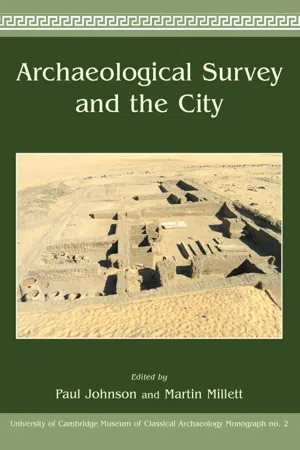
In the past 30 years archaeological field survey has become central to the practice of Classical Archaeology. During this time, approaches have developed from the systematic collection of artefacts to include the routine deployment of various geophysical and remote sensing techniques. The ability of archaeologists to reveal the topography of buried urban sites without excavation has now been demonstrated through a wide range of projects across the ancient world. Archaeological Survey and the City reviews the results of such projects and in particular discusses the ways in which the subject might develop in the future, with an emphasis on the integration of different strands of evidence and issues of archaeological interpretation rather than on the technicalities of particular methodologies. Several themes emerge from the fourteen papers. The first is the increasing number of large-area surveys providing data at a sufficient scale to make a significant contribution to our understanding of classical cities both in the Mediterranean and beyond (eg Baelo Claudia, Caistor-by-Norwich, Xanten, Ammaia). The second theme is the generation of new types of data through the application of specific techniques to address particular questions pertaining to urban life, for instance in identifying particular industrial processes such as metal-working (eg Munigua, Wroxeter) or the increasing success in isolating cemeteries (eg Silchester). The techniques involved in identifying these phenomena complement the use of geochemical survey to characterise particular soil properties related to animal husbandry, cultivation or the creation of domestic waste deposits (eg Faleri Veteres), an area which has considerable future potential. A third theme lies in the application and integration of multiple techniques to provide new dimensions to the information available. The data from a number of survey projects have demonstrated that a single survey technique will rarely, if ever, reveal all of the potential information so there is a significant benefit to be derived from applying multiple survey-strategies to the questions being asked of a site. These themes emphasise the dynamism of research in this area, which continues to revolutionise the study of ancient cities.
Information
Topic
HistoireSubtopic
Histoire de la Grèce antiqueTable of contents
- List of Contributors
- 1 Introduction
- 2 Conceptualising Townscapes: Perceptions of Urbanism and their Infl uence on Archaeological Survey Strategies
- 3 Understanding Roman Towns in Italy: Refl ections on the Role of Geophysical Survey
- 4 Rethinking the Spectrum – Th e Digital (R)Evolution in Archaeological Aerial Reconnaissance
- 5 Collecting Cities: some Problems and Prospects
- 6 Re-Evaluating a Forgotten Town using Intra-Site Surveys and the GIS Analysis of Surface Ceramics: Philosophianis-Sofi ana (Sicily) in the Longue Durée
- 7 Tinkering with Urban Survey Data: How Many Sagalassos-es do we Have?
- 8 Amara West: Remote Ssensing at a Pharaonic Town in Northern Sudan
- 9 Long-term Integrated Archaeological Prospection at the Roman Town of Carnuntum/Austria
- 10 Integrating Aerial Photography, Historical Cartography, Archaeological Excavations and Geophysical Survey on the Roman Colony of Mariana (Corsica, France)
- 11 Fluxgate Gradiometer and GPR Survey to Locate and Characterize the Perimeter, Early Imperial Centre and Street Network of the Roman Town Mariana (Corsica)
- 12 Surveying the Townscape of Roman Trea (Picenum)
- 13 Geophysical Survey of the City of Gabii, Italy
- 14 Challenges of Port Landscapes. Integrating Geophysics, Open Area Excavation and Computer Graphic Visualisation at Portus and the Isola Sacra
Trusted by 375,005 students
Access to over 1.5 million titles for a fair monthly price.
Study more efficiently using our study tools.
Frequently asked questions
Yes, you can cancel anytime from the Subscription tab in your account settings on the Perlego website. Your subscription will stay active until the end of your current billing period. Learn how to cancel your subscription
No, books cannot be downloaded as external files, such as PDFs, for use outside of Perlego. However, you can download books within the Perlego app for offline reading on mobile or tablet. Learn how to download books offline
Perlego offers two plans: Essential and Complete
- Essential is ideal for learners and professionals who enjoy exploring a wide range of subjects. Access the Essential Library with 800,000+ trusted titles and best-sellers across business, personal growth, and the humanities. Includes unlimited reading time and Standard Read Aloud voice.
- Complete: Perfect for advanced learners and researchers needing full, unrestricted access. Unlock 1.5M+ books across hundreds of subjects, including academic and specialized titles. The Complete Plan also includes advanced features like Premium Read Aloud and Research Assistant.
We are an online textbook subscription service, where you can get access to an entire online library for less than the price of a single book per month. With over 1.5 million books across 990+ topics, we’ve got you covered! Learn about our mission
Look out for the read-aloud symbol on your next book to see if you can listen to it. The read-aloud tool reads text aloud for you, highlighting the text as it is being read. You can pause it, speed it up and slow it down. Learn more about Read Aloud
Yes! You can use the Perlego app on both iOS and Android devices to read anytime, anywhere — even offline. Perfect for commutes or when you’re on the go.
Please note we cannot support devices running on iOS 13 and Android 7 or earlier. Learn more about using the app
Please note we cannot support devices running on iOS 13 and Android 7 or earlier. Learn more about using the app
Yes, you can access Archaeological Survey and the City by Paul Johnson, Martin Millett, Paul Johnson,Martin Millett in PDF and/or ePUB format, as well as other popular books in Histoire & Histoire de la Grèce antique. We have over 1.5 million books available in our catalogue for you to explore.