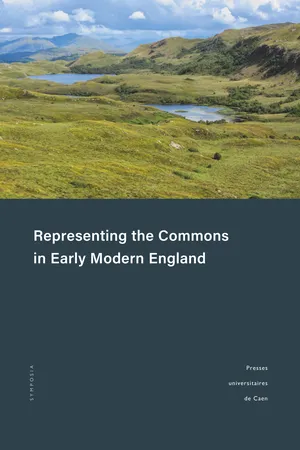
Ours is an age of extremely fragmented experiences and identities – a fragmentation paralleled by a growing awareness that we all inhabit a common world. In reality, these two phenomena have a lot more in common than one might suspect: deeply engrained individualism and the destruction of ecosystems are two sides of the same capitalist coin. Thus, the question of "the commons" becomes more relevant than ever.This book aims to fill a gap in the recent theoretical discussion of the commons by rethinking the notion from the perspective of early modern English literature and culture. It argues that the commons needs to be shown and represented, not just theorised or discussed in abstract terms. By focusing on some of the foundational, textually embodied forms through which this notion was represented and disseminated, the essays brought together here aim not only to interrogate the ways in which the commons was framed and appropriated in early modern English texts, but also to highlight the enduring relevance of these forms to critical discussions of the commons today.
- English
- ePUB (mobile friendly)
- Available on iOS & Android
eBook - ePub
Representing the Commons in Early Modern England
About this book
Information
Topic
LiteratureIndex
LiteratureTable of contents
- Introductory pages
- Table of contents
- Introduction: Empowering the Commons
- What Does “Common” Mean? British Civil War Radical Sects and the Commons
- Gerrard Winstanley and the Cromwellian Reconquest of Ireland: The Earth a “Common Treasury for All”?
- Richard Carew on Cornish Commons: Farming, Fishing and Mining “in Wastrell” (1602)
- “The commons, knit and united to one part”: Representing, Fearing and Controlling the Commons
- “Cloistering from the common”? Shakespeare’s Sonnet 130 and the Power of the Commonplace
- The Commons in Early Modern Emblem Literature
- Commons in Motion: Walking and Refuge, from Wordsworth to the Anthropocene
- Abstracts
- Notes on contributors
Trusted by 375,005 students
Access to over 1.5 million titles for a fair monthly price.
Study more efficiently using our study tools.
Frequently asked questions
Yes, you can cancel anytime from the Subscription tab in your account settings on the Perlego website. Your subscription will stay active until the end of your current billing period. Learn how to cancel your subscription
No, books cannot be downloaded as external files, such as PDFs, for use outside of Perlego. However, you can download books within the Perlego app for offline reading on mobile or tablet. Learn how to download books offline
Perlego offers two plans: Essential and Complete
- Essential is ideal for learners and professionals who enjoy exploring a wide range of subjects. Access the Essential Library with 800,000+ trusted titles and best-sellers across business, personal growth, and the humanities. Includes unlimited reading time and Standard Read Aloud voice.
- Complete: Perfect for advanced learners and researchers needing full, unrestricted access. Unlock 1.5M+ books across hundreds of subjects, including academic and specialized titles. The Complete Plan also includes advanced features like Premium Read Aloud and Research Assistant.
We are an online textbook subscription service, where you can get access to an entire online library for less than the price of a single book per month. With over 1.5 million books across 990+ topics, we’ve got you covered! Learn about our mission
Look out for the read-aloud symbol on your next book to see if you can listen to it. The read-aloud tool reads text aloud for you, highlighting the text as it is being read. You can pause it, speed it up and slow it down. Learn more about Read Aloud
Yes! You can use the Perlego app on both iOS and Android devices to read anytime, anywhere — even offline. Perfect for commutes or when you’re on the go.
Please note we cannot support devices running on iOS 13 and Android 7 or earlier. Learn more about using the app
Please note we cannot support devices running on iOS 13 and Android 7 or earlier. Learn more about using the app
Yes, you can access Representing the Commons in Early Modern England by Jeremy Elprin,Mickaël Popelard in PDF and/or ePUB format. We have over 1.5 million books available in our catalogue for you to explore.