The strange and contested evolution of the management of banking risk
Banks in America are private institutions with private shareholders, boards of directors, profit motives, customers, and competitors. And yet the public plays a key role in deciding what risks are taken as well as how, when, and to what end. Public-private negotiations over financial governance has evolved into an essential ecosystem of banking risk management. In Private Finance, Public Power, Peter Conti-Brown and Sean Vanatta offer a new history of finance and public policy in the United States by examining the idiosyncratic way the nation manages financial risk across the public-private divide. Covering two centuries, from the founding of the Republic to the early 1980s, Conti-Brown and Vanatta describe the often-contested, sometimes chaotic, engagement of bankers, politicians, bureaucrats, and others in the overlapping spaces of the public-private system of bank supervision.
Conti-Brown and Vanatta trace the different supervisory frameworks that evolved over time, from the imposition of private liability on bank shareholders to the development of the central bank to the creation of federal deposit insurance. Negotiations took place at federal and state levels, but, over time, the federal government assumed most of the responsibility for managing financial risk. Moreover, federal supervisory officials began to undertake more varied tasks, including monitoring racial discrimination and managing financial concentration. Conti-Brown and Vanatta introduce a diverse cast of characters—bankers, politicians, bureaucrats, and others—and show how they navigated two hundred years of financial panics, scandals, and crises to build the system that structures modern America’s banking system.
eBook - ePub
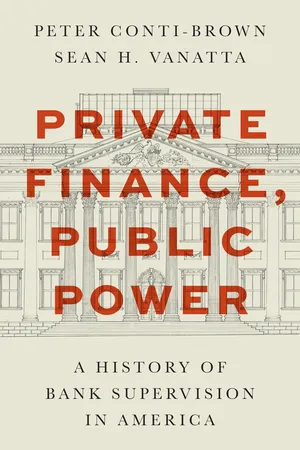
Private Finance, Public Power
A History of Bank Supervision in America
- English
- ePUB (mobile friendly)
- Available on iOS & Android
eBook - ePub
Private Finance, Public Power
A History of Bank Supervision in America
About this book
Information
Publisher
Princeton University PressYear
2025Print ISBN
9780691233475
9780691232829
eBook ISBN
9780691233468
Table of contents
- Cover
- Title Page
- Copyright
- Dedication
- Epigraph
- Contents
- Introduction
- 1. Origins: The Early Republic and the Free Banking Era
- Interlude: Supervision on Suspicion
- 2. The Rise and Retreat of Supervisory Discretion: Implementing the National Banking Acts in the 1860s
- Interlude: The Freedman’s Bank
- 3. Competition and Crisis in the Gilded Age
- Interlude: O. Henry and J.F.C. Nettlewick
- 4. Central Banking and Bank Supervision: Complements and Alternatives in the Founding of the Federal Reserve
- Interlude: Sioux Falls Falls
- 5. The 1933 Bank Holiday and the Legitimacy of Supervision
- Interlude: Banking on Bonds, for Better and Worse
- 6. Supervision’s New Deal: The Competitive Institutionalization of the 1930s
- Interlude: Supervising Japanese Banking
- 7. Supervising Concentration: Holding Companies and Merger Review in the Postwar Years
- Interlude: Training Examiners (and Bankers) in the 1950s
- 8. The Saxon Invasion: The Supervisory Battle over Risk and Failure in the 1960s
- Interlude: Bunco
- 9. The Expansion of Residual Risk: Bank Supervision for Antidiscrimination, Consumer Protection, and Community Reinvestment
- Conclusion: To What End, the Public Control of Private Finance
- Acknowledgments
- List of Abbreviations
- Notes
- Index
Trusted by 375,005 students
Access to over 1.5 million titles for a fair monthly price.
Study more efficiently using our study tools.
Frequently asked questions
Yes, you can cancel anytime from the Subscription tab in your account settings on the Perlego website. Your subscription will stay active until the end of your current billing period. Learn how to cancel your subscription
No, books cannot be downloaded as external files, such as PDFs, for use outside of Perlego. However, you can download books within the Perlego app for offline reading on mobile or tablet. Learn how to download books offline
Perlego offers two plans: Essential and Complete
- Essential is ideal for learners and professionals who enjoy exploring a wide range of subjects. Access the Essential Library with 800,000+ trusted titles and best-sellers across business, personal growth, and the humanities. Includes unlimited reading time and Standard Read Aloud voice.
- Complete: Perfect for advanced learners and researchers needing full, unrestricted access. Unlock 1.5M+ books across hundreds of subjects, including academic and specialized titles. The Complete Plan also includes advanced features like Premium Read Aloud and Research Assistant.
We are an online textbook subscription service, where you can get access to an entire online library for less than the price of a single book per month. With over 1.5 million books across 990+ topics, we’ve got you covered! Learn about our mission
Look out for the read-aloud symbol on your next book to see if you can listen to it. The read-aloud tool reads text aloud for you, highlighting the text as it is being read. You can pause it, speed it up and slow it down. Learn more about Read Aloud
Yes! You can use the Perlego app on both iOS and Android devices to read anytime, anywhere — even offline. Perfect for commutes or when you’re on the go.
Please note we cannot support devices running on iOS 13 and Android 7 or earlier. Learn more about using the app
Please note we cannot support devices running on iOS 13 and Android 7 or earlier. Learn more about using the app
Yes, you can access Private Finance, Public Power by Peter Conti-Brown,Sean H. Vanatta in PDF and/or ePUB format, as well as other popular books in Economics & Business Law. We have over 1.5 million books available in our catalogue for you to explore.