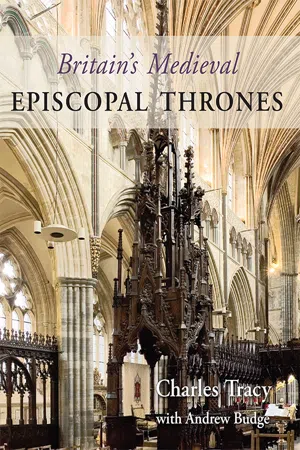
This book is the first major investigation of a subject of seminal importance in the study of church history and archaeology. The two stone thrones, at Wells and Durham, the three timber monuments, at Exeter, St Davids and Hereford, and the mid-14th-century bishop's chair at Lincoln, all come under a searching empirical enquiry.
The Exeter throne is the largest and most impressive in Europe. It is a distinguished innovatory example of the English Decorated style, with antecedents passing back to the court of Edward I. It exemplifies most of the historical and formal strands that suffuse the entire book– visual appearance, distinctiveness within the building, prestige, construction, stylistic context, finance, and the patronage and personal role of the bishop himself; as well as the subtler issues of the personal and collective politics of bishop and chapter, the monument's liturgical applications, its relationship with the cathedral's relics, its symbolism and what it tells us about the aspirations of the institution within the existing ecclesiastical hierarchy.
The thrones also reveal much about the personal circumstances of an individual bishop, and where he stood on the scale of a good diocesan on the one hand, and ambitious politician on the other, as exemplified at Exeter and Durham.
The text is by the art historian, Dr Charles Tracy, a seasoned expert on church furniture both in Britain and on the continent of Europe. The chapter on the stone thrones was prepared by Andrew Budge who is currently preparing a Ph.D thesis on 'English Chantry Churches' at Birkbeck College. The polychromy authority, Eddie Sinclair, spent many hours on the scaffold to bring forward her remarkable report on the Exeter throne. Her full report is to be published online.The Exeter throne is also interpreted by the established timber conservation practitioner, Hugh Harrison, and the St Davids throne by the experienced draughtsman, Peter Ferguson. In an age of the CAD, his meticulous measured drawings of the Exeter and St Davids monuments are one of the most remarkable features of book. The architect, Paul Woodfield prepared the drawings for the Lincoln chair.
- 201 pages
- English
- PDF
- Available on iOS & Android
eBook - PDF
Britain's Medieval Episcopal Thrones
About this book
Information
Subtopic
British HistoryIndex
Social SciencesTable of contents
- Cover
- Title Page
- Copyright Page
- Contents
- Acknowledgements
- Preface
- Chapter 1: Episcopal Thrones in the Early-Christian Church
- Chapter 2: The Timber Episcopal Thrones of Medieval Britain
- Chapter 3: The Lincoln Cathedral Bishop’s Chair
- Chapter 4: The Medieval Stone Episcopal Thrones at Wells and Durham Cathedrals
- Appendix I: Significant items connected with the manufacture of the Exeter Cathedral bishop’s throne
- Appendix II: Significant records connected with the manufacture of the Exeter Cathedral choir furnishings by Thomas of Witneys’s “high altar team” et al., 1316–1326
- Appendix III: The construction and assembly of the bishops’ thrones at Exeter and St Davids
- Appendix IV: The medieval polychromy scheme of the Exeter Cathedral bishop’s throne: a summary
- Appendix V: Chudleigh, Norton and the carriage of timber for Exeter Cathedral’s bishop’s throne
- Bibliography
- Index
Trusted by 375,005 students
Access to over 1.5 million titles for a fair monthly price.
Study more efficiently using our study tools.
Frequently asked questions
Yes, you can cancel anytime from the Subscription tab in your account settings on the Perlego website. Your subscription will stay active until the end of your current billing period. Learn how to cancel your subscription
No, books cannot be downloaded as external files, such as PDFs, for use outside of Perlego. However, you can download books within the Perlego app for offline reading on mobile or tablet. Learn how to download books offline
Perlego offers two plans: Essential and Complete
- Essential is ideal for learners and professionals who enjoy exploring a wide range of subjects. Access the Essential Library with 800,000+ trusted titles and best-sellers across business, personal growth, and the humanities. Includes unlimited reading time and Standard Read Aloud voice.
- Complete: Perfect for advanced learners and researchers needing full, unrestricted access. Unlock 1.5M+ books across hundreds of subjects, including academic and specialized titles. The Complete Plan also includes advanced features like Premium Read Aloud and Research Assistant.
We are an online textbook subscription service, where you can get access to an entire online library for less than the price of a single book per month. With over 1.5 million books across 990+ topics, we’ve got you covered! Learn about our mission
Look out for the read-aloud symbol on your next book to see if you can listen to it. The read-aloud tool reads text aloud for you, highlighting the text as it is being read. You can pause it, speed it up and slow it down. Learn more about Read Aloud
Yes! You can use the Perlego app on both iOS and Android devices to read anytime, anywhere — even offline. Perfect for commutes or when you’re on the go.
Please note we cannot support devices running on iOS 13 and Android 7 or earlier. Learn more about using the app
Please note we cannot support devices running on iOS 13 and Android 7 or earlier. Learn more about using the app
Yes, you can access Britain's Medieval Episcopal Thrones by Charles Tracy,Andrew Budge in PDF and/or ePUB format, as well as other popular books in Social Sciences & British History. We have over 1.5 million books available in our catalogue for you to explore.