eBook - PDF
TRAC 2014
- 128 pages
- English
- PDF
- Available on iOS & Android
eBook - PDF
About this book
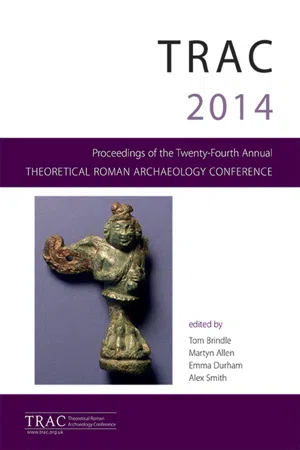
This volume contains a selection of papers presented at TRAC 2014, as well as some invited contributions. In keeping with the aims of TRAC, several papers make make innovative use of interdisciplinary theory: in humanistic geography, philosophy and archaeology; social psychology; and the cognitive science of religion in the study of Roman monuments, military social history and religion. Other papers share a common theme: the critical interpretation of archaeological evidence. A more careful consideration of non-grave good pottery sherds from graves suggests that these often disregarded items potentially shed light on funerary rites which are usually considered to be invisible; the potential importance of plant remains, particularly of exotic and rare species, in ritual deposits is examined and a new perspective on the negative aspects of Roman conquest of Northern Gaul presented. New approaches towards our understanding of space and landscape in the Roman world comprise an examination of the suburbs of ancient Rome and preliminary results of an ongoing project exploring the relationship between wetland landscapes and domestic settlements, presenting a case study from Spain.
Information
Subtopic
Greek Ancient HistoryIndex
HistoryTable of contents
- Cover
- Title Page
- Copyright Page
- Contents
- Preface
- Chapter 1: Place Theory, Genealogy, and the Cultural Biography of Roman Monuments
- Chapter 2: An Integrated Cognitive and Epigraphic Approach to Social Networks within the Community of a Roman Military Base
- Chapter 3: Cognitive Theory and Religious Integration: The Case of the Poetovian Mithraea
- Chapter 4: Residual or Ritual? Pottery from the Backfills of Graves and Other Features in Roman Cemeteries
- Chapter 5: Identifying Ritual Deposition of Plant Remains: A Case Study of Stone Pine Cones in Roman Britain
- Chapter 6: Caesar in Gaul: New Perspectives on the Archaeology of Mass Violence
- Chapter 7: Re-defining the Roman ‘suburbium’ from Republic to Empire: A Theoretical Approach
- Chapter 8: Riparia Concept: Roman Intervention in the Lacustrine Environment of Fuente De Piedra (Málaga, Spain)
- Chapter 9: Silchester: The Town Life Project 1997–2014: Reflections on a Long Term Research Excavation
Trusted by 375,005 students
Access to over 1.5 million titles for a fair monthly price.
Study more efficiently using our study tools.
Frequently asked questions
Yes, you can cancel anytime from the Subscription tab in your account settings on the Perlego website. Your subscription will stay active until the end of your current billing period. Learn how to cancel your subscription
No, books cannot be downloaded as external files, such as PDFs, for use outside of Perlego. However, you can download books within the Perlego app for offline reading on mobile or tablet. Learn how to download books offline
Perlego offers two plans: Essential and Complete
- Essential is ideal for learners and professionals who enjoy exploring a wide range of subjects. Access the Essential Library with 800,000+ trusted titles and best-sellers across business, personal growth, and the humanities. Includes unlimited reading time and Standard Read Aloud voice.
- Complete: Perfect for advanced learners and researchers needing full, unrestricted access. Unlock 1.5M+ books across hundreds of subjects, including academic and specialized titles. The Complete Plan also includes advanced features like Premium Read Aloud and Research Assistant.
We are an online textbook subscription service, where you can get access to an entire online library for less than the price of a single book per month. With over 1.5 million books across 990+ topics, we’ve got you covered! Learn about our mission
Look out for the read-aloud symbol on your next book to see if you can listen to it. The read-aloud tool reads text aloud for you, highlighting the text as it is being read. You can pause it, speed it up and slow it down. Learn more about Read Aloud
Yes! You can use the Perlego app on both iOS and Android devices to read anytime, anywhere — even offline. Perfect for commutes or when you’re on the go.
Please note we cannot support devices running on iOS 13 and Android 7 or earlier. Learn more about using the app
Please note we cannot support devices running on iOS 13 and Android 7 or earlier. Learn more about using the app
Yes, you can access TRAC 2014 by Tom Brindle, Martyn Allen, Emma Durham, Alex Smith, Tom Brindle,Martyn Allen,Emma Durham,Alex Smith in PDF and/or ePUB format, as well as other popular books in History & Greek Ancient History. We have over 1.5 million books available in our catalogue for you to explore.