eBook - PDF
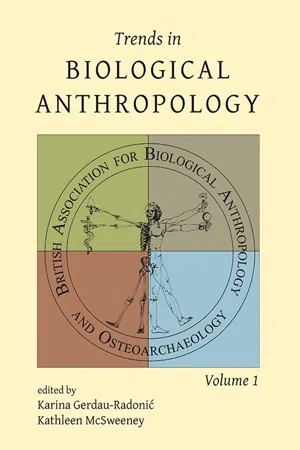
Trends in Biological Anthropology 1
- 121 pages
- English
- PDF
- Available on iOS & Android
eBook - PDF
Trends in Biological Anthropology 1
About this book
This first volume in the series Trends in Biological Anthropology presents 11 papers. The study of modern baboons as proxies to understand extinct hominin species' diet and the interpretation of skeletal degenerative joint disease on the skeletal remains of extant primates are presented as case studies using methods and standards usually applied to human remains. The methodological theme continues with an assessment of the implications for interpretation of different methods used to record Linear Enamel Hypoplasia (LEH) and on the use and interpretation of three dimensional modelling to generate pictures of the content of collective graves. Three case studies on palaeopathology are presented. First is the analysis of a 5th–16th century skeletal collection from the Isle of May compared with one from medieval Scotland in an attempt to ascertain whether the former benefitted from a healing tradition. Study of a cranium found at Verteba Cave, western Ukraine, provides a means to understand inter-personal interactions and burial ritual during the Trypillian culture. A series of skulls from Belgrade, Serbia, displays evidence for beheading. Two papers focus on the analysis disarticulated human remains at the Worcester Royal Infirmary and on Thomas Henry Huxley's early attempt to identify a specific individual through analysis of skeletal remains. The concept and definition of 'perimortem' particularly within a Forensic Anthropology context are examined and the final paper presents a collaborative effort between historians, archaeologists, museum officers, medieval re-enactors and food scientists to encourage healthy eating among present day Britons by presenting the ill effects of certain dietary habits on the human skeleton.
Information
Year
2015eBook ISBN
9781782978398
Topic
Scienze socialiSubtopic
BiologiaTable of contents
- Contributors
- The Trends in Biological Anthropology Series
- Introduction
- 1. Can Extant Primates Serve as Models to Determine the Dietary Ecology of Hominins?The Case of Paranthropines
- 2. Recording Primate Spinal Degenerative Joint Disease Using a Standardised Approach
- 3. Enamel Hypoplasia in Post-Medieval London: A Reassessment of the Evidencefor Childhood Health
- 4. Archaeoanthropology: How to Construct a Picture of the Past?
- 5. Palaeopathology of the Isle of May
- 6. First Evidence for Interpersonal Violence in Ukraine’s Trypillian Farming Culture:Individual 3 from Verteba Cave, Bilche Zolote
- 7. Beheading at the Dawn of the Modern Age: The Execution of Noblemen duringAustro-Ottoman Battles for Belgrade in the Late 17th Century
- 8. The Remains of a Humanitarian Legacy: Bioarchaeological Reflections of the AnatomizedHuman Skeletal Assemblage from the Worcester Royal Infirmary
- 9. Thomas Henry Huxley (AD 1825–1895): Pioneer of Forensic Anthropology
- 10. The Concept of Perimortem in Forensic Science
- 11. You Are What You Ate: Using Bioarchaeology to Promote Healthy Eating
Trusted by 375,005 students
Access to over 1.5 million titles for a fair monthly price.
Study more efficiently using our study tools.
Frequently asked questions
Yes, you can cancel anytime from the Subscription tab in your account settings on the Perlego website. Your subscription will stay active until the end of your current billing period. Learn how to cancel your subscription
No, books cannot be downloaded as external files, such as PDFs, for use outside of Perlego. However, you can download books within the Perlego app for offline reading on mobile or tablet. Learn how to download books offline
We are an online textbook subscription service, where you can get access to an entire online library for less than the price of a single book per month. With over 1.5 million books across 990+ topics, we’ve got you covered! Learn about our mission
Look out for the read-aloud symbol on your next book to see if you can listen to it. The read-aloud tool reads text aloud for you, highlighting the text as it is being read. You can pause it, speed it up and slow it down. Learn more about Read Aloud
Yes! You can use the Perlego app on both iOS and Android devices to read anytime, anywhere — even offline. Perfect for commutes or when you’re on the go.
Please note we cannot support devices running on iOS 13 and Android 7 or earlier. Learn more about using the app
Please note we cannot support devices running on iOS 13 and Android 7 or earlier. Learn more about using the app
Yes, you can access Trends in Biological Anthropology 1 by Karina Gerdau-Radonić, Kathleen McSweeney, Karina Gerdau-Radonić,Kathleen McSweeney in PDF and/or ePUB format, as well as other popular books in Scienze sociali & Biologia. We have over 1.5 million books available in our catalogue for you to explore.